440 books match the query 'Colonialism & Post-Colonialism' and 4 start with k
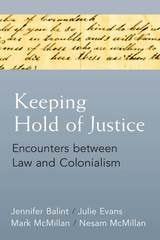
cover of Keeping Hold of Justice: Encounters between Law and Colonialism

Keeping Hold of Justice

Encounters between Law and Colonialism

Jennifer Balint, Julie Evans, Mark McMillan, and Nesam McMillan

University of Michigan Press, 2020

Keeping Hold of Justice focuses on a select range of encounters between law and colonialism from the early nineteenth century to the present. It emphasizes the nature of colonialism as a distinctively structural injustice, one which becomes entrenched in the social, political, legal, and discursive structures of societies and thereby continues to affect people’s lives in the present. It charts, in particular, the role of law in both enabling and sustaining colonial injustice and in recognizing and redressing it. In so doing, the book seeks to demonstrate the possibilities for structural justice that still exist despite the enduring legacies and harms of colonialism. It puts forward that these possibilities can be found through collaborative methodologies and practices, such as those informing this book, that actively bring together different disciplines, peoples, temporalities, laws and ways of knowing. They reveal law not only as a source of colonial harm but also as a potential means of keeping hold of justice. 
[more]
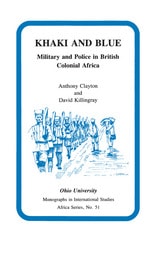
cover of Khaki and Blue: Military and Police in British Colonial Africa

Khaki and Blue

Military and Police in British Colonial Africa

Anthony Clayton

Ohio University Press, 1989
Drawing upon a survey of former police officers in the six British colonies of Ghana, Nigeria, Kenya, Uganda, Zambia, and Malawi, Clayton and Killingray examine the work of colonial law enforcement during the last years of British supremacy. In addition to such basic institutional information as the development of police forces from local militia, the training of African recruits, and the africanization of the police forces, the authors examine the typical activities of the colonial police. From investigations of stabbings and theft, to deportation of prostitutes and concern with smuggling, to enforcement of unpopular policies, the authors offer a profile not only of the institution of colonial law enforcement but also of the daily life of the village and the business activities which brought people into contact with the police.
[more]
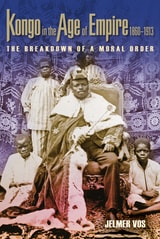
cover of Kongo in the Age of Empire, 1860–1913: The Breakdown of a Moral Order

Kongo in the Age of Empire, 1860–1913

The Breakdown of a Moral Order

Jelmer Vos

University of Wisconsin Press, 2015

This richly documented account of the arrival of rubber traders, new Christian missionaries, and the Portuguese colonial state in the Kongo realm is told from the perspective of the kingdom's inhabitants. Jelmer Vos shows that both Africans and Europeans were able to forward differing social, political, and economic agendas as Kongo's sacred city of São Salvador became a vital site for the expansion of European imperialism in Central Africa. Kongo people, he argues, built on the kingdom's long familiarity with Atlantic commerce and cultures to become avid intermediaries in a new system of colonial trade and mission schools.

Vos underlines that Kongo's incorporation in the European state system also had tragic consequences, including the undermining of local African structures of authority—on which the colonial system actually depended. Kongo in the Age of Empire carefully documents the involvement of Kongo's royal court in the exercise of Portuguese rule in northern Angola and the ways that Kongo citizens experienced colonial rule as an increasingly illegitimate extension of royal power.
[more]
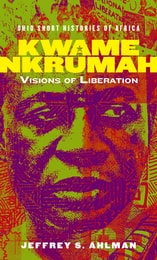
cover of Kwame Nkrumah: Visions of Liberation

Kwame Nkrumah

Visions of Liberation

Jeffrey S. Ahlman

Ohio University Press, 2021

A new biography of Ghana’s Kwame Nkrumah, one of the most influential political figures in twentieth-century African history. As the first prime minister and president ofthe West African state of Ghana, Kwame Nkrumah helped shape the global narrative of African decolonization. After leading Ghana to independence in 1957, Nkrumah articulated a political vision that aimed to free the country and the continent—politically, socially, economically, and culturally—from the vestiges of European colonial rule, laying the groundwork for a future in which Africans had a voice as equals on the international stage. Nkrumah spent his childhood in the maturing Gold Coast colonial state. During the interwar and wartime periods he was studying in the United States. He emerged in the postwar era as one of the foremost activists behind the 1945 Manchester Pan-African Congress and the demand for an immediate end to colonial rule. Jeffrey Ahlman’s biography plots Nkrumah’s life across several intersecting networks: colonial, postcolonial, diasporic, national, Cold War, and pan-African. In these contexts, Ahlman portrays Nkrumah not only as an influential political leader and thinker but also as a charismatic, dynamic, and complicated individual seeking to make sense of a world in transition.
[more]