Results by title
355 books match the query 'Communism, Post-Communism & Socialism' and 2 start with k
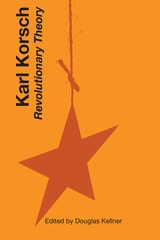
Karl Korsch
Revolutionary TheoryBy Karl Korsch
University of Texas Press, 1977
There is growing interest in Europe and the United States in the work of the major German social-political philosopher Karl Korsch. Korsch participated in the turbulent struggles in Weimar Germany and while in exile continually reflected on history and politics. His work affords one of the most important interpretations of the role of Marxism in twentieth-century revolutionary movements, while developing an ongoing critical interrogation of Marxism. His thought provides an illuminating perspective on the process of revolution and counterrevolution in recent history. Karl Korsch: Revolutionary Theory is the first English anthology of his most important writings.
This collection presents Korsch's essays on a wide range of subjects, including Marxism and socialization, Lenin and the Soviet Union, the crisis of Marxism, models of revolutionary practice, fascism and counterrevolution, and Korsch's final evaluation of Marxism. Much of this work is translated into English for the first time, and many unknown essays first published in radical journals which are no longer available appear here. The volume includes Korsch's major essays written during the 1920s and 1930s as well as some of his later work.
Douglas Kellner's detailed introduction, "Korsch's Revolutionary Marxism," contains the first comprehensive critical interpretation of Korsch's work to appear in English. It provides a historical-theoretical reconstruction of Korsch's life and thought and roots his political theory in the sociopolitical context in which it evolved. The introduction has been described by Korsch scholars as a "first-class piece of exposition and interpretation" and a "serious, first-rate contribution likely to preempt the field in the English language." The editor's introduction along with the representative selection of essays provide firm grounding in the ideas and historical significance of Karl Korsch.
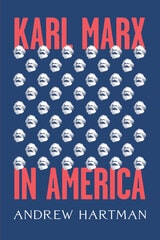
Karl Marx in America
Andrew Hartman
University of Chicago Press, 2025
To read Karl Marx is to contemplate a world created by capitalism. People have long viewed the United States as the quintessential anti-Marxist nation, but Marx’s ideas have inspired a wide range of people to formulate a more precise sense of the stakes of the American project. Historians have highlighted the imprint made on the United States by Enlightenment thinkers such as Adam Smith, John Locke, and Thomas Paine, but Marx is rarely considered alongside these figures. Yet his ideas are the most relevant today because of capitalism’s centrality to American life.
In Karl Marx in America, historian Andrew Hartman argues that even though Karl Marx never visited America, the country has been infused, shaped, and transformed by him. Since the beginning of the Civil War, Marx has been a specter in the American machine. During the Gilded Age, socialists read Marx as an antidote to the unchecked power of corporations. In the Great Depression, communists turned to Marx in hopes of transcending the destructive capitalist economy. The young activists of the 1960s were inspired by Marx as they gathered to protest an overseas war. Marx’s influence today is evident, too, as Americans have become increasingly attuned to issues of inequality, labor, and power.
After decades of being pushed to the far-left corner of intellectual thought, Marx’s ideologies have crossed over into the mainstream and are more alive than ever. Working-class consciousness is on the rise, and, as Marx argued, the future of a capitalist society rests in the hands of the people who work at the point of production. A valuable resource for anyone interested in Marx’s influence on American political discourse, Karl Marx in America is a thought-provoking account of the past, present, and future of his philosophies in American society.