Results by title
679 books match the query 'Ecology' and 4 start with k
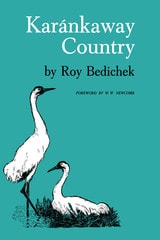
Karánkaway Country
By Roy Bedichek
University of Texas Press, 1974
Roy Bedichek spent most of his life working in the educational field in Texas, but his main interest was always the great outdoors. His first book, Adventures with a Texas Naturalist, was published when he was almost seventy, and his second, Karánkaway Country, appeared three years later. Both were the result of a lifetime of exploring a beloved land, of searching observation, of discussion, debate, wide reading, and reflection. Long out of print, Karánkaway Country is now available in a handsome second edition with a new Foreword by W. W. Newcomb, Jr.
Karánkaway Country focuses on the natural history of a strip of coastal prairie lying roughly between Corpus Christi and Galveston and once inhabited by the poorly known and much maligned Karankawa Indians. It serves as home base for an exposition of Bedichek's philosophy, providing a convenient local setting for richly tailored essays on wildlife, soil, human skin, and a variety of other topics suggested by a wide-ranging intellect. Bedichek's philosophy, if it can be reduced to a few words, is essentially that humans must learn to live on peaceful and conciliatory terms with our natural environment.
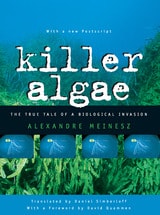
Killer Algae
Alexandre Meinesz
University of Chicago Press, 1999
This supposedly benign little plant—that no one thought could survive the waters of the Mediterranean—has now become a pernicious force. Caulerpa taxifolia now covers 10,000 acres of the coasts of France, Spain, Italy, and Croatia, and has devastated the Mediterranean ecosystem. And it continues to grow, unstoppable and toxic. When Alexandre Meinesz, a professor of biology at the University of Nice, discovered a square-yard patch of it in 1984, he warned biologists and oceanographers of the potential species invasion. His calls went unheeded. At that point, one person could have pulled the small patch out and ended the problem. Now, however, the plant has defeated the French Navy, thwarted scientific efforts to halt its rampage, and continues its destructive journey into the Adriatic Sea.
Killer Algae is the biological and political horror story of this invasion. For despite Meinesz's pleas to scientists and the French government, no agency was willing to take responsibility for the seaweed, and while the buck was passed, the killer algae grew. And through it all, the Oceanographic Museum in Monaco sought to exculpate itself. In short, Killer Algae—part detective story and part bureaucratic object lesson—is a classic case of a devastating ecological invasion and how not to deal with it.
"[U]tterly fascinating, not only because of the ecological battles [Meinesz] describes but also because of the wondrous natural phenomena involved."—Richard Bernstein, New York Times
"Akin to Rachel Carson's Silent Spring, Killer Algae shows the courage of a voice in the wilderness."—Choice
"A textbook case of how not to manage an environmental disaster."—Kirkus Reviews
"Meinesz's story is a frightening one, reading more like a science fiction thriller than a scientific account."—Publishers Weekly
Killing the Koala and Poisoning the Prairie
Australia, America, and the EnvironmentCorey J. A. Bradshaw and Paul R. Ehrlich
University of Chicago Press, 2015
In this book, Bradshaw and Ehrlich provide a spirited exploration of the ways in which the United States and Australia can learn from their shared problems and combine their most successful solutions in order to find and develop new resources, lower energy consumption and waste, and grapple with the dynamic effects of climate change. Peppering the book with humor, irreverence, and extensive scientific knowledge, the authors examine how residents of both countries have irrevocably altered their natural environments, detailing the most pressing ecological issues of our time, including the continuing resource depletion caused by overpopulation. They then turn their discussion to the politics behind the failures of environmental policies in both nations and offer a blueprint for what must be dramatically changed to prevent worsening the environmental crisis.
Although focused on two nations, Killing the Koala and Poisoning the Prairie clearly has global implications—the problems facing the United States and Australia are not theirs alone, and the solutions to come will benefit by being crafted in coalition. This book provides a vital opportunity to learn from both countries’ leading environmental thinkers and to heed their call for a way forward together.
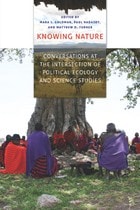
Knowing Nature
Conversations at the Intersection of Political Ecology and Science StudiesEdited by Mara J. Goldman, Paul Nadasdy, and Matthew D. Turner
University of Chicago Press, 2011
Political ecology and science studies have found fertile meeting ground in environmental studies. While the two distinct areas of inquiry approach the environment from different perspectives—one focusing on the politics of resource access and the other on the construction and perception of knowledge—their work is actually more closely aligned now than ever before.
Knowing Nature brings together political ecologists and science studies scholars to showcase the key points of encounter between the two fields and how this intellectual mingling creates a lively and more robust ecological framework for the study of environmental politics. The contributors all actively work at the interface between these two fields, and here they use empirical material to explore questions of theoretical and practical import for understanding the politics that surround nature-society relations, from wildlife management in the Yukon to soil fertility in Kenya. In addition, they examine how various environmental knowledge claims are generated, packaged, promoted, and accepted (or rejected) by the different actors involved in specific cases of environmental management, conservation, and development. Finally, they ask what is at stake in the struggles surrounding environmental knowledge, how such struggles shape conceptions of the environment, and whose interests are served in the process.