Results by title
304 books match the query 'Entertainment & Performing Arts' and 5 start with k
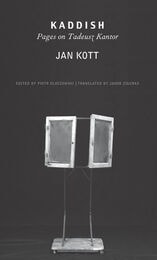
Kaddish
Pages on Tadeusz KantorJan Kott
Seagull Books, 2020
Tadeusz Kantor (1915–90) was renowned for his revolutionary theater performances in both his native Poland and abroad. Despite nominally being a Catholic, Kantor had a unique relationship with Jewish culture and incorporated many elements of Jewish theater into his works. In Kaddish, Jan Kott, an equally important figure in twentieth-century theater criticism, presents one of the most poignant descriptions of what might be called “the experience of Kantor.” At the core of the book is a fundamental philosophical question: What can save the memory of Kantor’s “Theatre of Death”—the Image, or the Word/Logos? Kott’s biblical answer in Kaddish is that Kantor’s theatre can be saved in its essence only by the Word, the Logos. This slim volume, Kott’s final work, is a distilled meditation that casts light on how two of the most prominent figures in Western theater reflected on the philosophy of the stage.
[more]
Kelly Reichardt
Katherine Fusco, Nicole Seymour
University of Illinois Press, 2017
Kelly Reichardt's 1994 debut River of Grass established her gift for a slow-paced realism that emphasizes the ongoing, everyday nature of emergency. Her work since then has communed with--yet remained apart from--postwar European realisms, the American avant-garde, independent film, and the emerging slow cinema movement. Katherine Fusco and Nicole Seymour read such Reichardt films as Wendy and Lucy and Night Moves to consider the root that emergency shares with emergence --the slowly unfolding or the barely perceptible. They see Reichardt as a filmmaker preoccupied with how environmental and economic crises affect those living on society's fringes. Her spare plots and slow editing reveal an artist who recognizes that disasters are gradual, with effects experienced through duration rather than sudden shock. Insightful and boldly argued, Kelly Reichardt is a long overdue portrait of a filmmaker who sees emergency not as a break from the everyday, but as a version of it.
[more]
Kim Ki-duk
Hye Seung Chung
University of Illinois Press, 2012
This study investigates the controversial motion pictures written and directed by the independent filmmaker Kim Ki-duk, one of the most acclaimed Korean auteurs in the English-speaking world. Propelled by underdog protagonists who can only communicate through shared corporeal pain and extreme violence, Kim's graphic films have been classified by Western audiences as belonging to sensationalist East Asian "extreme" cinema, and Kim has been labeled a "psychopath" and "misogynist" in South Korea.
Drawing upon both Korean-language and English-language sources, Hye Seung Chung challenges these misunderstandings, recuperating Kim's oeuvre as a therapeutic, yet brutal cinema of Nietzschean ressentiment (political anger and resentment deriving from subordination and oppression). Chung argues that the power of Kim's cinema lies precisely in its ability to capture, channel, and convey the raw emotions of protagonists who live on the bottom rungs of Korean society. She provides historical and postcolonial readings of victimization and violence in Kim's cinema, which tackles such socially relevant topics as national division in Wild Animals and The Coast Guard and U.S. military occupation in Address Unknown. She also explores the religious and spiritual themes in Kim's most recent works, which suggest possibilities of reconciliation and transcendence.
[more]
King of the Cowboys, Queen of the West
Roy Rogers and Dale EvansRaymond E. White
University of Wisconsin Press, 2006
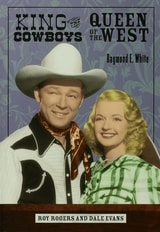
For more than sixty years, Roy Rogers and Dale Evans personified the romantic, mythic West that America cherished well into the modern age. Blazing a trail through every branch of the entertainment industry—radio, film, recordings, television, and even comic books—the couple capitalized on their attractive personas and appealed to the nation's belief in family values, an independent spirit, community.
King of the Cowboys, Queen of the West presents these two celebrities in the most comprehensive and inclusive account to date. Part narrative, part reference, this impeccably researched, highly accessible survey spans the entire scope of Rogers's and Evans's careers, illuminating and celebrating their place in twentieth-century American popular culture. Following the pair through each stage of their professional and personal trajectories, author Raymond E. White explores the unique alchemy of the singing cowboy and his free-spirited yet feminine partner. In a dual biography, he shows how Rogers and Evans carefully husbanded their public image and—of particular note—incorporated their Christian faith into their performances. And in a series of exhaustive appendixes, he documents their contributions to each medium they worked in. Testifying to both the breadth and the longevity of their careers, the book includes radio logs, discographies, filmographies, and comicographies that will delight historians and collectors alike. With its engaging tone and meticulous research, King of the Cowboys, Queen of the West is bound to become the definitive source on the lives of these two great American icons.
King of the Cowboys, Queen of the West presents these two celebrities in the most comprehensive and inclusive account to date. Part narrative, part reference, this impeccably researched, highly accessible survey spans the entire scope of Rogers's and Evans's careers, illuminating and celebrating their place in twentieth-century American popular culture. Following the pair through each stage of their professional and personal trajectories, author Raymond E. White explores the unique alchemy of the singing cowboy and his free-spirited yet feminine partner. In a dual biography, he shows how Rogers and Evans carefully husbanded their public image and—of particular note—incorporated their Christian faith into their performances. And in a series of exhaustive appendixes, he documents their contributions to each medium they worked in. Testifying to both the breadth and the longevity of their careers, the book includes radio logs, discographies, filmographies, and comicographies that will delight historians and collectors alike. With its engaging tone and meticulous research, King of the Cowboys, Queen of the West is bound to become the definitive source on the lives of these two great American icons.
[more]
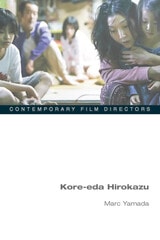
Kore-eda Hirokazu
Marc Yamada
University of Illinois Press, 2023
Films like Shoplifters and After the Storm have made Kore-eda Hirokazu one of the most acclaimed auteurs working today. Critics often see Kore-eda as a director steeped in the Japanese tradition defined by Yasujirō Ozu. Marc Yamada, however, views Kore-eda’s work in relation to the same socioeconomic concerns explored by other contemporary international filmmakers. Yamada reveals that a type of excess, not the minimalism associated with traditional aesthetics, defines Kore-eda’s trademark humanism. This excess manifests in small moments when a desire for human connection exceeds the logic of the institutions and policies formed by the neoliberal values that have shaped modern-day Japan. As Yamada shows, Kore-eda captures the shared spaces formed by bodies that move, perform, and assemble in ways that express the humanistic impulse at the core of the filmmaker’s expanding worldwide appeal.
[more]