Results by title
234 books match the query 'Families' and 3 start with k
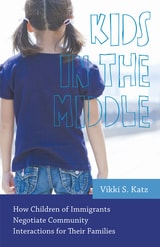
Kids in the Middle
How Children of Immigrants Negotiate Community Interactions for Their FamiliesKatz, Vikki S
Rutgers University Press, 2014
Through a unique interdisciplinary approach that combines elements of sociology and communication approaches, Katz investigates not only how immigrant children connect their families with local institutional networks, but also how they engage different media forms to bridge gaps between their homes and mainstream American culture. Drawing from extensive firsthand research, Katz takes us inside an urban community in Southern California and the experiences of a specific community of Latino immigrant families there. In addition to documenting the often-overlooked contributions that children of immigrants make to their families’ community encounters, the book provides a critical set of recommendations for how service providers and local institutions might better assist these children in fulfilling their family responsibilities. The story told in Kids in the Middle reveals an essential part of the immigrant experience that transcends both geographic and ethnic boundaries.
Kin
Crystal Williams
Michigan State University Press, 2000
In her first book-length collection of poetry, Crystal Williams utilizes memory and music as she lyrically weaves her way through American culture, pointing to the ways in which alienation, loss, and sensed "otherness" are corollaries of recent phenomena. Williams writes about being adopted by an interracial couple, a jazz pianist/Ford Foundry worker and a school psychologist, and how that has affected her development as an African American woman. She tries to work out the answers to many difficult questions: in what way do African American artists define themselves? What do they owe the culture and what does it owe them? To what extent does our combined national memory inform our individual selves? These poems are steeped in the black literary tradition. They are brimming over with the oral tradition that Williams perfected while spending years on the poetry "slam" circuit. This, combined with her musical upbringing, give the collection not only a sense of urgency, but also a rhythm, a breath all its own. Kin tackles not only racial issues, but also the troubling realities of violent acts that can occur, especially in our inner cities. But more importantly, the landscape that Williams creates offers readers an alternative to the racial/political dichotomy in which we all live. Overall, the book resonates with a message of reconciliation that will leave the reader uplifted.
Korean Families Yesterday and Today
Hyunjoon Park and Hyeyoung Woo, Editors
University of Michigan Press, 2020
Korean families have changed significantly during the last few decades in their composition, structure, attitudes, and function. Delayed and forgone marriage, fertility decline, and rising divorce rates are just a few examples of changes that Korean families have experienced at a rapid pace, more dramatic than in many other contemporary societies. Moreover, the increase of marriages between Korean men and foreign women has further diversified Korean families. Yet traditional norms and attitudes toward gender and family continue to shape Korean men and women’s family behaviors.
Korean Families Yesterday and Today portrays diverse aspects of the contemporary Korean families and, by explicitly or implicitly situating contemporary families within a comparative historical perspective, reveal how the past of Korean families evolved into their current shapes. While the study of families can be approached in many different angles, our lens focuses on families with children or young adults who are about to forge family through marriage and other means. This focus reflects that delayed marriage and declined fertility are two sweeping demographic trends in Korea, affecting family formation. Moreover, “intensive” parenting has characterized Korean young parents and therefore, examining change and persistence in parenting provides important clues for family change in Korea.
This volume should be of interest not only to readers who are interested in Korea but also to those who want to understand broad family changes in East Asia in comparative perspective.