Results by title
932 books match the query 'Genres & Styles' and 3 start with k
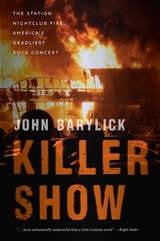
Killer Show
The Station Nightclub Fire, America’s Deadliest Rock ConcertJohn Barylick
University Press of New England, 2015
On February 20, 2003, the deadliest rock concert in U.S. history took place at a roadhouse called The Station in West Warwick, Rhode Island. That night, in the few minutes it takes to play a hard-rock standard, the fate of many of the unsuspecting nightclub patrons was determined with awful certainty. The blaze was ignited when pyrotechnics set off by Great White, a 1980s heavy-metal band, lit flammable polyurethane “egg crate” foam sound insulation on the club’s walls. In less than 10 minutes, 96 people were dead and 200 more were injured, many catastrophically. The final death toll topped out, three months later, at the eerily unlikely round number of 100. The story of the fire, its causes, and its legal and human aftermath is one of lives put at risk by petty economic decisions—by a band, club owners, promoters, building inspectors, and product manufacturers. Any one of those decisions, made differently, might have averted the tragedy. Together, however, they reached a fatal critical mass. Killer Show is the first comprehensive exploration of the chain of events leading up to the fire, the conflagration itself, and the painstaking search for evidence to hold the guilty to account and obtain justice for the victims. Anyone who has entered an entertainment venue and wondered, “Could I get out of here in a hurry?” will identify with concertgoers at The Station. Fans of disaster nonfiction and forensic thrillers will find ample elements of both genres in Killer Show.
[more]
Killing Poetry
Blackness and the Making of Slam and Spoken Word CommunitiesJohnson, Javon
Rutgers University Press, 2017
Winner of the 2019 Lilla A. Heston Award
Co-winner of the 2018 Ethnography Division’s Best Book from the NCA
In recent decades, poetry slams and the spoken word artists who compete in them have sparked a resurgent fascination with the world of poetry. However, there is little critical dialogue that fully engages with the cultural complexities present in slam and spoken word poetry communities, as well as their ramifications.
In Killing Poetry, renowned slam poet, Javon Johnson unpacks some of the complicated issues that comprise performance poetry spaces. He argues that the truly radical potential in slam and spoken word communities lies not just in proving literary worth, speaking back to power, or even in altering power structures, but instead in imagining and working towards altogether different social relationships. His illuminating ethnography provides a critical history of the slam, contextualizes contemporary black poets in larger black literary traditions, and does away with the notion that poetry slams are inherently radically democratic and utopic.
Killing Poetry—at times autobiographical, poetic, and journalistic—analyzes the masculine posturing in the Southern California community in particular, the sexual assault in the national community, and the ways in which related social media inadvertently replicate many of the same white supremacist, patriarchal, and mainstream logics so many spoken word poets seem to be working against. Throughout, Johnson examines the promises and problems within slam and spoken word, while illustrating how community is made and remade in hopes of eventually creating the radical spaces so many of these poets strive to achieve.
[more]
Kwaito's Promise
Music and the Aesthetics of Freedom in South AfricaGavin Steingo
University of Chicago Press, 2016
In mid-1990s South Africa, apartheid ended, Nelson Mandela was elected president, and the country’s urban black youth developed kwaito—a form of electronic music (redolent of North American house) that came to represent the post-struggle generation. In this book, Gavin Steingo examines kwaito as it has developed alongside the democratization of South Africa over the past two decades. Tracking the fall of South African hope into the disenchantment that often characterizes the outlook of its youth today—who face high unemployment, extreme inequality, and widespread crime—Steingo looks to kwaito as a powerful tool that paradoxically engages South Africa’s crucial social and political problems by, in fact, seeming to ignore them.
Politicians and cultural critics have long criticized kwaito for failing to provide any meaningful contribution to a society that desperately needs direction. As Steingo shows, however, these criticisms are built on problematic assumptions about the political function of music. Interacting with kwaito artists and fans, he shows that youth aren’t escaping their social condition through kwaito but rather using it to expand their sensory realities and generate new possibilities. Resisting the truism that “music is always political,” Steingo elucidates a music that thrives on its radically ambiguous relationship with politics, power, and the state.
Politicians and cultural critics have long criticized kwaito for failing to provide any meaningful contribution to a society that desperately needs direction. As Steingo shows, however, these criticisms are built on problematic assumptions about the political function of music. Interacting with kwaito artists and fans, he shows that youth aren’t escaping their social condition through kwaito but rather using it to expand their sensory realities and generate new possibilities. Resisting the truism that “music is always political,” Steingo elucidates a music that thrives on its radically ambiguous relationship with politics, power, and the state.
[more]