Results by title
593 books match the query 'Jews' and 6 start with k

Kafka and Cultural Zionism
Dates in PalestineIris Bruce
University of Wisconsin Press, 2007

Kentucky
I. J. Schwartz
University of Alabama Press, 1990
An epic poem about life in America in the early 20th century, as perceived by a Jewish immigrant.
Kentucky is the first major work in Yiddish literature to present America as its primary theme. The long epic poem paints a rich picture of life in Kentucky just after the Civil War. Written between 1918 and 1922 by Lithuanian-born writer, I. J. Schwartz, it first appeared in the Yiddish journal Zukunft and later, in 1925, was published as a book. Although unknown to English readers until this translation, the book was a primary text for immigrants and potential immigrants in places as remote as Poland and Argentina who received their first impressions of America from its pages. Parts of it were even set to music and sung in choruses around the world.
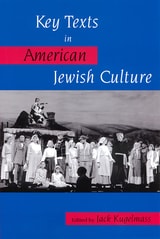
Key Texts in American Jewish Culture
Kugelmass, Jack
Rutgers University Press, 2003
Contributors come from a variety of disciplines, including American studies, anthropology, comparative literature, history, music, religious studies, and women's studies. Each provides an analysis of a specific text in art, music, television, literature, homily, liturgy, or history. Some of the works discussed, such as Philip Roth's novel Counterlife, the musical Fiddler on the Roof, and Irving Howe's World of Our Fathers, are already widely acknowledged components of the American Jewish studies canon. Others-such as Bridget Loves Bernie, infamous for the hostile reception it received among American Jews+ may be considered "key texts" because of the controversy they provoked. Still others, such as Joshua Liebman's Piece of Mind and the radio and TV sitcom The Goldbergs, demonstrate the extent to which American Jewish culture and mainstream American culture intermingle with and borrow from each other.
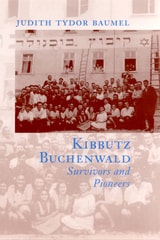
Kibbutz Buchenwald
Survivors and PioneersJudith Tydor Baumel
Rutgers University Press, 1997
Kibbutz Buchenwald is the story of a nightmare that became a dream and a dream that became a reality. Emerging from the depths of the liberated concentration camp Buchenwald in the spring of 1945, a group of sixteen gaunt and battered young men organized and formed Kibbutz Buchenwald, the first agricultural collective in postwar Germany designed to prepare Jews for emigation to Palestine. What caused a handful of survivors to take their fate into their own hands within days of their liberation, at a time when most survivors were passively awaiting orders from the occupying forces? From what wellsprings did they draw the physical and emotional strength to begin life anew as Zionist pioneers in a world which had turned upside down?
Judith Baumel's moving account of this courageous group is divided into two parts. Part One, entitled "The Dream," examines the kibbutz from its creation in Germany until the departure of the founding group for Palestine in the summer of 1945. Part Two, "The Reality," follows the members of Kibbutz Buchenwald into Palestine, where they eventually established their own independent settlement in 1948. This settlement exists as Kibbutz Netzer Sereni today.
Drawing from the diaries of the kibbutz's founding members, Baumel provides a detailed account of an incredible story and places the central narrative in the larger contexts of communal living, European politics after the war, and the link between European Jewry and Israeli postwar nationhood. An afterword, "Where Are They Now," briefly describes the later life of each of the original kibbutz members.
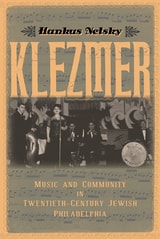
Klezmer
Music and Community in Twentieth-Century Jewish PhiladelphiaHankus Netsky
Temple University Press, 2017
Netsky defines what klezmer music is, how it helped define Jewish immigrant culture in Philadelphia, and how its current revival has changed klezmer’s meaning historically. Klezmer also addresses the place of musicians and celebratory music in Jewish society, the nature of klezmer culture, the tensions between sacred and secular in Jewish music, and the development of Philadelphia's distinctive “Russian Sher” medley, a unique and masterfully crafted composition.
Including a significant amount of musical transcriptions, Klezmer chronicles this special musical genre from its heyday in the immigrant era, through the mid-century period of its decline through its revitalization from the 1980s to today.

Knish
In Search of the Jewish Soul FoodLaura Silver
Brandeis University Press, 2014