Results by title
645 books match the query 'Judaism' and 4 start with k
Kabbalistic Revolution
Reimagining Judaism in Medieval SpainLachter, Hartley
Rutgers University Press, 2014
Keeping the Feast
Metaphors of Sacrifice in 1 Corinthians and PhilippiansJane Lancaster Patterson
SBL Press, 2015
Develop a keener ear for Paul’s rhetorical strategy
Patterson uses cognitive metaphor theory to trace the apostle Paul’s use of metaphors from the Jewish sacrificial system in his moral counsels to the Philippians and the Corinthians. In these letters, Paul moves from the known (the practice of sacrifice) to the unknown (how to live in accord with the life, death, and resurrection of Jesus Christ). Patterson illustrates that the significant sacrificial metaphors in 1 Corinthians and Philippians are not derived from Jewish sacrifices of atonement, but rather from the Passover and sacrifices of thanksgiving. Attention to these metaphors demonstrates that imagery drawn from these sacrifices shapes the overall moral counsel of the letters, reveals more varied and nuanced interpretations of sacrificial references in Paul’s letters, and sheds light on Paul’s continuity with Jewish cultic practice.
Features
- Clarification of the strategic function of metaphors as a means of establishing an imaginative framework for ethical deliberation
- Evidence of Paul’s active processes of theological reflection
- Exploration of the intertwining of Jewish cultic practice with the rhetoric of moral commitment within early Christian churches

Kentucky
I. J. Schwartz
University of Alabama Press, 1990
An epic poem about life in America in the early 20th century, as perceived by a Jewish immigrant.
Kentucky is the first major work in Yiddish literature to present America as its primary theme. The long epic poem paints a rich picture of life in Kentucky just after the Civil War. Written between 1918 and 1922 by Lithuanian-born writer, I. J. Schwartz, it first appeared in the Yiddish journal Zukunft and later, in 1925, was published as a book. Although unknown to English readers until this translation, the book was a primary text for immigrants and potential immigrants in places as remote as Poland and Argentina who received their first impressions of America from its pages. Parts of it were even set to music and sung in choruses around the world.
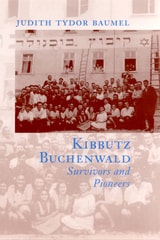
Kibbutz Buchenwald
Survivors and PioneersJudith Tydor Baumel
Rutgers University Press, 1997
Kibbutz Buchenwald is the story of a nightmare that became a dream and a dream that became a reality. Emerging from the depths of the liberated concentration camp Buchenwald in the spring of 1945, a group of sixteen gaunt and battered young men organized and formed Kibbutz Buchenwald, the first agricultural collective in postwar Germany designed to prepare Jews for emigation to Palestine. What caused a handful of survivors to take their fate into their own hands within days of their liberation, at a time when most survivors were passively awaiting orders from the occupying forces? From what wellsprings did they draw the physical and emotional strength to begin life anew as Zionist pioneers in a world which had turned upside down?
Judith Baumel's moving account of this courageous group is divided into two parts. Part One, entitled "The Dream," examines the kibbutz from its creation in Germany until the departure of the founding group for Palestine in the summer of 1945. Part Two, "The Reality," follows the members of Kibbutz Buchenwald into Palestine, where they eventually established their own independent settlement in 1948. This settlement exists as Kibbutz Netzer Sereni today.
Drawing from the diaries of the kibbutz's founding members, Baumel provides a detailed account of an incredible story and places the central narrative in the larger contexts of communal living, European politics after the war, and the link between European Jewry and Israeli postwar nationhood. An afterword, "Where Are They Now," briefly describes the later life of each of the original kibbutz members.