Results by title
72 books match the query 'Korea (South)' and 2 start with k
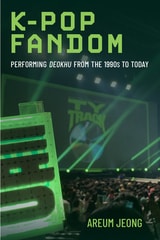
K-Pop Fandom
Performing Deokhu from the 1990s to TodayAreum Jeong
University of Michigan Press, 2026
Through an autoethnography of becoming a K-pop deokhu, Jeong connects their experiences to generations of K-pop fans, showing simultaneously how fandom practices have shifted over time and the intricacies of fan labor participation. This personal connection paved the way for participant-observation and co-performer witnessing methodologies in the study, which crucially allowed for collaborating with fans whose communal pursuits have been stigmatized by dominant discourses that denigrate their activities as solely addictive, uncritical, and wasteful. Jeong’s genre-spanning corpus of fan activities and analyzing its contexts and contents represents an important contribution to the making of a fan archive that is also an archive of affective labor.
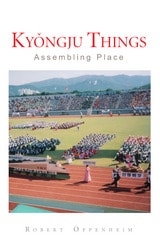
Kyongju Things
Assembling PlaceRobert Oppenheim
University of Michigan Press, 2008
Kyongju is South Korea's preeminent "culture city," an urban site rich with archaeological wonders that residents compare to those of Nara, Xian, and Rome. By examining these ancient objects in relation to the controversies that engulfed South Korea's high-speed railway line when it was first proposed in the 1990s, Kyongju Things offers a grounded and theoretically sophisticated account of South Korean development and citizenship in the last quarter of the twentieth century. Its sensitivity to issues of place, knowledge, and cultural heritage and its innovative use of network theory will be of interest to a wide range of scholars in anthropology, Asian studies, the history of science and technology, cultural geography, urban planning, and political science.
Robert Oppenheim is Assistant Professor of Asian Studies at the University of Texas at Austin.
"A tale of South Korea's new politics involving antiquarians, weekend hikers, activists, and entrepreneurs, told with wit and theoretical sophistication."
---Laurel Kendall, Curator, Division of Anthropology, American Museum of Natural History
"In Kyongju Things, Robert Oppenheim employs an innovative theoretical blend to insightfully illuminate the interactions of agency and objects in the making of a 'place.'"
---Roger L. Janelli, Professor Emeritus, Department of East Asian Languages and Cultures and Department of Folklore and Ethnomusicology, Indiana University
"Kyongju Things is responsible, pathbreaking, and ambitious, with a stunning and welcoming introduction . . . Oppenheim calls upon a theoretical tool kit that allows him to productively re-think place, locality, technology, things, and subjectivity in ways that really do challenge the existing scholarship on South Korea. Kyongju Things will make a splash in Korean studies."
---Nancy Abelmann, Associate Professor of Anthropology, University of Illinois at Urbana-Champaign, and author of Echoes of the Past, Epics of Dissent: A South Korean Social Movement