Results by title
6 books match the query 'Bomb'
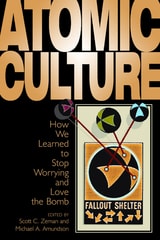
Atomic Culture
How We Learned to Stop Worrying and Love the BombMichael A. Amundson
University Press of Colorado, 2004
Despite the growing interest in atomic culture and history, the body of relevant scholarship is relatively sparse. Atomic Culture opens new doors into the field by providing a substantive, engaging, and historically based consideration of the topic that will appeal to students and scholars of the Atomic Age as well as general readers.
Contributors include Michael A. Amundson, Mick Broderick, Peter Goin, John Hunner, Ferenc M. Szasz, A. Costandina Titus, Peter C. van Wyck, and Scott C. Zeman.
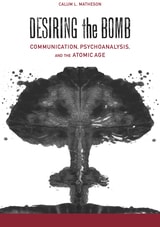
Desiring the Bomb
Communication, Psychoanalysis, and the Atomic AgeCalum L. Matheson
University of Alabama Press, 2019
Every culture throughout history has obsessed over various “end of the world” scenarios. The dawn of the Atomic Age marked a new twist in this tale. For the first time, our species became aware of its capacity to deliberately destroy itself. Since that time the Bomb has served as an organizing metaphor, a symbol of human annihilation, a stand-in for the unspeakable void of extinction, and a discursive construct that challenges the limits of communication itself. The parallel fascination with and abhorrence of nuclear weapons has metastasized into a host of other end-of-the-world scenarios, from global pandemics and climate change to zombie uprisings and asteroid collisions.
Desiring the Bomb: Communication, Psychoanalysis, and the Atomic Age explores these world-ending fantasies through the lens of psychoanalysis to reveal their implications for both contemporary apocalyptic culture and the operations of language itself. What accounts for the enduring power of the Bomb as a symbol? What does the prospect of annihilation suggest about language and its limits? Thoroughly researched and accessibly written, this study expands on the theories of Kenneth Burke, Jacques Lacan, Sigmund Freud, and many others from a variety of disciplines to arrive at some answers to these questions.
Calum L. Matheson undertakes a series of case studies—including the Trinity test site, nuclear war games, urban shelter schemes, and contemporary survivalism—and argues that contending with the anxieties (individual, social, cultural, and political) born of the Atomic Age depends on rhetorical conceptions of the “real,” an order of experience that cannot be easily negotiated in language. Using aspects of media studies, rhetorical theory, and psychoanalysis, the author deftly engages the topics of Atomic Age survival, extinction, religion, and fantasy, along with their enduring cultural legacies, to develop an account of the Bomb as a signifier and to explore why some Americans have become fascinated with fantasies of nuclear warfare and narratives of postapocalyptic rebirth.

Empire and the Bomb
How the U.S. Uses Nuclear Weapons to Dominate the WorldJoseph Gerson
Pluto Press, 2007
Gerson reveals how and why the United States made more than twenty threats of nuclear attack during the Cold War---against Russia, China, Vietnam, and the Middle East. He shows how such threats continued under Presidents Bush, Clinton, and George W. Bush.
The book concludes with an appeal for the abolition of nuclear weapons and an overview of the history of the anti-nuclear movement. Drawing from a wide range of sources, including extensive government documents, this fascinating and timely account shows how the United States has used nuclear weapons to dominate the world.
Read a review of Empire and the Bomb:
http://www.jamesclayfuller.com/2007/09/terrifying-book-but-read-it-anyway.html
My Heart Became a Bomb
Poems by Ramy al-Asheq; translated by Levi Thompson
University of Texas Press, 2021
My Heart Became a Bomb is the first collection of poetry by Syrian-Palestinian poet Ramy al-Asheq to be translated into English. Poignant and raw, these poems take the reader along a path of forced emigration from Bashar al-Assad’s prisons in Syria to Amsterdam to Auschwitz to Berlin, Germany, where Al-Asheq is now creating a new home. By turns melancholy and reflective, celebratory and hopeful, Al-Asheq’s newly translated poems offer the English-reading audience a contemporary perspective on the experience of exile in a world facing the phenomeno of mass migration, whether for political or environmental reasons. The translations are the result of a long collaboration between Al-Asheq and Thompson (who also edited this collection). Raising questions about the nature of love, identity, and the role of poetry in the face of constant flux and great uncertainty, My Heart Became a Bomb introduces an important new voice to the world of contemporary poetry.

Paranoia, the Bomb, and 1950s Science Fiction Films
Cyndy Hendershot
University of Wisconsin Press, 1999
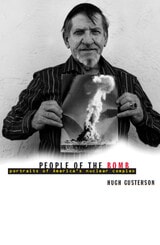
People Of The Bomb
Portraits of America’s Nuclear ComplexHugh Gusterson
University of Minnesota Press, 2004
How the American military-industrial complex has invaded our consciousness to create consent for its programs
“We have had the bomb on our minds since 1945. It was first our weaponry and then our diplomacy, and now it’s our economy. How can we suppose that something so monstrously powerful would not, after forty years, compose our identity?” —E. L. Doctorow
This book tells the story of how—like it or not, know it or not—we have become “the people of the bomb.” Integrating fifteen years of field research at weapons laboratories across the United States with discussion of popular movies, political speeches, media coverage of war, and the arcane literature of defense intellectuals, Hugh Gusterson shows how the military-industrial complex has built consent for its programs and, in the process, taken the public “nuclear.”People of the Bomb mixes empathic and vivid portraits of individual weapons scientists with hard-hitting scrutiny of defense intellectuals’s inability to foresee the end of the Cold War, government rhetoric on missile defense, official double standards about nuclear proliferation, and pork barrel politics in the nuclear weapons complex. Overall, the book assembles a disturbing picture of the ways in which the military-industrial complex has transformed our public culture and personal psychology in the half century since we entered the nuclear age.