Results by title
754 books match the query 'Native American Studies' and 7 start with k
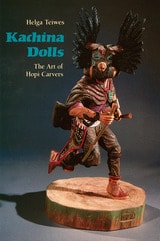
Kachina Dolls
The Art of Hopi CarversHelga Teiwes
University of Arizona Press, 1991
Teiwes explains the role of the Katsina spirit in Hopi religion and that of the kachina doll—the carved representation of a Katsina—in the ritual and economic life of the Hopis. In tracing the history of the kachina doll in Hopi culture, she shows how these wooden figures have changed since carvers came to be influenced by their marketability among Anglos and how their carving has been characterized by increasingly refined techniques. Unique to this book are Teiwes's description of the most recent trends in kachina doll carving and her profiles of twenty-seven modern carvers, including such nationally known artists as Alvin James Makya and Cecil Calnimptewa. Enhancing the text are more than one hundred photographs, including twenty-five breathtaking color plates that bring to life the latest examples of this popular art form.
Kaiaulu
Gathering TidesMehana Blaich Vaughan
Oregon State University Press, 2018
This coast is known as a playground for tourists and backdrop for Hollywood movies, but catch from small local reefs, and the sharing of this abundance, has sustained area families for centuries, helping them to thrive through tidal waves, hurricanes, an influx of new residents, and economic recessions. Yet fishing families are increasingly invisible and many have moved away, threatened by global commodification and loss of access to coastal lands that are now private retreats for star entertainers, investors, and dot-com millionaires.
Building on two decades of interviews with more than sixty Hawaiian elders, leaders, and fishermen and women, Kaiāulu shares their stories of enduring community efforts to perpetuate kuleana, often translated to mean “rights and responsibilities.” Community actions extend kuleana to include nurturing respectful relationships with resources, guarding and cultivating fishing spots, perpetuating collective harvests and sharing, maintaining connection to family lands, reasserting local governance rooted in ancestral values, and preparing future generations to carry on.
An important contribution to scholarship in the fields of natural resource management, geography, Indigenous Studies, and Hawaiian Studies, Kaiāulu is also a skillfully written and deeply personal tribute to a community based not on ownership, but reciprocity, responsibility, and caring for the places that shape and sustain us all.
Kandik Map
Linda Johnson
University of Alaska Press, 2009
Keewaydinoquay, Stories from My Youth
Keewaydinoquay Peschel
University of Michigan Press, 2006
Michael Blake's Dances with Wolves transformed denigrating Indian sterotypes and created widespread interest in Native American culture. The subsequent popularity of books on this topic underscores the power of a tale well told. While Blake's story relates the early chapters of Native Americans' survival struggles, later accounts of this struggle remain untold.
The Indians of Hungry Hollow authentically presents these later chapters. The days of Hungry Hollow have long passed, but the opportunity to capture its lessons of community, strong values, and an urge to thrive in matters of the heart and soul are still very much with us.
These are stories of survival, community, sharing, and caring. The situations are often dire: winter in the middle of the Depression; an Indian settlement illegally taken from its inhabitants and set on fire; boaters stranded by bad weather and threatened with death. But if the situations are extreme, the telling of the stories is consistently optimistic yet completely without self-pity or sentimentality, and the characters always find a way through the darkness.
Dunlop's unique style of storytelling is compelling and informative, and these historically significant stories help to elucidate the transition of the American Indian culture from post-tribal days to the present.
Bill Dunlop is a respected Ottawa elder and storyteller. Marcia Fountain-Blacklidge is a professional writer, counselor, and consultant.
Kinaalda
Charlotte J Frisbie
University of Utah Press, 1993
Kinaaldá, the ceremony associated with the onset of a girl’s puberty, is an important Navajo rite within the Blessingway complex. Derived from the experiences of Changing Woman, the puberty ceremony has been passed through generations and continues to be observed throughout Navajoland.
An acknowledged classic, Kinaaldá remains the most complete "outsider" account of this important ceremony. Charlotte Frisbie’s lucid description takes the reader through the four-day ritual, describing sequence, daily activities, restrictions, observances that include the girl’s race toward the east, and an analysis of the ceremonial music, complete with notations and translation.
To give readers a better sense of why, Frisbie relates the beliefs and practices expressed in Kinaaldá to origin accounts conveyed by medicine people and to explanations and discussions with other Navajos.
Kiowa Ethnogeography
By William C. Meadows
University of Texas Press, 2008
Examining the place names, geographical knowledge, and cultural associations of the Kiowa from the earliest recorded sources to the present, Kiowa Ethnogeography is the most in-depth study of its kind in the realm of Plains Indian tribal analysis. Linking geography to political and social changes, William Meadows applies a chronological approach that demonstrates a cultural evolution within the Kiowa community.
Preserved in both linguistic and cartographic forms, the concepts of place, homeland, intertribal sharing of land, religious practice, and other aspects of Kiowa life are clarified in detail. Native religious relationships to land (termed "geosacred" by the author) are carefully documented as well. Meadows also provides analysis of the only known extant Kiowa map of Black Goose, its unique pictographic place labels, and its relationship to reservation-era land policies. Additional coverage of rivers, lakes, and military forts makes this a remarkably comprehensive and illuminating guide.
Kiowa, Apache, and Comanche Military Societies
Enduring Veterans, 1800 to the PresentBy William C. Meadows
University of Texas Press, 1999
A CHOICE Outstanding Academic Book
For many Plains Indians, being a warrior and veteran has long been the traditional pathway to male honor and status. Men and boys formed military societies to celebrate victories in war, to perform community service, and to prepare young men for their role as warriors and hunters. By preserving cultural forms contained in song, dance, ritual, language, kinship, economics, naming, and other semireligious ceremonies, these societies have played an important role in maintaining Plains Indian culture from the pre-reservation era until today.
In this book, Williams C. Meadows presents an in-depth ethnohistorical survey of Kiowa, Apache, and Comanche military societies, drawn from extensive interviews with tribal elders and military society members, unpublished archival sources, and linguistic data. He examines their structure, functions, rituals, and martial symbols, showing how they fit within larger tribal organizations. And he explores how military societies, like powwows, have become a distinct public format for cultural and ethnic continuity.