Results by title
1668 books match the query 'Popular culture' and 9 start with k

Katherine Mansfield's Fiction
Patrick D. Morrow
University of Wisconsin Press, 1993
This book attempts to analyze a major part of Mansfield's fiction, concentrating on an analysis of the various textures, themes, and issues, plus the point of view virtuosity that she accomplished in her short lifetime (34 years). Many of her most famous works, such as "Prelude" and "Bliss," are explicated, along with many of her less famous and unfinished stories.
Ken Follett
The Transformation of a WriterCarlos Ramet
University of Wisconsin Press, 1999
Kenneth Burke's Dramatism and Popular Arts
C. Ronald Kimberling
University of Wisconsin Press, 1982
Kid on the Sandlot
Congress and Professional Sports, 1910–1992Stephen R. Lowe
University of Wisconsin Press, 1995
Lowe provides concise, interpretive narrative of Congress’s involvement in professional sports. Testimony is included from such colorful figures as Jackie Robinson, Casey Stengel, Pete Rozelle, Muhammad Ali, Sonny Liston, and Don King. Leading congressmen and senators are also included.

Killer Bodies
The Rise and Fall of "Bad Girl" ComicsJoseph Crawford
Rutgers University Press, 2026
Killer Bodies offers a history of the single most critically derided subgenre in American superhero comics: the “bad girl” comics of the 1990s, which chronicled the blood-soaked adventures of barely dressed and improbably proportioned action heroines for an audience of adolescent boys. While not in any way attempting to rehabilitate the genre, which for the most part amply deserved its reputation as sexist and borderline pornographic, this book situates it within its original cultural context, as the result of a matrix of influences that included third-wave feminism, neopaganism, “girl power,” the rise of the internet, the growing popularity of manga, supermodel beauty ideals, and the mainstreaming of pornography. It explores why and how the figure of the antiheroic, physically aggressive, sexually objectified heroine arose within American comics culture, and the commercial and ideological factors that led to the genre’s rapid rise and equally rapid decline amidst the crisis-racked comics industry of the mid-1990s.
Killing Poetry
Blackness and the Making of Slam and Spoken Word CommunitiesJohnson, Javon
Rutgers University Press, 2017
Co-winner of the 2018 Ethnography Division’s Best Book from the NCA
In recent decades, poetry slams and the spoken word artists who compete in them have sparked a resurgent fascination with the world of poetry. However, there is little critical dialogue that fully engages with the cultural complexities present in slam and spoken word poetry communities, as well as their ramifications.
In Killing Poetry, renowned slam poet, Javon Johnson unpacks some of the complicated issues that comprise performance poetry spaces. He argues that the truly radical potential in slam and spoken word communities lies not just in proving literary worth, speaking back to power, or even in altering power structures, but instead in imagining and working towards altogether different social relationships. His illuminating ethnography provides a critical history of the slam, contextualizes contemporary black poets in larger black literary traditions, and does away with the notion that poetry slams are inherently radically democratic and utopic.
Killing Poetry—at times autobiographical, poetic, and journalistic—analyzes the masculine posturing in the Southern California community in particular, the sexual assault in the national community, and the ways in which related social media inadvertently replicate many of the same white supremacist, patriarchal, and mainstream logics so many spoken word poets seem to be working against. Throughout, Johnson examines the promises and problems within slam and spoken word, while illustrating how community is made and remade in hopes of eventually creating the radical spaces so many of these poets strive to achieve.

King of Hearts
Drag Kings in the American SouthBaker A. Rogers
Rutgers University Press, 2022
King of Hearts shows how drag king performers are thriving in an unlikely location: Southern Bible Belt states like Tennessee, Georgia, and South Carolina. Based on observations and interviews with sixty Southern drag kings, this study reveals how they are challenging the region’s gender norms while creating a unique community with its own distinctive Southern flair. Reflecting the region’s racial diversity, it profiles not only white drag kings, but also those who are African American, multiracial, and Hispanic.
Queer scholar Baker A. Rogers—who has also performed as drag king Macon Love—takes you on an insider’s tour of Southern drag king culture, exploring its history, the communal bonds that unite it, and the controversies that have divided it. King of Hearts offers a groundbreaking look at a subculture that presents a subversion of gender norms while also providing a vital lifeline for non-gender-conforming Southerners.

Knowledge and Social Imagery
David Bloor
University of Chicago Press, 1991
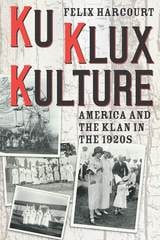
Ku Klux Kulture
America and the Klan in the 1920sFelix Harcourt
University of Chicago Press, 2017
Ku Klux Kulture reveals the extent to which the KKK participated in and penetrated popular American culture, reaching far beyond its paying membership to become part of modern American society. The Klan owned radio stations, newspapers, and sports teams, and its members created popular films, pulp novels, music, and more. Harcourt shows how the Klan’s racist and nativist ideology became subsumed in sunnier popular portrayals of heroic vigilantism. In the process he challenges prevailing depictions of the 1920s, which may be best understood not as the Jazz Age or the Age of Prohibition, but as the Age of the Klan. Ku Klux Kulture gives us an unsettling glimpse into the past, arguing that the Klan did not die so much as melt into America’s prevailing culture.