175 books match the query 'Rites and ceremonies' and 5 start with k

cover of Keepers of the Sacred Chants: The Poetics of Ritual Power in an Amazonian Society

Keepers of the Sacred Chants

The Poetics of Ritual Power in an Amazonian Society

Jonathan D. Hill

University of Arizona Press, 1993

The Wakuenai of the upper Rio Negro region in southern Venezuela employ a form of singing called malikai for ceremonies of childbirth, initiation, and healing. This ritual chanting is a rich amalgam of myth and music, and serves as a means of integrating individuals into a vertical hierarchy of power relations between mythic ancestors and human descendants. Jonathan Hill here shows how the musical and semantic transformations of everyday discourse in malikai integrate the everyday world into a poetic process of empowerment.
[more]
cover of Kinaalda

Kinaalda

Charlotte J Frisbie

University of Utah Press, 1993

Kinaaldá, the ceremony associated with the onset of a girl’s puberty, is an important Navajo rite within the Blessingway complex. Derived from the experiences of Changing Woman, the puberty ceremony has been passed through generations and continues to be observed throughout Navajoland.

An acknowledged classic, Kinaaldá remains the most complete "outsider" account of this important ceremony. Charlotte Frisbie’s lucid description takes the reader through the four-day ritual, describing sequence, daily activities, restrictions, observances that include the girl’s race toward the east, and an analysis of the ceremonial music, complete with notations and translation.

To give readers a better sense of why, Frisbie relates the beliefs and practices expressed in Kinaaldá to origin accounts conveyed by medicine people and to explanations and discussions with other Navajos.
[more]
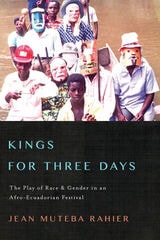
cover of Kings for Three Days: The Play of Race and Gender in an Afro-Ecuadorian Festival

Kings for Three Days

The Play of Race and Gender in an Afro-Ecuadorian Festival

Jean Muteba Rahier

University of Illinois Press, 2013
 
With its rich mix of cultures, European influences, colonial tensions, and migration from bordering nations, Ecuador has long drawn the interest of ethnographers, historians, and political scientists. In this book, Jean Muteba Rahier delivers a highly detailed, thought-provoking examination of the racial, sexual, and social complexities of Afro-Ecuadorian culture, as revealed through the annual Festival of the Kings. During the Festival, the people of various villages and towns of Esmeraldas--Ecuador's province most associated with blackness--engage in celebratory and parodic portrayals, often donning masks, cross-dressing, and disguising themselves as blacks, indigenous people, and whites, in an obvious critique of local, provincial, and national white, white-mestizo, and light-mulatto elites. Rahier shows that this festival, as performed in different locations, reveals each time a specific location's perspective on the larger struggles over identity, class, and gender relations in the racial-spacial order of Esmeraldas, and of the Ecuadorian nation in general.

[more]
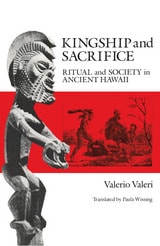
cover of Kingship and Sacrifice: Ritual and Society in Ancient Hawaii

Kingship and Sacrifice

Ritual and Society in Ancient Hawaii

Valerio Valeri

University of Chicago Press, 1985
Valeri presents an overview of Hawaiian religious culture, in which hierarchies of social beings and their actions are mirrored by the cosmological hierarchy of the gods. As the sacrifice is performed, the worshipper is incorporated into the god of his class. Thus he draws on divine power to sustain the social order of which his action is a part, and in which his own place is determined by the degree of his resemblance to his god. The key to Hawaiian society—and a central focus for Valeri—is the complex and encompassing sacrificial ritual that is the responsibility of the king, for it displays in concrete actions all the concepts of pre-Western Hawaiian society. By interpreting and understanding this ritual cycle, Valeri contends, we can interpret all of Hawaiian religious culture.
[more]
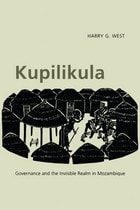
cover of Kupilikula: Governance and the Invisible Realm in Mozambique

Kupilikula

Governance and the Invisible Realm in Mozambique

Harry G. West

University of Chicago Press, 2005

On the Mueda plateau in northern Mozambique, sorcerers are said to feed on their victims, sometimes "making" lions or transforming into lions to literally devour their flesh. When the ruling FRELIMO party subscribed to socialism, it condemned sorcery beliefs and counter-sorcery practices as false consciousness, but since undertaking neoliberal reform, the party—still in power after three electoral cycles—has "tolerated tradition," leaving villagers to interpret and engage with events in the idiom of sorcery. Now, when the lions prowl plateau villages ,suspected sorcerers are often lynched.

In this historical ethnography of sorcery, Harry G. West draws on a decade of fieldwork and combines the perspectives of anthropology and political science to reveal how Muedans expect responsible authorities to monitor the invisible realm of sorcery and to overturn or, as Muedans call it, "kupilikula" sorcerers' destructive attacks by practicing a constructive form of counter-sorcery themselves. Kupilikula argues that, where neoliberal policies have fostered social division rather than security and prosperity, Muedans have, in fact, used sorcery discourse to assess and sometimes overturn reforms, advancing alternative visions of a world transformed.
[more]