Results by title
54 books match the query 'Tanzania' and 2 start with k
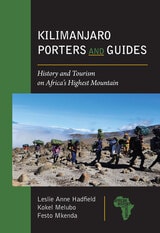
Kilimanjaro Porters and Guides
History and Tourism on Africa's Highest MountainLeslie Anne Hadfield
Michigan State University Press, 2026
Mt. Kilimanjaro, Africa’s tallest mountain, draws tens of thousands of tourists annually. Many attempt to climb its nineteen thousand feet snow-covered peak, an arduous trek that can span several days. Like the climbers who scale Everest, they are aided by local porters, cooks, and guides. But unlike Everest’s Sherpas, who have been extensively documented and profiled, the Chagga people of the Kilimanjaro mountain crews remain nearly anonymous.
The Chagga people, who were the first settlers near Kilimanjaro, have been an essential part of the climbing industry that has developed since the colonial period. Kilimanjaro Porters and Guidesreveals the history of these porters, cooks, and guides. The book takes us from early Chagga settlement, through European colonialism and African independence, to today. It argues that while the Kilimanjaro climbing industry developed in a colonial context, local Tanzanian actors have played an integral role in determining access to and understanding of the mountain. They also have been central to climbers’ successes, mountain crew culture, and the evolution of key industry features—even as they have struggled in the postcolonial period.
Kuria Cattle Raiders
Violence and Vigilantism on the Tanzania/Kenya FrontierMichael L. Fleisher
University of Michigan Press, 2000
The reciprocal raiding of cattle by pastoralists has a long and venerable history in East Africa, but there has been, until now, no book-length treatment of the practice, and, more importantly, no detailed case study of the newer, "modern" form of cattle raiding described here. In addition, the phenomenon of Kuria cattle raiding conveys significant implications for our understanding of informal economies and globalization processes.
Kuria Cattle Raiders engages issues of theoretical as well as practical significance for anthropologists, sociologists, criminologists, cultural ecologists, economic development agencies, and all those concerned with the pressing issues of globalization and rapid social and cultural change.
Michael L. Fleisher, a Post-Doctoral Research Fellow in the Department of Rangeland Resources, Utah State University, is currently engaged in a study of conflict among pastoralists in southern Ethiopia as part of a research project jointly administered by the University of Kentucky, Utah State University, and Cornell University under a grant from U.S.A.I.D.