Results by title
967 books match the query 'Theater' and 3 start with k
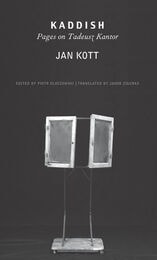
Kaddish
Pages on Tadeusz KantorJan Kott
Seagull Books, 2020
Tadeusz Kantor (1915–90) was renowned for his revolutionary theater performances in both his native Poland and abroad. Despite nominally being a Catholic, Kantor had a unique relationship with Jewish culture and incorporated many elements of Jewish theater into his works. In Kaddish, Jan Kott, an equally important figure in twentieth-century theater criticism, presents one of the most poignant descriptions of what might be called “the experience of Kantor.” At the core of the book is a fundamental philosophical question: What can save the memory of Kantor’s “Theatre of Death”—the Image, or the Word/Logos? Kott’s biblical answer in Kaddish is that Kantor’s theatre can be saved in its essence only by the Word, the Logos. This slim volume, Kott’s final work, is a distilled meditation that casts light on how two of the most prominent figures in Western theater reflected on the philosophy of the stage.
[more]

King of Hearts
Drag Kings in the American SouthBaker A. Rogers
Rutgers University Press, 2022
While drag subcultures have gained mainstream media attention in recent years, the main focus has been on female impersonators. Equally lively, however, is the community of drag kings: cis women, trans men, and non-binary people who perform exaggerated masculine personas onstage under such names as Adonis Black, Papi Chulo, and Oliver Clothesoff.
King of Hearts shows how drag king performers are thriving in an unlikely location: Southern Bible Belt states like Tennessee, Georgia, and South Carolina. Based on observations and interviews with sixty Southern drag kings, this study reveals how they are challenging the region’s gender norms while creating a unique community with its own distinctive Southern flair. Reflecting the region’s racial diversity, it profiles not only white drag kings, but also those who are African American, multiracial, and Hispanic.
Queer scholar Baker A. Rogers—who has also performed as drag king Macon Love—takes you on an insider’s tour of Southern drag king culture, exploring its history, the communal bonds that unite it, and the controversies that have divided it. King of Hearts offers a groundbreaking look at a subculture that presents a subversion of gender norms while also providing a vital lifeline for non-gender-conforming Southerners.
[more]
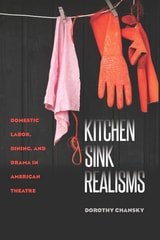
Kitchen Sink Realisms
Domestic Labor, Dining, and Drama in American TheatreDorothy Chansky
University of Iowa Press, 2015
From 1918’s Tickless Time through Waiting for Lefty, Death of a Salesman, A Streetcar Named Desire, A Raisin in the Sun, and The Prisoner of Second Avenue to 2005’s The Clean House, domestic labor has figured largely on American stages. No dramatic genre has done more than the one often dismissively dubbed “kitchen sink realism” to both support and contest the idea that the home is naturally women’s sphere. But there is more to the genre than even its supporters suggest.
In analyzing kitchen sink realisms, Dorothy Chansky reveals the ways that food preparation, domestic labor, dining, serving, entertaining, and cleanup saturate the lives of dramatic characters and situations even when they do not take center stage. Offering resistant readings that rely on close attention to the particular cultural and semiotic environments in which plays and their audiences operated, she sheds compelling light on the changing debates about women’s roles and the importance of their household labor across lines of class and race in the twentieth century.
The story begins just after World War I, as more households were electrified and fewer middle-class housewives could afford to hire maids. In the 1920s, popular mainstream plays staged the plight of women seeking escape from the daily grind; African American playwrights, meanwhile, argued that housework was the least of women’s worries. Plays of the 1930s recognized housework as work to a greater degree than ever before, while during the war years domestic labor was predictably recruited to the war effort—sometimes with gender-bending results. In the famously quiescent and anxious 1950s, critiques of domestic normalcy became common, and African American maids gained a complexity previously reserved for white leading ladies. These critiques proliferated with the re-emergence of feminism as a political movement from the 1960s on. After the turn of the century, the problems and comforts of domestic labor in black and white took center stage. In highlighting these shifts, Chansky brings the real home.
[more]