Results by title
173 books match the query 'Women in literature' and 2 start with k
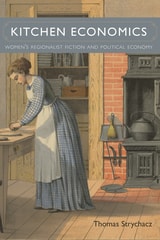
Kitchen Economics
Women’s Regionalist Fiction and Political EconomyThomas Strychacz
University of Alabama Press, 2020
An analysis of how nineteenth-century women regional writers represent political economic thought
WINNER OF THE ELIZABETH AGEE PRIZE IN AMERICAN LITERATURE
Readers of late nineteenth-century female American authors are familiar with plots, characters, and households that make a virtue of economizing. Scholars often interpret these scenarios in terms of a mythos of parsimony, frequently accompanied by a sort of elegiac republicanism whereby self-sufficiency and autonomy are put to the service of the greater good—a counterworld to the actual economic conditions of the period.
In Kitchen Economics: Women’s Regionalist Fiction and Political Economy, Thomas Strychacz takes a new approach to the question of how female regionalist fictions represent “the economic” by situating them within traditions of classical political economic thought. Offering case studies of key works by Sarah Orne Jewett, Mary Wilkins Freeman, Harriet Beecher Stowe, Rose Terry Cooke, and Alice Dunbar-Nelson, this study focuses on three complex cultural fables—the island commonwealth, stadialism (or stage theory), and feeding the body politic—which found formal expression in political economic thought, made their way into endless public debates about the economic turmoil of the late nineteenth century, and informed female authors. These works represent counterparts, not counterworlds, to modernity; and their characteristic stance is captured in the complex trope of feminaeconomica.
This approach ultimately leads us to reconsider what we mean by the term “economic,” for the emphasis of contemporary neoclassical economics on economic agents given over to infinite wants and complete self-interest has caused the “sufficiency” and “common good” models of female regionalist authors to be misinterpreted and misvalued. These fictions are nowhere more pertinent to modernity than in their alliance with today’s important alternative economic discourses.
[more]
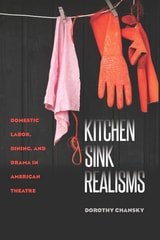
Kitchen Sink Realisms
Domestic Labor, Dining, and Drama in American TheatreDorothy Chansky
University of Iowa Press, 2015
From 1918’s Tickless Time through Waiting for Lefty, Death of a Salesman, A Streetcar Named Desire, A Raisin in the Sun, and The Prisoner of Second Avenue to 2005’s The Clean House, domestic labor has figured largely on American stages. No dramatic genre has done more than the one often dismissively dubbed “kitchen sink realism” to both support and contest the idea that the home is naturally women’s sphere. But there is more to the genre than even its supporters suggest.
In analyzing kitchen sink realisms, Dorothy Chansky reveals the ways that food preparation, domestic labor, dining, serving, entertaining, and cleanup saturate the lives of dramatic characters and situations even when they do not take center stage. Offering resistant readings that rely on close attention to the particular cultural and semiotic environments in which plays and their audiences operated, she sheds compelling light on the changing debates about women’s roles and the importance of their household labor across lines of class and race in the twentieth century.
The story begins just after World War I, as more households were electrified and fewer middle-class housewives could afford to hire maids. In the 1920s, popular mainstream plays staged the plight of women seeking escape from the daily grind; African American playwrights, meanwhile, argued that housework was the least of women’s worries. Plays of the 1930s recognized housework as work to a greater degree than ever before, while during the war years domestic labor was predictably recruited to the war effort—sometimes with gender-bending results. In the famously quiescent and anxious 1950s, critiques of domestic normalcy became common, and African American maids gained a complexity previously reserved for white leading ladies. These critiques proliferated with the re-emergence of feminism as a political movement from the 1960s on. After the turn of the century, the problems and comforts of domestic labor in black and white took center stage. In highlighting these shifts, Chansky brings the real home.
[more]