Results by title
402 books match the query 'American poetry' and 10 start with l

LOST, HURT, OR IN TRANSIT BEAUTIFUL
Rohan Chhetri
Tupelo Press, 2021
—from the Judge’s Citation by Kristina Marie Darling
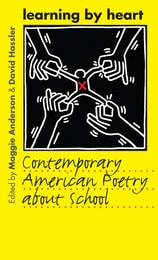
Learning by Heart
Contemporary American Poetry about SchoolMaggie Anderson
University of Iowa Press, 1999
Learning by Heart brings together a unique and diverse collection of poems about the experience of school as seen through the eyes of America's best contemporary poets. These poets capture the educational process not only in the classroom but as it takes place in libraries and hallways, on playing fields and at dances. Alternately joyous and defiant, they demonstrate how it is that young people come to find their place in the world.
Most of the poems in this anthology were written between 1970 and 1995, a period that encompasses both the halcyon years of poets-in-the-schools programs and the primary and secondary school years of many of the poets included. Their poems define school in that most contemporary sense — “with a multitude of voices”—reflecting perspectives from African American, Hispanic American, Asian American, and Native American as well as Anglo American backgrounds, from both public and private schools in rural and urban environments.
Learning by Heart offers a profound and timely statement about schools and learning as well as the role of art in education. Finally, these poems validate that most important lesson: even the most common of experiences is worthy of creative expression.
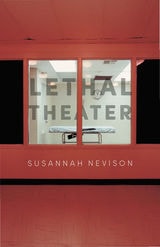
Lethal Theater
Susannah Nevison
The Ohio State University Press, 2019
Reckons with the rituals of violence that underpin the American prison system, asking readers to consider the act and complications of looking at violence and suffering.
In Lethal Theater, Susannah Nevison offers a stark and lyrical reckoning with the hidden architectures of the American prison system. These poems inhabit the charged territory where medicine and punishment converge, revealing how the body becomes both patient and instrument under state control. Moving through histories of wartime confinement, interrogation, and isolation, Nevison writes a poetry of witness to the carceral state, illuminating what is so often kept from view.
With precision and moral force, Nevison examines the shadows cast by medical experimentation on imprisoned bodies, the blurred boundary between hospital anesthesia and the drugs used in lethal injection protocols, and the rituals of surveillance that shape life behind bars. This is a work rooted in the medical humanities of confinement, an inquiry into how suffering is recorded, observed, and, at times, rendered invisible.
Lethal Theater makes visible the brutal logics beneath state-sanctioned pain and insists on the urgency—and responsibility—of looking closely at what the nation asks its incarcerated to endure.
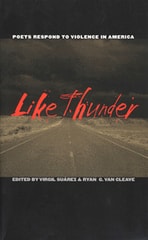
Like Thunder
Poets Respond to Violence in AmericaVirgil & Ryan G. Suarez & Van Cleave
University of Iowa Press, 2002
More than 140 poems by 120 of America's best poets that focus on the effects of violence in contemporary America.
From Waco to Columbine, from Oklahoma City to New York City, from domestic abuse and drive-by shootings to religious fanaticism and acts of terrorism, the poems in Like Thunder are for those who have perished and those who have survived. More than 140 poems by 120 poets focus, in the editors' words, on “the violence in the news, the violence in our schools, the violence in our homes, as well as the violence in our own minds.”
The poets gathered here articulate terror and suffering but also present images of hope and redemption; they write of individual menaces and individual victims and the melding of the two that potentially exists in everyone. By transforming horrifying details into larger truths, they create a poetry of witness, of survival, and of remembrance.
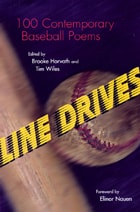
Line Drives
100 Contemporary Baseball PoemsEdited by Brooke Horvath and Tim Wiles. Foreword by Elinor Nauen
Southern Illinois University Press, 2002
“We wait for baseball all winter long,” Bill Littlefield wrote in Boston Magazine a decade ago, “or rather, we remember it and anticipate it at the same time. We re-create what we have known and we imagine what we are going to do next. Maybe that’s what poets do, too.”
Poetry and baseball are occasions for well-put passion and expressive pondering, and just as passionate attention transforms the prose of everyday life into poetry, it also transforms this game we write about, play, or watch. Editors Brooke Horvath and Tim Wiles unite their own passion for baseball and poetry in this collection, Line Drives: 100 Contemporary Baseball Poems, providing a forum for ninety-two poets. Line after line, like baseball itself game after game and season after season, these poems manage to make the old and the familiar new and surprising.
The poems in these pages invite interrogation, and the reader—like the true baseball fan—must be willing to play the game, for these poems are fun, fresh, angry, nostalgic, meditative, and meant to be read aloud. They are keen on taking us deeply into baseball as sport and intent on offering countless metaphors for exploring history, religion, love, family, and self-identity. Each poem delivers images of pure beauty as the poets speak of murder and ghost runners and old ball gloves, of baseball as a tie that binds families—and indeed the nation—together, of the game as a stage upon which no-nonsense grit and skill are routinely displayed, and of the delight experienced in being one amid a mindlessly happy crowd. This book is true to the game’s long season and to the lives of those the game engages.
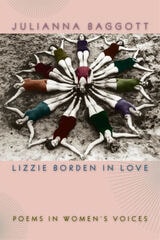
Lizzie Borden in Love
Poems in Women's VoicesJulianna Baggott
Southern Illinois University Press, 2006
Women’s voices offering an intimate view into women’s lives
Lizzie Borden in Love, a collection of poems by national bestselling author Julianna Baggott, offers poignant commentary in the voices of women as varied as Mary Todd Lincoln and Monica Lewinsky. The poems often focus on a particular moment in life: Katherine Hepburn discovers the dead body of her brother in an attic, or painter Mary Cassatt mourns the failure of her eyesight. Sometimes heartbreaking, sometimes ecstatic, the poems in this collection never fail the trust of the subjects of their intimate portrayals
Looking and Seeing/Seeing and Looking
Damon Potter and Truong Tran
Omnidawn, 2023
This book brings together different perspectives under two titles, considering the lives and experiences of two friends, one Vietnamese American and one white. Looking And Seeing is a poetic work of yearning, regret, and righteous indignation. In Truong Tran’s poetry, what is said and what is written reveal our complexities. Composed as an investigation of his own being and body as a brown person moving through white spaces, this collection moves alongside Tran’s friend and collaborator Damon Potter. Seeing and Looking offers a record of Potter’s perspective as a white man examining who he is and wants to be and the complications of trying to be good while also benefiting from histories of oppression. Potter considers death—both his own future death and the deaths of his friends—while grappling with how to witness horrors, wonders, and his self.
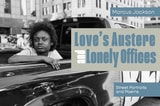
Love’s Austere and Lonely Offices
Street Portraits and PoemsMarcus Jackson
Northwestern University Press, 2026
An astounding collection of photographs from a renowned poet
Created during the tumultuous years of 2020 and 2021, Love’s Austere and Lonely Offices: Street Portraits and Poems intersects the lens of accomplished poet and photographer Marcus Jackson with his words. The focus: the Black experience and existence. Amid isolation, protest, and survival, Jackson is the aperture and scribe giving visual consciousness and breath to these human portraits. His camera strips the view of endless cycles of social and moral injustices, presenting a resonant collection of photographs that make space for the moments and the people whose beings represent the ongoing interplay between history, society, and the individual soul.
Lyric Interventions
Feminism, Experimental Poetry, DiscourseLinda A. Kinnahan
University of Iowa Press, 1998
Lyric Interventions explores linguistically innovative poetry by contemporary women in North America and Britain whose experiments give rise to fresh feminist readings of the lyric subject. The works discussed by Linda Kinnahan explore the lyric subject in relation to the social: an “I” as a product of social discourse and as a conduit for change.
Contributing to discussions of language-oriented poetries through its focus on women writers and feminist perspectives, this study of lyric experimentation brings attention to the cultural contexts of nation, gender, and race as they significantly shift the terms by which the “experimental” is produced, defined, and understood.
This study focuses upon lyric intervention in distinct but related spheres as they link public and ideological norms of identity. Firstly, lyric innovations with visual and spatial realms of cultural practice and meaning, particularly as they naturalize ideologies of gender and race in North America and the post-colonial legacies of the Caribbean, are investigated in the works of Barbara Guest, Kathleen Fraser, Erica Hunt, and M. Nourbese Philip. Secondly, experimental engagements with nationalist rhetorics of identity, marking the works of Carol Ann Duffy, Denise Riley, Wendy Mulford, and Geraldine Monk, are explored in relation to contemporary evocations of “self” in Britain. And thirdly, in discussions of all of the poets, but particularly accenuated in regard to Guest, Fraser, Riley, Mulford, and Monk, formal experimentation with the lyric “I” is considered through gendered encounters with critical and avant-garde discourses of poetics.
This fresh, energetic study will be of great interest to literary critics and womens studies scholars, as well as poets on both sides of the Atlantic.
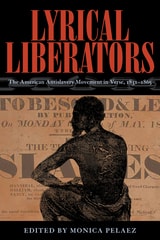
Lyrical Liberators
The American Antislavery Movement in Verse, 1831–1865Monica Pelaez
Ohio University Press, 2018
Before Black Lives Matter and Hamilton, there were abolitionist poets, who put pen to paper during an era when speaking out against slavery could mean risking your life. Indeed, William Lloyd Garrison was dragged through the streets by a Boston mob before a planned lecture, and publisher Elijah P. Lovejoy was fatally shot while defending his press from rioters. Since poetry formed a part of the cultural, political, and emotional lives of readers, it held remarkable persuasive power. Yet antislavery poems have been less studied than the activist editorials and novels of the time.
In Lyrical Liberators, Monica Pelaez draws on unprecedented archival research to recover these poems from the periodicals—Garrison’s Liberator, Frederick Douglass’s North Star, and six others—in which they originally appeared. The poems are arranged by theme over thirteen chapters, a number that represents the amendment that finally abolished slavery in 1865. The book collects and annotates works by critically acclaimed writers, commercially successful scribes, and minority voices including those of African Americans and women.
There is no other book like this. Sweeping in scope and passionate in its execution, Lyrical Liberators is indispensable for scholars and teachers of American literature and history, and stands as a testimony to the power of a free press in the face of injustice.