Results by title
131 books match the query 'Baseball' and 4 start with l
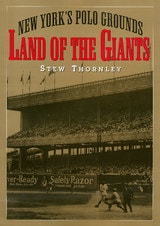
Land of the Giants
New York's Polo GroundsStewart Thornley
Temple University Press, 2000
The Polo Grounds was the home of the New York Giants from John McGraw and Christy Mathewson to Carl Hubbell and Mel Ott to Willie Mays and Leo Durocher. It was also home to the Yankees when Babe Ruth's home run production was soaring (which led to "the House that Ruth built") and home to the Mets in their painful early years.
From "Merkle's Boner," which cost the New York Giants a pennant, to Bobby Thomson's homer, which won them one, Stew Thornley retells the legendary events of the park and its legendary personalities. He reveals little-known facts too:
When the championship Giants and Yankees played in the 1921 and 1922 World Series, it
wasn't a "subway series," because the two teams shared the same ballpark.
The team Bays was playing for when he hit his firstd home run in the Polo Grounds was
not the Giants, but the Birmingham Black Barons. The Polo Grounds was also the site for
the Negro World Series games in 1946 and 1947.
Fans cherish not only the historic moments and team traditions of these stadiums, but treasure their physical peculiarities. Like the "Green Monster" at Fenway Park, the unusual horseshoe shape of the Polo Grounds made the park a special place to play. Stew Thornley analyzes the effect of the very short porches along the foul lines and of a cavernous center field on home run production and hitting in general.
Baseball wasn't the only sport played in the Polo Grounds. The footbal Giants played here from 1925 to 1955, but the stadium was better known for some of the great college games, including the 1924 Army-Notre Dame game in which the "Four Horsemen" of Notre Dame were christened. Numerous boxing title bouts were held at the Polo Grounds, and it also hosted tennis, rodeo, midget auto racing, outdoor opera, ice skating, and religious rallies.
Legal Bases
Baseball And The LawRoger Abrams
Temple University Press, 1998
But how does collective bargaining and labor arbitration work in the major leagues? Why is baseball exempt from the antitrust laws? In Legal Bases, Roger Abrams has assembled an all-star baseball law team whose stories illuminate the sometimes uproarious, sometimes ignominious relationship between law and baseball that has made the business of baseball a truly American institution.
Line Drives
100 Contemporary Baseball PoemsEdited by Brooke Horvath and Tim Wiles. Foreword by Elinor Nauen
Southern Illinois University Press, 2002
“We wait for baseball all winter long,” Bill Littlefield wrote in Boston Magazine a decade ago, “or rather, we remember it and anticipate it at the same time. We re-create what we have known and we imagine what we are going to do next. Maybe that’s what poets do, too.”
Poetry and baseball are occasions for well-put passion and expressive pondering, and just as passionate attention transforms the prose of everyday life into poetry, it also transforms this game we write about, play, or watch. Editors Brooke Horvath and Tim Wiles unite their own passion for baseball and poetry in this collection, Line Drives: 100 Contemporary Baseball Poems, providing a forum for ninety-two poets. Line after line, like baseball itself game after game and season after season, these poems manage to make the old and the familiar new and surprising.
The poems in these pages invite interrogation, and the reader—like the true baseball fan—must be willing to play the game, for these poems are fun, fresh, angry, nostalgic, meditative, and meant to be read aloud. They are keen on taking us deeply into baseball as sport and intent on offering countless metaphors for exploring history, religion, love, family, and self-identity. Each poem delivers images of pure beauty as the poets speak of murder and ghost runners and old ball gloves, of baseball as a tie that binds families—and indeed the nation—together, of the game as a stage upon which no-nonsense grit and skill are routinely displayed, and of the delight experienced in being one amid a mindlessly happy crowd. This book is true to the game’s long season and to the lives of those the game engages.
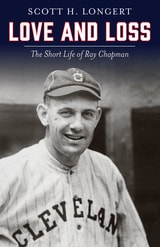
Love and Loss
The Short Life of Ray ChapmanScott H. Longert
Ohio University Press, 2024
The son of a coal miner from a small Illinois town, Cleveland Indians shortstop Ray Chapman lived the American dream until his untimely death at age twenty-nine. In his brief life, he reached the pinnacle of baseball success as the best shortstop in the American League. While many professional ballplayers struggled with meager salaries, the handsome Chapman had married heiress Kathleen Daly, one of Cleveland’s wealthiest women. With a child on the way and an executive job in the offseason, Chapman was moving toward a privileged place in society until an errant fastball fractured his skull and ended his life the next day. Late in the 1920 pennant race, the Indians were in New York for a key series against the Yankees. New York pitcher Carl Mays threw a high hard one that Chapman could not evade. He was taken to a nearby hospital, where doctors tried in vain to save his life. The tragedy did not end there. His widow took her own life eight years later, and their daughter, Rae, subsequently died from meningitis. Today, people visit Chapman’s impressive grave in Cleveland’s Lake View Cemetery, leaving baseballs and gloves in his memory. Though gone over a hundred years, he is well remembered as a Cleveland icon. This book goes far beyond the well-worn accounts of Chapman’s untimely death to illustrate the fullness of his short life.