69 books match the query 'Capital' and 6 start with l
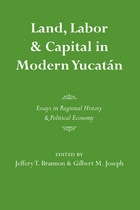
cover of Land, Labor, and Capital in Modern Yucatan: Essays in Regional History and Political Economy

Land, Labor, and Capital in Modern Yucatan

Essays in Regional History and Political Economy

Jeffrey T. Brannon

University of Alabama Press, 1991

Owing to Yucatan’s relative isolation, many assume that the history and economy of the peninsula have evolved in a distinctive way, apart from the central government in Mexico City and insulated from world social and economic factors. The essays in this volume suggest that this has not been the case: the process of development in Yucatan has been linked firmly to national and global forces of change over the past two centuries. The essays are by U.S., Mexican, Canadian, and Belizean social scientists representing both well-established and younger scholars. The result is a perspective on Yucatan’s historical development that is at once international, interdisciplinary, and intergenerational.

    In this volume, all of the contributors are genuinely comfortable with the theories and approaches of several disciplines—economics, history, and anthropology, and sociology. All have used largely untapped, primary, archival sources, and the result is a fascinating offering of new information.
[more]
cover of Law of Accumulation and Breakdown of the Capitalist System

Law of Accumulation and Breakdown of the Capitalist System

Henryk Grossmann

Pluto Press, 1992
[more]
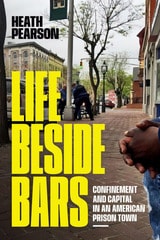
cover of Life beside Bars: Confinement and Capital in an American Prison Town

Life beside Bars

Confinement and Capital in an American Prison Town

Heath Pearson

Duke University Press, 2024
In Life beside Bars, Heath Pearson showcases dynamic, interdependent community as the best hope for undoing the systems of confinement that reproduce capital in Cumberland County, New Jersey—a place that is home to three state prisons, one federal prison, and the regional jail. Pearson places today’s prisons within the region’s longer history of Lenape genocide, chattel slavery, Japanese American labor camps, and other forms of racialized punishment and carceral control. From this vantage, prisons appear not as the structural fix for the region’s failed political economy but as a continuation of the carceral principle that has always sustained it. This ongoing use of confinement, though, is merely the backdrop. Through ethnographic vignettes written in story form, Pearson offers an alternative history of the unruly and unexpected ways that people resist, get by, make money, find joy, and build radical social life in the small, unseen spaces beside large-scale confinement. As such, Pearson enriches our understanding of daily life in and around prisons—in any American community—while providing a kaleidoscope of possibilities for theorizing and organizing alternative paths.
[more]
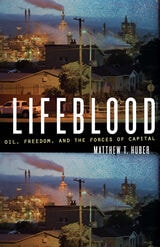
cover of Lifeblood: Oil, Freedom, and the Forces of Capital

Lifeblood

Oil, Freedom, and the Forces of Capital

Matthew T. Huber

University of Minnesota Press, 2013

If our oil addiction is so bad for us, why don’t we kick the habit? Looking beyond the usual culprits—Big Oil, petro-states, and the strategists of empire—Lifeblood finds a deeper and more complex explanation in everyday practices of oil consumption in American culture. Those practices, Matthew T. Huber suggests, have in fact been instrumental in shaping the broader cultural politics of American capitalism.

How did gasoline and countless other petroleum products become so central to our notions of the American way of life? Huber traces the answer from the 1930s through the oil shocks of the 1970s to our present predicament, revealing that oil’s role in defining popular culture extends far beyond material connections between oil, suburbia, and automobility. He shows how oil powered a cultural politics of entrepreneurial life—the very American idea that life itself is a product of individual entrepreneurial capacities. In so doing he uses oil to retell American political history from the triumph of New Deal liberalism to the rise of the New Right, from oil’s celebration as the lifeblood of postwar capitalism to increasing anxieties over oil addiction.

Lifeblood rethinks debates surrounding energy and capitalism, neoliberalism and nature, and the importance of suburbanization in the rightward shift in American politics. Today, Huber tells us, as crises attributable to oil intensify, a populist clamoring for cheap energy has less to do with American excess than with the eroding conditions of life under neoliberalism.
[more]
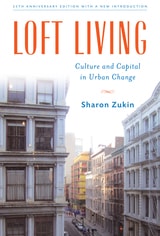
cover of Loft Living: Culture and Capital in Urban Change

Loft Living

Culture and Capital in Urban Change

Zukin, Sharon

Rutgers University Press, 2014

Since its initial publication, Loft Living has become the classic analysis of the emergence of artists as a force of gentrification and the related rise of “creative city” policies around the world.  This 25th anniversary edition, with a new introduction, illustrates how loft living has spread around the world and that artists’ districts—trailing the success of SoHo in New York—have become a global tourist attraction. Sharon Zukin reveals the economic shifts and cultural transformations that brought widespread attention to artists as lifestyle models and agents of urban change, and explains their role in attracting investors and developers to the derelict loft districts where they made their home.

Prescient and dramatic, Loft Living shows how a declining downtown Manhattan became a popular “scene,” how loft apartments became hot commodities for the middle class, and how investors, corporations, and rich elites profited from deindustrializing the city’s factory districts and turning them into trendy venues for art galleries, artisanal restaurants, and bars. However, this edition points out that the artists who led the trend are now priced out of the loft market.  Even in New York, where the loft living market was born, artists have no legal claim on loft districts, nor do they get any preferential treatment in the harsh real estate market.

From the story of SoHo in Lower Manhattan to SoWa in Boston and SoMa in San Francisco, Zukin explains how once-edgy districts are transformed into high-price neighborhoods, and how no city can restrain the juggernaut of rising property values.
[more]
cover of Loft Living: Culture and Capital in Urban Change

Loft Living

Culture and Capital in Urban Change

Zukin, Sharon

Rutgers University Press, 1989

.
[more]