Results by title
501 books match the query 'Catholic Church' and 8 start with l
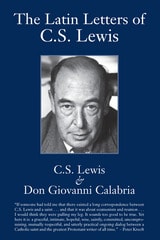
Latin Letters of C.S. Lewis
C.S. Lewis and Don Giovanni Calabria
St. Augustine's Press, 1999
[more]
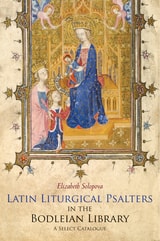
Latin Liturgical Psalters in the Bodleian Library
A Select CatalogueElizabeth Solopova
Bodleian Library Publishing, 2013
Liturgical psalters are among the most important—and beautifully illustrated— of medieval Christian books. In their simplest form, psalters included 150 psalms, preceded by a calendar and followed by canticles, or biblical texts, meant to be sung at church services. Though this core content remained relatively unchanged throughout the Middle Ages and across countries, psalters show considerable variation in size, style of presentation, and choice of supplementary texts.
Latin Liturgical Psalters in the Bodleian Library describes more than one hundred psalters from Britain, France, the Netherlands, Germany, Austria, Italy, and Spain, ranging from the ninth to the sixteenth century and reflecting a wide range of requirements and interests. Each entry includes a description of the psalter’s contents, physical makeup, and provenance, alongside full-color images of pages, a bibliography, and tables to assist in the study of illumination and the liturgical use of psalms.
Bringing together important information on a stunning selection of little-known manuscripts held by the Bodleian Library, this volume will prove a valuable resource.
[more]
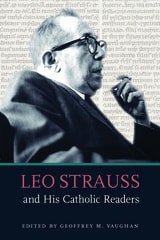
Leo Strauss and His Catholic Readers
Geoffrey M. Vaughan
Catholic University of America Press, 2018
This book looks at the work and influence of Leo Strauss in a variety of ways that will be of interest to readers of political philosophy. It will be of particular interest to Catholics and scholars of other religious traditions. Strauss had a great deal of interaction with his contemporary Catholic scholars, and many of his students or their students teach or have taught at Catholic colleges and universities in America. Leo Strauss and His Catholic Readers brings together work by scholars from two continents, some of whom knew Strauss, one of whom was his student at the University of Chicago. The first section of essays considers Catholic responses to Strauss’s project of recovering Classical natural right as against modern individual rights. Some of the authors suggest that his approach can be a fruitful corrective to an uncritical reception of modern ideas. Nevertheless, most point out that the Catholic cannot accept all of Strauss’s project. The second section deals with areas of overlap between Strauss and Catholics. Some of the chapters explore encounters with his contemporary scholars while others turn to more current concerns. The final section approaches the theological-political question itself, a question central to both Strauss’s work and that of the Catholic intellectual tradition. This section of the book considers the relationship of Strauss’s work to Christianity and Christian commitments at a broader level. Because Christianity does not have an explicit political doctrine, Christians have found themselves as rulers, subjects, and citizens in a variety of political regimes. Leo Strauss’s return to Platonic political philosophy can provide a useful lens through which his Catholic readers can assess what it means for there to be a best regime.
[more]
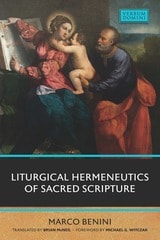
Liturgical Hermeneutics of Sacred Scripture
Marco Benini
Catholic University of America Press, 2023
The purpose of this book is to explore what a liturgical approach to the Bible looks like and what hermeneutical implications this might have: How does the liturgy celebrate, understand, and communicate Scripture? The starting point is Pope Benedict's affirmation that “a faith-filled understanding of sacred Scripture must always refer back to the liturgy” (Verbum Domini 52).
The first part of the book (based on SC 24) provides significant examples to demonstrate: The liturgical order of readings intertextually combines Old Testament and New Testament readings using manifold hermeneutical principles, specifically how the psalms show the wide range of interpretations the liturgy employs. Prayers are biblically inspired and help to appropriate Scripture personally. The hymns convey Scripture in a poetic way. Signs and actions such as foot-washing or the Ephphetha rite enact Scripture. The study considers the Mass, the sacraments and the Liturgy of the Hours.
In the second part, Benini systematically focuses on the various dimensions of liturgical hermeneutics of the Bible, which emerge from the first part. The study reflects the approaches the liturgy offers to Scripture and its liturgical reception. It explores theological aspects such as the unity of the two Testaments in Christ’s paschal mystery or the anamnesis as a central category in both Scripture and liturgy. The liturgy does not understand Scripture primarily as a document of the past, but celebrates it as a current and living “Word of the Lord,” as a medium of encounter with God: Scripture is sacramental.
Liturgical Hermeneutics of Sacred Scripture seeks to contribute not only to the comparison of the Roman, Ambrosian, and Byzantine Rite regarding the Word of God, but most of all to the overall “liturgical approach” to Scripture. As such, it promotes an interdisciplinary dialogue of liturgical and biblical studies.
[more]
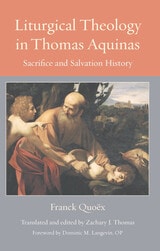
Liturgical Theology in Thomas Aquinas
Sacrifice and Salvation HistoryFranck Quoex
Catholic University of America Press, 2023
In this volume, Fr. Franck Quoëx responds to Joseph Ratzinger’s call for a renewed appreciation of liturgical rite. A student of Pierre Gy, OP, he brings to this study of Aquinas’s liturgical theology a rare combination of expert knowledge of liturgical sources and history and the best of modern historical-critical research guided by sound theological judgment. Fr. Quoëx frames his study with an overview of the problem of rite in modern theological-anthropological discourse, before turning to Aquinas’ theory of worship in the treatise on the virtue of religion. He then explores Aquinas’ doctrine on the cultic dimensions of the Eucharist and other sacraments in his sacramental theology more broadly, finishing with a close study of the mass commentary of the Tertia Pars.
Although there has been increasing attention to Thomas’s treatment of religion as a virtue, none have approached him from an anthropological angle with a focus on the nature of liturgical rite, or fully exploited the perspectives of liturgical scholarship to shed light on sacramental theology. Quoëx’s work, as the work of a Thomist, liturgist, and medievalist well versed in medieval liturgical development and in the genre of often-allegorical liturgical commentary, opens up this crucial but neglected facet of Aquinas’ theological synthesis. Few books have been published on Aquinas’s liturgical theology. Now that interest in Aquinas’s virtue theory and sacramental theology is growing rapidly, Quoëx’s studies are an invitation to further reflection on the topic of Aquinas’s liturgical theology with its manifold ramifications for and connections with other theological topics in his Summa, including his theological anthropology, his soteriology, his treatment of the Old and New Laws, and his account of the virtue of religion in connection with the other virtues.
[more]
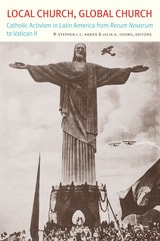
Local Church, Global Church
Stephen J.C. Andes
Catholic University of America Press, 2016
This important volume investigates the many forms of Catholic activism in Latin America between the 1890s and 1962 (from the publication of the papal encyclical Rerum Novarum to the years just prior to the Second Vatican Council). It argues that this period saw a variety of lay and clerical responses to the social changes wrought by industrialization, political upheavals and mass movements, and increasing secularization. Spurred by these local developments as well as by initiatives from the Vatican, and galvanized by national projects of secular state-building, Catholic activists across Latin America developed new ways of organizing in order to effect social and political change within their communities.
[more]
Logos and Revelation
Ibn 'Arabi, Meister Eckhart, and Mystical HermeneuticsRobert J. Dobie
Catholic University of America Press, 2010
Logos and Revelation looks closely at the writings of two of the most prominent medieval mystical writers: the Muslim, Ibn 'Arabi (1165-1240) and the Christian Meister Eckhart (1260-1328).
[more]
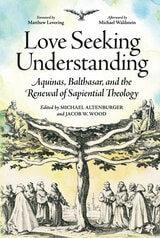
Love Seeking Understanding
Aquinas, Balthasar, and the Renewal of Sapiential TheologyMichael Altenburger
Catholic University of America Press, 2024
As Catholic theology emerged from the crisis of modernity, theologians turned to both patristic and medieval sources to recover lost wisdom from the theological tradition, and adapt it to the challenges of an age that separated reason from faith, the practice of theology from the spiritual life. . In time, Thomas Aquinas and Hans Urs von Balthasar became the patrons of two very different approaches to this challenge. St. Thomas Aquinas offering contemporary theologians an approach rooted in the patristic-medieval Latin synthesis of Augustine and Aristotle that also draws on the East, and von Balthasar offering contemporary theologians a patristic-modern approach rooted in the Eastern theological synthesis of Maximus the Confessor and Erich Przywara, that also draws on the West. Although Aquinas and Balthasar, together with their contemporary followers, sought to unite reason and faith, theology and prayer, contemporary Thomists and Balthasarians have tended to diverge widely from one another, often with a polemical spirit. How should one understand the theological genius of St. Thomas Aquinas and Hans Urs von Balthasar today? How can two of the greatest theologians in the Catholic tradition be brought together in more fruitful and peaceful dialogue?
This edited volume comprises contributions from a range of scholars who elucidate the depth and breadth of two of the most prominent figures of the Catholic tradition today. A scholar from each school of thought contributes an essay on a particular theme: Metaphysics, Trinity, Revelation, Christology, Anthropology, Evil, and Eschatology. By presenting the two essays side by side, this volume provides the contemporary reader with an opportunity to better engage both thinkers and understand disagreements and areas for constructive movement forward. The tone of the volume is intentionally irenic, seeking points of constructive dialogue, and opening new pathways to the renewal of sapiential theology through a fruitful synthesis of Thomistic and Balthasarian thought.
[more]