Results by title
99 books match the query 'Censorship' and 3 start with l
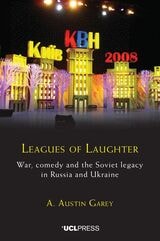
Leagues of Laughter
War, Comedy and the Soviet Legacy in Russia and UkraineA. Austin Garey
University College London, 2025
An exploration of how comedy has shaped civil society—and become a form of subtle political resistance—in post-Soviet Russia and Ukraine.
Leagues of Laughter traces the evolution of a Soviet-created youth game called KVN (Klub veselykh i nakhodchivykh or Club of the Cheerful and Clever) over sixty years as students’ nation-states collapsed, competed, and eventually went to war. Through cross-border narratives, the book shows how humor persists—and transforms—amid authoritarianism, censorship, and conflict. With insight and compassion, author A. Austin Garey reveals how laughter became a mode of resistance, identity, and cultural continuity in the long cultural context of the war in Ukraine. In addition to introducing a novel theory of “tradition as stance” to explain how traditions are reproduced and reinterpreted over time, the book offers a compelling comparative analysis of cultural production under political pressure.
Leagues of Laughter traces the evolution of a Soviet-created youth game called KVN (Klub veselykh i nakhodchivykh or Club of the Cheerful and Clever) over sixty years as students’ nation-states collapsed, competed, and eventually went to war. Through cross-border narratives, the book shows how humor persists—and transforms—amid authoritarianism, censorship, and conflict. With insight and compassion, author A. Austin Garey reveals how laughter became a mode of resistance, identity, and cultural continuity in the long cultural context of the war in Ukraine. In addition to introducing a novel theory of “tradition as stance” to explain how traditions are reproduced and reinterpreted over time, the book offers a compelling comparative analysis of cultural production under political pressure.
[more]
Letter to Beaumont, Letters Written from the Mountain, and Related Writings
Jean-Jacques Rousseau
Dartmouth College Press, 2012
Published between 1762 and 1765, these writings are the last works Rousseau wrote for publication during his lifetime. Responding in each to the censorship and burning of Emile and Social Contract, Rousseau airs his views on censorship, religion, and the relation between theory and practice in politics. The Letter to Beaumont is a response to a Pastoral Letter by Christophe de Beaumont, Archbishop of Paris (also included in this volume), which attacks the religious teaching in Emile. Rousseau’s response concerns the general theme of the relation between reason and revelation and contains his most explicit and boldest discussions of the Christian doctrines of creation, miracles, and original sin. In Letters Written from the Mountain, a response to the political crisis in Rousseau’s homeland of Geneva caused by a dispute over the burning of his works, Rousseau extends his discussion of Christianity and shows how the political principles of the Social Contract can be applied to a concrete constitutional crisis. One of his most important statements on the relation between political philosophy and political practice, it is accompanied by a fragmentary “History of the Government of Geneva.” Finally, “Vision of Peter of the Mountain, Called the Seer” is a humorous response to a resident of Motiers who had been inciting attacks on Rousseau during his exile there. Taking the form of a scriptural account of a vision, it is one of the rare examples of satire from Rousseau’s pen and the only work he published anonymously after his decision in the early 1750s to put his name on all his published works. Within its satirical form, the “Vision” contains Rousseau’s last public reflections on religious issues. Neither the Letter to Beaumont nor the Letters Written from the Mountain has been translated into English since defective translations that appeared shortly after their appearance in French. These are the first translations of both the “History” and the “Vision.”
[more]
Liberal Democracy and the Limits of Tolerance
Essays in Honor and Memory of Yitzhak RabinRaphael Cohen-Almagor, Editor
University of Michigan Press, 2000
An irony inherent in all political systems is that the principles that underlie and characterize them can also endanger and destroy them. This collection examines the limits that need to be imposed on democracy, liberty, and tolerance in order to ensure the survival of the societies that cherish them. The essays in this volume consider the philosophical difficulties inherent in the concepts of liberty and tolerance; at the same time, they ponder practical problems arising from the tensions between the forces of democracy and the destructive elements that take advantage of liberty to bring harm that undermines democracy.
Written in the wake of the assasination of Yitzhak Rabin, this volume is thus dedicated to the question of boundaries: how should democracies cope with antidemocratic forces that challenge its system? How should we respond to threats that undermine democracy and at the same time retain our values and maintain our commitment to democracy and to its underlying values?
All the essays here share a belief in the urgency of the need to tackle and find adequate answers to radicalism and political extremism. They cover such topics as the dilemmas embodied in the notion of tolerance, including the cost and regulation of free speech; incitement as distinct from advocacy; the challenge of religious extremism to liberal democracy; the problematics of hate speech; free communication, freedom of the media, and especially the relationships between media and terrorism.
The contributors to this volume are David E. Boeyink, Harvey Chisick, Irwin Cotler, David Feldman, Owen Fiss, David Goldberg, J. Michael Jaffe, Edmund B. Lambeth, Sam Lehman-Wilzig, Joseph Eliot Magnet, Richard Moon, Frederick Schauer, and L.W. Sumner. The volume includes the opening remarks of Mrs.Yitzhak Rabin to the conference--dedicated to the late Yitzhak Rabin--at which these papers were originally presented. These studies will appeal to politicians, sociologists, media educators and professionals, jurists and lawyers, as well as the general public.
[more]