Results by title
27 books match the query 'Shipwrecks'
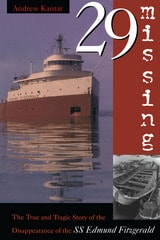
29 Missing
The True and Tragic Story of the Disappearance of the SS Edmund FitzgeraldAndrew Kantar
Michigan State University Press, 1998
On November 10, 1975, SS Edmund Fitzgerald, a giant freighter, sank with its entire crew of 29 aboard, in one of the most violent storms ever witnessed on Lake Superior. In 29 Missing, Kantar tells the "Fitz's" story from the christening in 1958 as the largest ship on the Great Lakes to the expedition in 1995 to recover the ship's bell in what proved to be a moving memorial to the lost crew. Using information from government investigative reports, the book provides a dramatic hour-by-hour account of what transpired during that terrible voyage, including dialogue from actual radio transmissions between the Fitzgerald and the Arthur Anderson, the freighter that followed behind the Fitz.
In his passionate retelling of the story, designed primarily for young adults, Kantar provides the facts leading up to the disappearance, detailing the subsequent expeditions to the wreck site as well as the leading theories about the sinking that have been debated by maritime experts.
A History of the World in Sixteen Shipwrecks
Stewart Gordon
University Press of New England, 2017
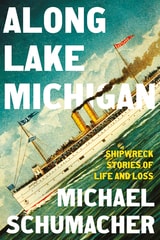
Along Lake Michigan
Shipwreck Stories of Life and LossMichael Schumacher
University of Minnesota Press, 2025
Notable shipwrecks of Lake Michigan throughout a century of enterprise, industry, heroism, and disaster on the Great Lakes
The Great Lakes are graveyards of a vast number of shipwrecks (30,000 by some estimates), and Lake Michigan has more than the other four lakes combined. The stories of those wrecks tell the history of that mighty lake in its endless, mercurial challenge to human endeavor.
Surveying the wreckage throughout the decades, from the fiery end of the twin propeller–driven Phoenix in 1847 to the failure of the Anna Minch to outrun the infamous 1940 Armistice Day storm, Michael Schumacher charts the course of shipping disasters great and small on Lake Michigan. He illuminates the details of maritime weather and shipcraft, the lives devoted to and lost on the water, and the mistakes and monumental failures that led to these ships’ watery ends.
Schumacher’s deft storytelling, drawing from deep research and comprehensive knowledge, brings forth the vivid details of the last minutes of these doomed ships, along with the circumstances surrounding their voyages. Here are tragic tales like that of the Eastland, the deadliest shipwreck in Great Lakes history, lost while docked in the Chicago River; the Rouse Simmons, a wooden schooner loaded with Christmas trees; the train ferry Milwaukee and the Wisconsin, a package freighter, gone within one week of each other in October 1929; and the passenger vessel the Lady Elgin, a devastating loss met with incredible heroism.
Liberally illustrated with historical photographs, the stories of these shipwrecks, spanning a full century of commercial traffic on Lake Michigan, document the myriad forms of bravery and misfortune that mark our encounters with the Great Lakes.
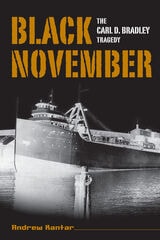
Black November
The Carl D. Bradley TragedyAndrew Kantar
Michigan State University Press, 2006
Michigan’s "storms of November" are famous in song, lore, and legend and have taken a tragic toll, breaking the hulls of many ships and sending them to cold, dark, and silent graves on the bottoms of the Great Lakes. On November 18, 1958, when the limestone carrier Carl D. Bradley broke up during a raging storm on Lake Michigan, it became the largest ship in Great Lakes' history to vanish beneath storm-tossed waves. Along with the Bradley, thirty-three crew members perished. Most of the casualties hailed from the little harbor town of Rogers City, Michigan, a community that was stung with grief when, in an instant, twenty-three women became widows and fifty- three children were left fatherless. Nevertheless, this is also a story of survival, as it recounts the tale of two of the ship’s crew, whose fifteen-hour ordeal on a life raft, in gale-force winds and 25 foot waves, is a remarkable story of endurance and tenacity.
Written in a style that is equally appealing to young adults and adult readers, Black November is a tale of adventure, courage, heroism, and tragedy. Kantar, the author of 29 Missing, a book about the loss of the great lakes freighter the Edmund Fitzgerald, has once again crafted a dramatic narrative that is both informative and compelling. Although the Carl D. Bradley has been called "the ship that time forgot," Black November recalls that tragic day nearly fifty years ago and is a moving tribute to the ship and its crew.
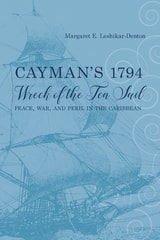
Cayman's 1794 Wreck of the Ten Sail
Peace, War, and Peril in the CaribbeanMargaret E. Leshikar-Denton
University of Alabama Press, 2020
The story has been passed through generations for more than two centuries. Details vary depending on who is doing the telling, but all refer to this momentous maritime event as the Wreck of the Ten Sail. Sometimes misunderstood as the loss of a single ship, it was in fact the wreck of ten vessels at once, comprising one of the most dramatic maritime disasters in all of Caribbean naval history. Surviving historical documents and the remains of the wrecked ships in the sea confirm that the narrative is more than folklore. It is a legend based on a historical event in which HMS Convert, formerly L’Inconstante, a recent prize from the French, and 9 of her 58-ship merchant convoy sailing from Jamaica to Britain, wrecked on the jagged eastern reefs of Grand Cayman in 1794.
The incident has historical significance far beyond the boundaries of the Cayman Islands. It is tied to British and French history during the French Revolution, when these and other European nations were competing for military and commercial dominance around the globe. The Wreck of the Ten Sail attests to the worldwide distribution of European war and trade at the close of the eighteenth century.
In Cayman’s 1794 Wreck of the Ten Sail: Peace, War, and Peril in the Caribbean, Margaret E. Leshikar-Denton focuses on the ships, the people, and the wreck itself to define their place in Caymanian, Caribbean, and European history. This well-researched volume weaves together rich oral folklore accounts, invaluable supporting documents found in archives in the United Kingdom, Jamaica, and France, and tangible evidence of the disaster from archaeological sites on the reefs of the East End.
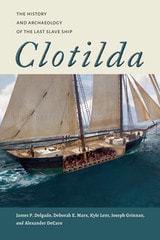
Clotilda
The History and Archaeology of the Last Slave ShipJames P. Delgado, Deborah E. Marx, Kyle Lent, Joseph Grinnan, and Alexander DeCaro
University of Alabama Press, 2023
Documents the maritime historical research and archaeological fieldwork used to identify the wreck of the notorious schooner Clotilda
Clotilda: The History and Archaeology of the Last Slave Ship is the first definitive work to examine the maritime historical and archaeological record of one of the most infamous ships in American history. Clotilda was owned by Alabama businessman Timothy Meaher, who, on a dare, equipped it to carry captured Africans from what is now Benin and bring them to Alabama in 1860—some fifty years after the import of captives to be enslaved was banned. To hide the evidence, Clotilda was set afire and sunk.
What remained was a substantially intact, submerged, and partially buried shipwreck located in a backwater of the Mobile River. The site of the wreck was an open secret to some people who knew Meaher, but its identity remained unknown for more than a century as various surveys through the years failed to locate the ship.
This volume, authored by the archaeological team who conducted a comprehensive, systematic survey of a forgotten “ship graveyard,” details the exhaustive forensic work that conclusively identified the wreck, as well as the stories and secrets that have emerged from the partly burned hulk. James P. Delgado and his coauthors discuss the various searches for Clotilda, sharing the forensic data and other analyses showing how those involved concluded that this wreck was indeed Clotilda. Additionally, they offer physical evidence not previously shared that situates the schooner and its voyage in a larger context of the slave trade.
Clotilda: The History and Archaeology of the Last Slave Ship serves as a nautical biography of the ship as well. After reviewing the maritime trade in and out of Mobile Bay, this account places Clotilda within the larger landscape of American and Gulf of Mexico schooners and chronicles its career before being used as a slave ship. All of its voyages had a link to slavery, and one may have been another smuggling voyage in violation of federal law. The authors have also painstakingly reconstructed Clotilda’s likely appearance and characteristics.
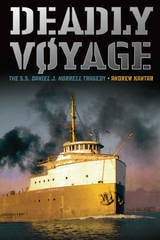
Deadly Voyage
The S.S. Daniel J. Morrell TragedyAndrew Kantar
Michigan State University Press, 2009
This is the harrowing story of one of the worst shipwrecks in Great Lakes history. In the early morning hours of November 29, 1966, the S.S. Daniel J. Morrell was caught in a deadly storm on Lake Huron. Waves higher than the ship crested over it, and winds exceeding sixty miles per hour whipped at its hull, splitting the 603-foot freighter into two giant pieces. Amazingly, after the bow went down, the stern blindly powered itself through the stormy seas for another five miles! Twenty-eight men drowned in the icy waters of Lake Huron, but one sailor—26-year-old Dennis Hale—miraculously survived the treacherous storm. Wearing only boxer shorts, a lifejacket, and a pea coat, Hale clung to a life raft in near-freezing temperatures for 38 hours until he was rescued late in the afternoon of the following day. Three of his fellow crewmates died in his raft.
In Deadly Voyage, Andrew Kantar recounts this tale of tragedy and triumph on Lake Huron. Informed by meticulous research and the eyewitness details provided by Hale, and illustrated with photographs from the Coast Guard search and rescue operation, Kantar depicts one of the most tragic shipwrecks in Great Lakes history.
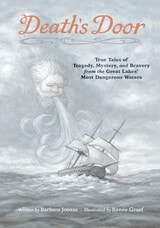
Death's Door
True Tales of Tragedy, Mystery, and Bravery from the Great Lakes' Most Dangerous WatersBarbara Joosse
Wisconsin Historical Society Press, 2023
This beautifully illustrated book for children ages 8–11 relates dramatic moments from Great Lakes maritime history in a graphic-novel style. The book’s five true stories span four centuries but take place in one location: a dangerous stretch of water near Lake Michigan’s western shore that is known as “Death’s Door.”
Young readers will devour these tales of tragic accidents, mysterious disappearances, and heroic moments. The stories feature a 17th-century fur trading crew, an 18th-century Potawatomi trading party, a mail carrier and a shipbuilding family from the 19th century, and an early 20th-century basketball team. The narrator is Death’s Door itself, who wonders why people insist on crossing its treacherous waters, concluding it is “because they are human. Ambitious and restless…but loving too.”
An informative afterword provides insight into the author’s sources and features archival images and additional historical details about each of the stories.
Silver winner of the 2023 Midwest Book Award for Graphic Novels
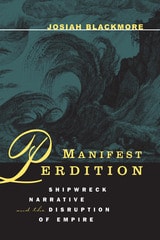
Manifest Perdition
Shipwreck Narrative And The Disruption Of EmpireJosiah Blackmore
University of Minnesota Press, 2002
A new take on a famous collection of shipwreck narratives that places them at the center of resistance to colonialism
Shipwreck, death, and survival; terror, hunger, and salvation—these are the experiences of the passengers onboard merchant Portuguese ships sailing the high seas in the sixteenth and seventeenth centuries. And this is the stuff of the stories committed to print by survivors upon their return to the homeland. These Portuguese shipwreck narratives, rescued for all time in the eighteenth century by Bernardo Gomes de Brito in História Trágico-Marítima (1735-36), or The Tragic History of the Sea, are the subject of Manifest Perdition, a work that reveals their important—and until now, largely ignored—place in literary history.
In this book we see how the dramatic, compelling, and often gory accounts of shipwreck, depicting a world out of control, challenge state-sponsored versions of events in the prevailing historiographic culture. Written during the heyday of Iberian maritime expansion and colonialism, the shipwreck narrative builds an alternative historical record to the vision and reality of empire elaborated by the official chroniclers of the realm. Manifest Perdition presents both theoretical considerations this genre and close readings of several texts, readings that disclose a poetics of the shipwreck text, of how survivors characteristically yet multifariously narrated their world. Included is a study of the medieval Iberian poetic predecessors of the shipwreck tale, as well as an exploration of the Portuguese Inquisition’s attempt to commandeer and steer the reading of the unruly narratives. The book engages issues of literary theory, historiography, and colonialism to portray the Portuguese shipwreck narrative for the first time as both a product of and a resistance to the prolific culture of sixteenth- and seventeenth-century expansionist history.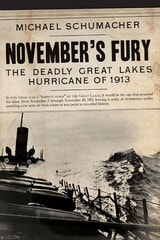
November's Fury
The Deadly Great Lakes Hurricane of 1913Michael Schumacher
University of Minnesota Press, 2014
On Thursday, November 6, the Detroit News forecasted “moderate to brisk” winds for the Great Lakes. On Friday, the Port Huron Times-Herald predicted a “moderately severe” storm. Hourly the warnings became more and more dire. Weather forecasting was in its infancy, however, and radio communication was not much better; by the time it became clear that a freshwater hurricane of epic proportions was developing, the storm was well on its way to becoming the deadliest in Great Lakes maritime history.
The ultimate story of man versus nature, November’s Fury recounts the dramatic events that unfolded over those four days in 1913, as captains eager—or at times forced—to finish the season tried to outrun the massive storm that sank, stranded, or demolished dozens of boats and claimed the lives of more than 250 sailors. This is an account of incredible seamanship under impossible conditions, of inexplicable blunders, heroic rescue efforts, and the sad aftermath of recovering bodies washed ashore and paying tribute to those lost at sea. It is a tragedy made all the more real by the voices of men—now long deceased—who sailed through and survived the storm, and by a remarkable array of photographs documenting the phenomenal damage this not-so-perfect storm wreaked.
The consummate storyteller of Great Lakes lore, Michael Schumacher at long last brings this violent storm to terrifying life, from its first stirrings through its slow-mounting destructive fury to its profound aftereffects, many still felt to this day.
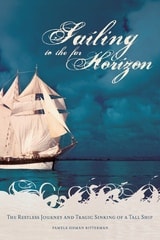
Sailing to the Far Horizon
The Restless Journey and Tragic Sinking of a Tall ShipPamela Sisman Bitterman
University of Wisconsin Press, 2004
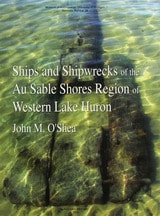
Ships and Shipwrecks of the Au Sable Shores Region of Western Lake Huron
John M. O'Shea
University of Michigan Press, 2004
Ships and Shipwrecks
Stories from the Great LakesRichard Gebhart
Michigan State University Press, 2022
Sinking of the Princess Sophia
Taking the North Down with HerKen Coates and Bill Morrison
University of Alaska Press, 1991
On October 23, 1918, a storm rose and the Canadian Pacific steamer Princess Sophia ran aground on Vanderbilt Reef, northwest of Juneau, Alaska. Tragically, there were no survivors. The 353 aboard represented a significant cross-section of the population of the Yukon and Alaska, and their loss was a heavy blow to a society that, with the end of the gold rush, was already in decline. This book tells the dramatic stories of many of the passengers, how they had gone to the north, what they did there, and why they were leaving that fall, and sheds light on a little-known aspect of Alaska's history.
Stories from the Wreckage
A Great Lakes Maritime History Inspired by ShipwrecksJohn Odin Jensen
Wisconsin Historical Society Press, 2019
Surviving the Essex
The Afterlife of America's Most Storied ShipwreckDavid O. Dowling
University Press of New England, 2016

The Cedarville Conspiracy
Indicting U.S. SteelL. Stephen Cox
University of Michigan Press, 2005
The Cedarville Conspiracy is the story of that doomed ship and its crew. It is also the first Great Lakes history to expose the heroism, villainy, courage, and confusion surrounding the Cedarville disaster.
In atmospheric, cinematic style, L. Stephen Cox's gripping page-turner dramatizes the events surrounding the collision between the Norwegian and American freighters. As the mortally wounded Cedarville began to list and sink, U.S. Steel refused to allow the crew to escape to safety, while the captain secretly donned his life jacket and abandoned the sinking ship. Ten seamen died in the frigid waters that morning as the captain and survivors swam to safety.
Researching the story, author L. Stephen Cox interviewed the surviving crew and their rescuers and attorneys, examined more than 20,000 pages of Coast Guard reports, and discovered deposition transcripts and other documentary evidence that detailed the deterioration of the ship, the captain's disregard of Great Lakes navigational rules, the company's participation in the decision to confine the men aboard the sinking vessel, and the subsequent efforts by U.S. Steel to manipulate the evidence.
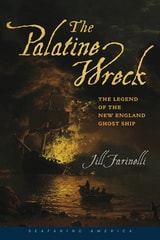
The Palatine Wreck
The Legend of the New England Ghost ShipJill Farinelli
University Press of New England, 2017
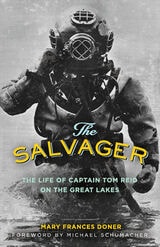
The Salvager
The Life of Captain Tom Reid on the Great LakesMary Frances Doner
University of Minnesota Press, 2017
First published in 1958, The Salvager is both a narrative history of Great Lakes shipping disasters of 1880–1950 and the life story of Captain Thomas Reid, who operated one of the region’s largest salvaging companies during that era.
The treacherous shoals, unpredictable storms, and sub-zero temperatures of the Great Lakes have always posed special hazards to mariners—particularly before the advent of modern navigational technologies—and offered ample opportunity for an enterprising sailor to build a salvage business up from nothing. Designing much of his equipment himself and honing a keen eye for the risks and rewards of various catastrophes, Captain Reid rose from humble beginnings and developed salvaging into a science. Using the actual records of the Reid Wrecking and Towing Company as well as Reid’s personal logs and letters, Mary Frances Doner deftly tells the stories not only of the maritime disasters and the wrecking adventures that followed, but also of those waiting back on shore for their loved ones to return.

The Unforgiving Coast
Maritime Disasters of the Pacific NorthwestDavid Grover
Oregon State University Press, 2002
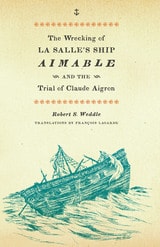
The Wrecking of La Salle's Ship Aimable and the Trial of Claude Aigron
By Robert S. Weddle
University of Texas Press, 2009
When Robert Cavelier, sieur de La Salle, landed on the Texas coast in 1685, bent on founding a French colony, his enterprise was doomed to failure. Not only was he hundreds of miles from his intended landfall—the mouth of the Mississippi—but his supply ship, Aimable, was wrecked at the mouth of Matagorda Bay, leaving the colonists with scant provisions and little protection against local Indian tribes. In anger and disgust, he struck out at the ship's captain, Claude Aigron, accusing him of wrecking the vessel purposely and maliciously.
Captain Aigron and his crew escaped the doomed colony by returning to France on the warship that had escorted the expedition on its ocean crossing. Soon after reaching France, Aigron found himself defendant in a civil suit filed by two of his officers seeking recompense for lost salary and personal effects, and then imprisoned on order of King Louis XIV while La Salle's more serious accusations were being investigated.
In this book, Robert Weddle meticulously recounts, through court documents, the known history of Aigron and the Aimable, and finds that despite La Salle's fervent accusations, the facts of the case offer no clear indictment. The court documents, deftly translated by François Lagarde, reveal Captain Aigron's successful defense and illuminate the circumstances of the wreck with Aigron's testimony. Much is also revealed about the French legal system and how the sea laws of the period were applied through the French government's L'Ordonnance de la Marine.

Too Much Sea for Their Decks
Shipwrecks of Minnesota's North Shore and Isle RoyaleMichael Schumacher
University of Minnesota Press, 2023
Shipwreck stories from along Minnesota’s north shore of Lake Superior and Isle Royale
Against the backdrop of the extraordinary history of Great Lakes shipping, Too Much Sea for Their Decks chronicles shipwrecked schooners, wooden freighters, early steel-hulled steamers, whalebacks, and bulk carriers—some well-known, some unknown or forgotten—all lost in the frigid waters of Lake Superior.
Included are compelling accounts of vessels destined for infamy, such as that of the Stranger, a slender wooden schooner swallowed by the lake in 1875, the sailors’ bodies never recovered nor the wreckage ever found; an account of the whaleback Wilson, rammed by a large commercial freighter in broad daylight and in calm seas, sinking before many on board could escape; and the mysterious loss of the Kamloops, a package freighter that went down in a storm and whose sailors were found on the Isle Royale the following spring, having escaped the wreck only to die of exposure on the island. Then there is the ill-fated Steinbrenner, plagued by bad luck from the time of her construction, when she was nearly destroyed by fire, to her eventual (and tragic) sinking in 1953. These tales and more represent loss of life and property—and are haunting stories of brave and heroic crews.
Arranged chronologically and presented in three sections covering Minnesota's North Shore, Isle Royale, and the three biggest storms in Minnesota’s Great Lakes history (the 1905 Mataafa storm, the 1913 hurricane on the lakes, and the 1940 Armistice Day storm), each shipwreck documented within these pages provides a piece to the history of shipping on Lake Superior.
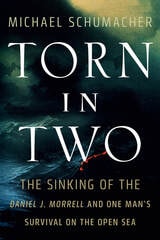
Torn in Two
The Sinking of the Daniel J. Morrell and One Man's Survival on the Open SeaMichael Schumacher
University of Minnesota Press, 2018
Dennis Hale reached the dock just in time to see the Daniel J. Morrell heading out to open waters, a 600-foot freighter that had plied the waters for sixty years, carrying ore from Minnesota’s Iron Range to steel firms around the Great Lakes. The twenty-six-year-old watchman had, quite literally, missed the boat—which meant scrambling to rejoin the Morrell at its next stop or forfeiting a good chunk of his pay package. Seventy-two hours later, Hale would find himself clinging to a life raft alongside the frozen bodies of his crewmates in the violent waves of Lake Huron. The boat would not be reported missing for another twenty-seven hours and by the time the life raft was found, Dennis Hale would remain as the sole survivor of the wreck of the Daniel J. Morrell.
This is life-and-death drama on the inland sea as only Michael Schumacher can tell it. In Torn in Two the great Lakes historian recreates the circumstances surrounding the terrible storm of November 29, 1966, that broke the mighty freighter in half, sending twenty-five of the Morrell’s twenty-nine-man crew to their deaths and consigning the surviving four to the freezing raft where all but Hale would perish. At the heart of Torn in Two are the terrible hours spent by Hale on the life raft with his crewmen, clinging to life for thirty-eight hours in freezing temperatures and wearing only a peacoat, life jacket, and boxer shorts. The fight to save Hale and find the others, the Coast Guard hearings into what happened, the discovery of the wreckage—Schumacher’s vivid narrative captures every harrowing detail and curious fact of the Morrell’s demise, finally doing justice to this epic shipwreck fifty years past.
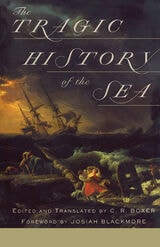
Tragic History Of The Sea
C.R. Boxer
University of Minnesota Press, 2001
Compelling stories of shipwreck, adventure, and death on the high seas, now back in print.
The sixteenth and seventeenth centuries were a time of great colonial expansion, marked by a mercantile frenzy of ships carrying merchants, aristocrats, missionaries, sailors, Inquisitors, botanists, and statesmen pursuing the spoils of empire. Among the narratives that chronicled these voyages, those of the Portuguese are unequaled. C. R. Boxer’s fascinating translations of famous Portuguese shipwreck stories detail the disasters and terrors plaguing the perilous sea trading route between Portugal and India.
In the tradition of Homer, Virgil, Shakespeare, Defoe, and Poe, these dramatic stories of shipwreck—and those who lived to tell about it—represent existence and survival pushed to the limits. They describe disastrous turns of fate and miraculous rescues, heroism and cowardice, and offer the exhilaration and sheer emotive appeal of a tale of adventure well told. Often circulated in pamphlet form, these stories recounting the dangers and terrors of storm-tossed ocean voyages and the fate of castaways in distant lands were a popular genre, rife with compelling and often gory details. This first ever paperback edition includes a new translation of the tragic tale of Captain Manuel de Sousa Sepúlveda, shipwrecked with his family on the sands of Africa in 1552, the previous English versions of which have long been unavailable. Vividly descriptive and engrossing, these tales of selfishness, cruelty, despair, pirates, mayhem, and harrowing storms will captivate readers.
Working with Water
Wisconsin WaterwaysBobbie Malone and Jefferson J. Gray
Wisconsin Historical Society Press, 2001
"Water, water, everywhere . . ." Working with Water, the latest in the popular New Badger History series, teaches young readers about the many ways water has shaped Wisconsin’s history, from glaciers to stewardship. It touches on geography and hydrography; transportation networks of Indians and fur traders; the Erie Canal; shipwrecks, lighthouses, shipping, and shipbuilding; fishing, ricing, "pearling" (clamming), and cranberry cultivation; lumbering, milling, and papermaking; recreation, resorts, tourism, and environmentalism.
The companion Teacher’s Guide and Student Materials engages students in hands-on exploration. It highlights historical processes and encourages multiple learning styles.
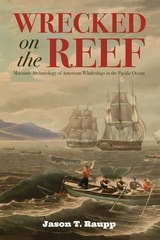
Wrecked on the Reef
Maritime Archaeology of American Whaleships in the Pacific OceanJason T. Raupp
University of Alabama Press, 2025
Take to the sea on this maritime archaeological exploration of nineteenth-century American whaling ships
American whaleships of the early nineteenth century were more than ocean-going vessels—they were complex workplaces, designed for long-term voyages, round-the-clock labor, and the large-scale extraction of marine resources. In Wrecked on the Reef, maritime archaeologist Jason T. Raupp presents a pioneering study of these ships as mobile production platforms, rooted in the logic of industrial capitalism operating far from land.
Drawing on shipwreck sites from the central Pacific region, Raupp offers a rare archaeological look at everyday life aboard nineteenth-century whaling vessels during the so-called “Golden Age” of whaling. He examines the tools used to hunt and process whales, the strict labor hierarchies onboard, and the physical evidence of diverse, often vulnerable crews who lived and worked under demanding conditions. By combining maritime and industrial archaeology, Raupp reveals how these ships functioned not just as transportation, but as full-scale factories at sea.
Chapters trace the rise of Pacific whaling, the importance of Hawaii as a supply and repair hub, the design and mechanics of whaleships, and the dangerous work crews performed in extreme isolation. Raupp shows how these ships were not only technological marvels of their time, but also part of a much larger system of labor, risk, and ocean-based resource extraction that fueled American expansion into the Pacific.
By exploring whaleships as floating work sites, Raupp offers readers a deeper understanding of maritime labor, capitalism, and imperialism in the nineteenth century. Wrecked on the Reef charts a new course in the study of labor and landscape at sea, providing significant contributions to maritime archaeology, industrial history, and environmental humanities.

Wrecked
The Edmund Fitzgerald and the Sinking of the American EconomyThomas M Nelson
Michigan State University Press, 2025