Results by title
260 books match the query 'Central America' and 9 start with l
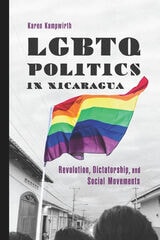
LGBTQ Politics in Nicaragua
Revolution, Dictatorship, and Social MovementsKaren Kampwirth
University of Arizona Press, 2022
Karen Kampwirth is a renowned scholar of the Nicaraguan Revolution, who has been writing at the intersection of gender and politics for decades. In this chronological telling of the last fifty years of political history in Nicaragua, Kampwirth deploys a critical new lens: understanding politics from the perspective of the country’s LGBTQ community. Kampwirth details the gay and lesbian guerrillas in the 1960s and 1970s, Nicaragua’s first openly gay television wizard in the 1980s, and the attempts by LGBTQ revolutionaries to create a civil rights movement and the subsequent squashing of that movement by the ruling Sandinista party. She analyzes the shifting political alliances, the rise of strong feminist and LGBTQ movements in Nicaragua, and the attempts by the administration of Daniel Ortega to co-opt and control these movements.
Ultimately, this is a story of struggle and defeat, progress and joy. This timely book provides a well-documented review of LGBTQ politics in modern Nicaragua, helping us to see the Sandinista Revolution and its ongoing aftermath in a new light.
Last Rites for the Tipu Maya
Genetic Structuring in a Colonial CemeteryKeith Jacobi
University of Alabama Press, 2000
Jacobi's groundbreaking osteology study uncovers the history of the Tipu Maya of Belize and their subsequent contact with the Spanish conquistadores and missionaries.
Two cultures collided at Tipu, Belize, in the 1600s: that of the native Maya and that of the Spanish missionaries, who arrived with an agenda of religious subjugation and, ultimately, political control. Combining historical documentation with the results of an archaeological exploration of a Tipu cemetery, Keith Jacobi provides an account of the meshing of these two cultures and the assimilation of Catholic practices by the Tipu.
In particular, Jacobi focuses on the dental remains recovered at this site. A tooth may be the last tangible evidence of a living creature, so teeth can reveal information about an individual's health, diet, cosmetic alteration, trauma, and genetic structure. From the genetic structure the researcher can learn information about an individual's relationship to others in a particular population and between populations.
Jacobi's research reveals how these European and Spanish Catholic practices were assimilated by the Tipu Maya and enables the first description of the prevalent attitudes toward death and burial customs. Through this study of Tipu Maya dentition changes through time, Jacobi sheds light on Spanish intermarriage, Maya familial relationships, and the Tipu genetic affinity with other prehistoric, historic, and modern Maya.
Learning on the Left
Political Profiles of Brandeis UniversityStephen J. Whitfield
Brandeis University Press, 2020
Stephen J. Whitfield makes the case for the pertinence of Brandeis University in understanding the vicissitudes of American liberalism since the mid-twentieth century. Founded to serve as a refuge for qualified professors and students haunted by academic antisemitism, Brandeis University attracted those who generally envisioned the republic as worthy of betterment. Whether as liberals or as radicals, figures associated with the university typically adopted a critical stance toward American society and sometimes acted upon their reformist or militant beliefs. This volume is not an institutional history, but instead shows how one university, over the course of seven decades, employed and taught remarkable men and women who belong in our accounts of the evolution of American politics, especially on the left. In vivid prose, Whitfield invites readers to appreciate a singular case of the linkage of political influence with the fate of a particular university in modern America.
Legitimizing Empire
Filipino American and U.S. Puerto Rican Cultural CritiqueFaye Caronan
University of Illinois Press, 2015
Faye Caronan's examination interprets the pivotal engagement of novels, films, performance poetry, and other cultural productions as both symptoms of and resistance against American military, social, economic, and political incursions. Though the Philippines became an independent nation and Puerto Rico a U.S. commonwealth, both remain subordinate to the United States. Caronan's juxtaposition reveals two different yet simultaneous models of U.S. neocolonial power and contradicts American exceptionalism as a reluctant empire that only accepts colonies for the benefit of the colonized and global welfare. Her analysis, meanwhile, demonstrates how popular culture allows for alternative narratives of U.S. imperialism, but also functions to contain those alternatives.
Literature and Politics in the Central American Revolutions
By John Beverley and Marc Zimmerman
University of Texas Press, 1990
“This book began in what seemed like a counterfactual intuition . . . that what had been happening in Nicaraguan poetry was essential to the victory of the Nicaraguan Revolution,” write John Beverley and Marc Zimmerman. “In our own postmodern North American culture, we are long past thinking of literature as mattering much at all in the ‘real’ world, so how could this be?” This study sets out to answer that question by showing how literature has been an agent of the revolutionary process in Nicaragua, El Salvador, and Guatemala.
The book begins by discussing theory about the relationship between literature, ideology, and politics, and charts the development of a regional system of political poetry beginning in the late nineteenth century and culminating in late twentieth-century writers. In this context, Ernesto Cardenal of Nicaragua, Roque Dalton of El Salvador, and Otto René Castillo of Guatemala are among the poets who receive detailed attention.
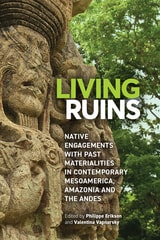
Living Ruins
Native Engagements with Past Materialities in Contemporary Mesoamerica, Amazonia, and the AndesPhilippe Erikson
University Press of Colorado, 2022
Ten case studies from the Maya region, Amazonia, and the Andes detail and contextualize narratives, rituals, and a range of practices and attitudes toward different kinds of vestiges. The chapters engage with recently debated issues such as regimes of historicity and knowledge, cultural landscapes, conceptions of personhood and ancestrality, artifacts, and materiality. They focus on Indigenous perspectives rather than mainstream narratives such as those mediated by UNESCO, Hollywood, travel agents, and sometimes even academics. The contributions provide critical analyses alongside a multifaceted account of how people relate to the place/time nexus, expanding our understanding of different ontological conceptualizations of the past and their significance in the present.
Living Ruins adds to the lively body of work on the invention of tradition, Indigenous claims on their lands and history, “retrospective ethnogenesis,” and neo-Indianism in a world where tourism, NGOs, and Western essentialism are changing Indigenous attitudes and representations. This book is significant to anyone interested in cultural heritage studies, Amerindian spirituality, and Indigenous engagement with archaeological sites in Latin America.
Contributors: Cedric Becquey, Laurence Charlier Zeineddine, Marie Chosson, Pablo Cruz, Philippe Erikson, Antoinette Molinié, Fernando Santos-Granero, Emilie Stoll, Valentina Vapnarsky, Pirjo Kristiina Virtanen
Living with the Dead
Mortuary Ritual in MesoamericaEdited by James L. Fitzsimmons and Izumi Shimada
University of Arizona Press, 2011
This book results from a symposium organized by the editors for an annual meeting of the Society for American Archaeology. The contributors employ historical sources, comparative art history, anthropology, and sociology, as well as archaeology and anthropology, to uncover surprising commonalities across cultures, including the manner in which the dead were politicized, the perceptions of reciprocity between the dead and the living, and the ways that the dead were used by the living to create, define, and renew social as well as family ties. In exploring larger issues of a “good death” and the transition from death to ancestry, the contributors demonstrate that across Mesoamerica death was almost never accompanied by the extinction of a persona; it was more often the beginning of a social process than a conclusion.
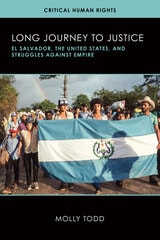
Long Journey to Justice
El Salvador, the United States, and Struggles against EmpireMolly Todd
University of Wisconsin Press, 2023
Drawing on two decades of work with former refugees from El Salvador as well as unprecedented access to private archives and oral histories, Molly Todd’s compelling history provides the first in-depth look at “grassroots sistering.” This model of citizen diplomacy emerged in the mid-1980s out of relationships between a few repopulated villages in Chalatenango, El Salvador, and US cities.
Todd shows how the leadership of Salvadorans and left-leaning activists in the US concerned with the expansion of empire as well as the evolution of human rights–related discourses and practices created a complex dynamic of cross-border activism that continues today.
Lost Shores, Forgotten Peoples
Spanish Explorations of the South East Maya LowlandsLawrence H. Feldman, ed. and translator
Duke University Press, 2000
In these narratives—primary documents written by missionaries and conquistadors—vivid details of these little known Mayan cultures are revealed, answering how and why lowlanders were able to evade Spanish conquest while similar civilizations could not. Fascinating tales of the journey from Europe are included, involving unknown islands, lost pilots, life aboard a galleon fleet, political intrigue, cannibals, and breathtaking natural beauty. In short, these forgotten manuscripts—translations of the papers of the past—provide an unforgettable look at an understudied chapter in the age of exploration.
Lost Shores, Forgotten Peoples will appeal to archaeologists, anthropologists, and historians interested in Central America, the Maya, and the Spanish Conquest.