Results by title
121 books match the query 'Comic books, strips, etc' and 8 start with l
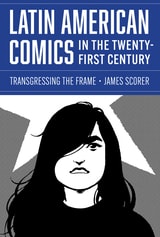
Latin American Comics in the Twenty-First Century
Transgressing the FrameJames Scorer
University of Texas Press, 2024
2025 Katherine Singer Kovacs Prize, Modern Language Association
2025 Comics Studies Society Charles Hatfield Book Prize, Honorable Mention
How twenty-first-century Latin American comics transgress social, political, and cultural frontiers.
Given comics’ ability to cross borders, Latin American creators have used the form to transgress the political, social, spatial, and cultural borders that shape the region. A groundbreaking and comprehensive study of twenty-first-century Latin American comics, Latin American Comics in the Twenty-First Century documents how these works move beyond national boundaries and explores new aspects of the form, its subjects, and its creators.
Latin American comics production is arguably more interconnected and more networked across national borders than ever before. Analyzing works from Argentina, Chile, Colombia, Mexico, Peru, and Uruguay, James Scorer organizes his study around forms of “transgression,” such as transnationalism, border crossings, transfeminisms, punk bodies, and encounters in the neoliberal city. Scorer examines the feminist comics collective Chicks on Comics; the DIY comics zine world; nonfiction and journalistic comics; contagion and zombie narratives; and more. Drawing from archives across the United States, Europe, and Latin America, Latin American Comics in the Twenty-First Century posits that these comics produce micronarratives of everyday life that speak to sites of social struggle shared across nation states.

Latinx Comics Studies
Critical and Creative CrossingsFernanda Díaz-Basteris
Rutgers University Press, 2025
This collection moves beyond simply cataloguing and celebrating Latinx representation within comics. It examines how comics by, for, and about Latinx peoples creatively and conceptually experiment with the very boundaries of “Latinx” and portray the diverse lived experiences therein.
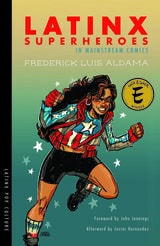
Latinx Superheroes in Mainstream Comics
Frederick Luis Aldama; Foreword by John Jennings; Afterword by Javier Hernandez
University of Arizona Press, 2017
Whether good or evil, beautiful or ugly, smart or downright silly, able-bodied or differently abled, gay or straight, male or female, young or old, Latinx superheroes in mainstream comic book stories are few and far between. It is as if finding the Latinx presence in the DC and Marvel worlds requires activation of superheroic powers.
Latinx Superheroes in Mainstream Comics blasts open barriers with a swift kick. It explores deeply and systematically the storyworld spaces inhabited by brown superheroes in mainstream comic book storyworlds: print comic books, animation, TV, and film. It makes visible and lets loose the otherwise occluded and shackled. Leaving nothing to chance, it sheds light on how creators (authors, artists, animators, and directors) make storyworlds that feature Latinos/as, distinguishing between those that we can and should evaluate as well done and those we can and should evaluate as not well done.
The foremost expert on Latinx comics, Frederick Luis Aldama guides us through the full archive of all the Latinx superheros in comics since the 1940s. Aldama takes us where the superheroes live—the barrios, the hospitals, the school rooms, the farm fields—and he not only shows us a view to the Latinx content, sometimes deeply embedded, but also provokes critical inquiry into the way storytelling formats distill and reconstruct real Latinos/as.
Thoroughly entertaining but seriously undertaken, Latinx Superheroes in Mainstream Comics allows us to truly see how superhero comic book storyworlds are willfully created in ways that make new our perception, thoughts, and feelings.

Liberated
The Radical Art and Life of Claude CahunKaz Rowe
J. Paul Getty Trust, The, 2023
At the turn of the twentieth century in Nantes, France, Lucy Schwob met Suzanne Malherbe, and lightning struck. The two became partners both artistically and romantically and transformed themselves into the creative personas Claude Cahun and Marcel Moore. Together, the couple embarked on a radical journey of Surrealist collaboration that would take them from conservative provincial France to the vibrancy of 1920s Paris to the oppression of Nazi-occupied Jersey during World War II, where they used art to undermine the Nazi regime.
Cahun and Moore challenged gender roles and championed freedom at a time when strict societal norms meant that the truth of their relationship had to remain secret. Featuring ten photographs by Cahun and Moore, this graphic biography by cartoonist Kaz Rowe brings Cahun’s inspiring story to life.
Ages thirteen to eighteen

Library Collections for Teens
Manga and Graphic NovelsAmerican Library Association, 2010
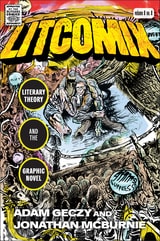
Litcomix
Literary Theory and the Graphic NovelAdam Geczy
Rutgers University Press, 2023
Using the methodology of Georg Lukács and his detailed defense of literary realism as a socially embedded practice, Litcomix tackles difficult questions about reading graphic novels as literature. What critical standards should we use to measure the quality of a graphic novel? How does the genre contribute to our understanding of ourselves and the world? What qualities distinguish it from other forms of literature?
LitComix hones its theoretical approach through case studies taken from across the diverse world of comics, from Yoshihiro Tatsumi’s groundbreaking manga to the Hernandez Brothers’ influential alt-comix. Whether looking at graphic novel adaptations of Proust or considering how Jack Kirby’s use of intertextuality makes him the Balzac of comics, this study offers fresh perspectives on how we might appreciate graphic novels as literature.
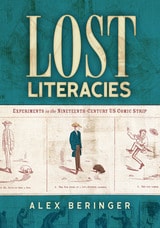
Lost Literacies
Experiments in the Nineteenth-Century US Comic StripAlex Beringer
The Ohio State University Press, 2024
Lost Literacies is the first full-length study of US comic strips from the period prior to the rise of Sunday newspaper comics. Where current histories assume that nineteenth-century US comics consisted solely of single-panel political cartoons or simple “proto-comics,” Lost Literacies introduces readers to an ambitious group of artists and editors who were intent on experimenting with the storytelling possibilities of the sequential strip, resulting in playful comics whose existence upends prevailing narratives about the evolution of comic strips.
Over the course of the nineteenth century, figures such as artist Frank Bellew and editor T. W. Strong introduced sequential comic strips into humor magazines and precursors to graphic novels known as “graphic albums.” These early works reached audiences in the tens of thousands. Their influences ranged from Walt Whitman’s poetry to Mark Twain’s travel writings to the bawdy stage comedies of the Bowery Theatre. Most importantly, they featured new approaches to graphic storytelling that went far beyond the speech bubbles and panel grids familiar to us today. As readers of Lost Literacies will see, these little-known early US comic strips rival even the most innovative modern comics for their diversity and ambition.
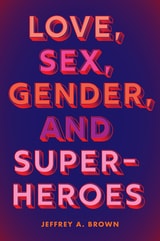
Love, Sex, Gender, and Superheroes
Jeffrey A. Brown
Rutgers University Press, 2022
Love, Sex, Gender, and Superheroes examines a full range of superhero media, from comics to films to television to merchandising. With a keen eye for the genre’s complex and internally contradictory mythology, comics scholar Jeffrey A. Brown considers its mixed messages. Superhero comics may reinforce sex roles with their litany of phallic musclemen and slinky femme fatales, but they also blur gender binaries with their emphasis on transformation and body swaps. Similarly, while most heroes have heterosexual love interests, the genre prioritizes homosocial bonding, and it both celebrates and condemns gendered and sexualized violence.
With examples spanning from the Golden Ages of DC and Marvel comics up to recent works like the TV series The Boys, this study provides a comprehensive look at how superhero media shapes our perceptions of love, sex, and gender.