Results by title
89 books match the query 'Communities' and 3 start with l
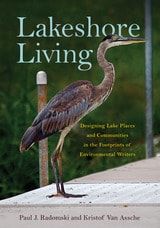
Lakeshore Living
Designing Lake Places and Communities in the Footprints of Environmental WritersPaul J. Radomski
Michigan State University Press, 2014
In this remarkable and remarkably accessible synthesis of ecology, landscape design, and social sciences, the authors present an approach to lakeshore living that addresses the need to create rich, sustainable places and communities on the water, where both the loon and the family find a place, and where the cabin can be handed down with integrity to the grandchildren. Fragile shorelands require care, and that caring comes from knowledge, experience, and an environmental ethic. Radomski and Van Assche argue that an environmentally sensitive lakeshore place and community design is the way forward. While many factors affect the quality of lakes and lakeshore living, property owners and local communities do not have to wait until policies are perfect: the design approach advocated here can be applied in any place people living lakeside can get together and collaborate. The approach presented here is proactive and context sensitive: new designs have to fit the existing ecological, cultural, and policy landscapes. Development is always re-development in this sense. The authors introduce the reader step-by-step to this approach and carefully discuss leverage points that can be helpful in implementation and system change.
[more]
Latinas/os in New Jersey
Histories, Communities, and CulturesAldo A. Lauria Santiago
Rutgers University Press, 2025
Since the 1890s, New Jersey has attracted hundreds of thousands of Caribbean and Latin American migrants. The state’s rich economic history, high-income suburbs, and strong public sector have all contributed to attracting, retaining, and setting the stage for Latin American and Caribbean immigrants and secondary-step migrants from New York City. Since the 1980s, however, Latinos have developed a more complex presence in the state’s political landscape and institutions. The emergence of Latino-majority towns and cities and coalition politics facilitated the election of Latino mayors, council persons, and many social and community leaders, as well as the election of statewide officers. This collection brings together innovative and empirically grounded scholarship from different disciplines and interdisciplinary fields of study and addresses topics including the demographic history of Latinos in the state, Latino migration from gateway cities to suburban towns, Latino urban enclaves, Latino economic and social mobility, Latino students and education, the New Jersey Dream Act and in-state tuition act organizing, Latinos and criminal justice reform, Latino electoral politics and leadership, and undocumented communities.
Contributors: Yamil Avivi; Jennifer Ayala; Ulla D. Berg; Giovani Burgos; Elsa Candelario; Laura Curran; Lilia Fernández; Ismael García Colón; Olga Jiménez de Wagenheim; Benjamin Lapidus; Aldo A. Lauria Santiago; Johana Londoño; Kathleen Lopez; Giancarlo Muschi; Melanie Z. Plasencia; Ana Y. Ramos-Zayas; Elena Sabogal; Raymond Sanchez Mayers; William Suárez Gómez; Alex F. Trillo; Daniela Valdez; Anil Venkatesh; Lyna L. Wiggins
Contributors: Yamil Avivi; Jennifer Ayala; Ulla D. Berg; Giovani Burgos; Elsa Candelario; Laura Curran; Lilia Fernández; Ismael García Colón; Olga Jiménez de Wagenheim; Benjamin Lapidus; Aldo A. Lauria Santiago; Johana Londoño; Kathleen Lopez; Giancarlo Muschi; Melanie Z. Plasencia; Ana Y. Ramos-Zayas; Elena Sabogal; Raymond Sanchez Mayers; William Suárez Gómez; Alex F. Trillo; Daniela Valdez; Anil Venkatesh; Lyna L. Wiggins
[more]
Latino Los Angeles
Transformations, Communities, and ActivismEdited by Enrique C. Ochoa and Gilda L. Ochoa
University of Arizona Press, 2005
As the twenth-first century begins, Latinas/os represent 45 percent of the residents of Los Angeles County, making them the largest racial/ethnic group in the region. At the same time, the shift from manufacturing to a service-based economy in the area has contributed to a decline in good-paying jobs, significantly impacting working class families. These transformations have created a backlash that has included state propositions impacting Latinas/os and escalating anti-immigrant rhetoric—and Latina/os of all backgrounds are making their voices heard. Until recently, most research on Latinas/os in the U.S. has ignored historical and contemporary dynamics in Latin America, just as scholars of Latin America have generally stopped their studies at the border. This volume roots Los Angeles in the larger arena of globalization, exploring the demographic changes that have transformed the Latino presence in LA from primarily Mexican-origin to one that now includes peoples from throughout the hemisphere. Bringing together scholars from a range of disciplines, it combines historical perspectives with analyses of power and inequality to consider how Latinas/os are responding to exclusionary immigration, labor, and schooling practices and actively creating communities. The contributors examine Latina/o Los Angeles in the context of historical, economic and social factors that have shaped the region. The first section provides contexts for understanding Latina/o migration, with chapters focusing on such factors as U.S. economic and military domination, labor and economic integration in the Americas, and Los Angeles’ economic history. The second section considers how various Latina/o groups have settled and formed communities and interacted with the existing Mexican-origin populations, showing how Zapotecs, Salvadorans, and other peoples are remaking urban demographics. The final section on labor organizing and political activism examines the role of Latina/o immigrants in such actions as the janitors’ strike and also considers the contemporary role of students in political activism. The volume concludes with an up-to-date compilation of contemporary scholarship on immigration, the economy, schools, neighborhoods, gender and activism as they relate to Central American and Mexican immigrants. Reflecting a range of methodologies—statistical, historical, ethnographic, and participatory research—this collection is relevant not only to ethnic studies but also to broader concerns in political science, sociology, history, economics, and urban studies. In addition, some chapters focus explicitly on women, and gender issues are interwoven throughout the text. Latino Los Angeles is an important work that contributes to contemporary scholarship on transnationalism as it reexamines the changing face of America’s largest western metropolis.
[more]