Results by title
47 books match the query 'Motion'
Aztec Philosophy
Understanding a World in MotionJames Maffie
University Press of Colorado, 2014
Aztec Philosophy focuses on the ways Aztec metaphysics—the Aztecs’ understanding of the nature, structure and constitution of reality—underpinned Aztec thinking about wisdom, ethics, politics,\ and aesthetics, and served as a backdrop for Aztec religious practices as well as everyday activities such as weaving, farming, and warfare. Aztec metaphysicians conceived reality and cosmos as a grand, ongoing process of weaving—theirs was a world in motion. Drawing upon linguistic, ethnohistorical, archaeological, historical, and contemporary ethnographic evidence, Maffie argues that Aztec metaphysics maintained a processive, transformational, and non-hierarchical view of reality, time, and existence along with a pantheistic theology.
Aztec Philosophy will be of great interest to Mesoamericanists, philosophers, religionists, folklorists, and Latin Americanists as well as students of indigenous philosophy, religion, and art of the Americas.
Beyond Sanctuary
The Humanism of a World in MotionAnanya Roy and Veronika Zablotsky, editors
Duke University Press, 2025
Contributors. Leisy Abrego, Damon Azali-Rojas, Amy Sara Carroll, Sharad Chari, Nicholas De Genova, Ricardo Dominguez, Lorgia García-Peña, Sarah Haley, Gaye Theresa Johnson, Moon-Kie Jung, Maria Kaika, Saree Makdisi, Kyle T. Mays, Ananya Roy, Charles Sepulveda, SA Smythe, Vanessa E. Thompson, Charalampos Tsavdaroglou, João H. Costa Vargas, Rinaldo Walcott, Veronika Zablotsky, Maite Zubiaurre

Body and Mind in Motion
Dance and Neuroscience in ConversationGlenna Batson with Margaret Wilson
Intellect Books, 2014

Books in Motion
Connecting Preschoolers with Books through Art, Games, Movement, Music, Playacting, and PropsJulie Dietzel-Glair
American Library Association, 2013

Cargoes in Motion
Materiality and Connectivity across the Indian OceanBurkhard Schnepel
Ohio University Press, 2022
An innovative collection of essays that foregrounds specific cargoes as a means to understand connectivity and mobility across the Indian Ocean world.
Scholars have long appreciated the centrality of trade and commerce in understanding the connectivity and mobility that underpin human experience in the Indian Ocean region. But studies of merchant and commercial activities have paid little attention to the role that cargoes have played in connecting the disparate parts of this vast oceanic world. Drawing from the work of anthropologists, geographers, and historians, Cargoes in Motion tells the story of how material objects have informed and continue to shape processes of exchange across the Indian Ocean.
By following selected cargoes through both space and time, this book makes an important and innovative contribution to Indian Ocean studies. The multidisciplinary approach deepens our understanding of the nature and dynamics of the Indian Ocean world by showing how transoceanic connectivity has been driven not only by economic, social, cultural, and political factors but also by the materiality of the objects themselves.
Essays by:
- Edward A. Alpers
- Fahad Ahmad Bishara
- Eva-Maria Knoll
- Karl-Heinz Kohl
- Lisa Jenny Krieg
- Pedro Machado
- Rupert Neuhöfer
- Mareike Pampus
- Hannah Pilgrim
- Burkhard Schnepel
- Hanne Schönig
- Tansen Sen
- Steven Serels
- Julia Verne
- Kunbing Xiao
Climate in Motion
Science, Empire, and the Problem of ScaleDeborah R. Coen
University of Chicago Press, 2018

Descartes' Metaphysical Physics
Daniel Garber
University of Chicago Press, 1992
Garber achieves a philosophically rigorous reading of Descartes that is sensitive to the historical and intellectual context in which he wrote. What emerges is a novel view of this familiar figure, at once unexpected and truer to the historical Descartes.
The book begins with a discussion of Descartes' intellectual development and the larger project that frames his natural philosophy, the complete reform of all the sciences. After this introduction Garber thoroughly examines various aspects of Descartes' physics: the notion of body and its identification with extension; Descartes' rejection of the substantial forms of the scholastics; his relation to the atomistic tradition of atoms and the void; the concept of motion and the laws of motion, including Descartes' conservation principle, his laws of the persistence of motion, and his collision law; and the grounding of his laws in God.
Devotion in Motion
Pilgrimage in Modern MexicoEdward Wright-Ríos
University of Chicago Press, 2025
For many, pilgrimage conjures ideas about ancient traditions and somber journeys of self-discovery—an escape from modern life. In Devotion in Motion, Edward Wright-Ríos argues that we misunderstand pilgrimage (past and present) if we ignore its dynamic relationship with the rhythms of daily life and community.
Through the story of a centuries-old, ever-changing Catholic shrine to Our Lady of Juquila in Oaxaca, Mexico, Wright-Ríos reveals how tradition, innovation, marketing, and devotion coexist and interact in pilgrimage. Devotees, he shows, are not dissuaded by the embeddedness of the sacred site in the complexities, hierarchies, or conflicts of their lives. In fact, the truckers, accountants, and health-care workers we meet in this book actively seek new resources (including social media) to aid and share their devotion. Part microhistory, part ethnography, Devotion in Motion is a celebration of pilgrimage as a living experience in every generation.
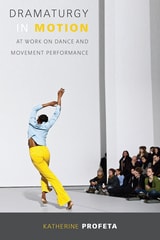
Dramaturgy in Motion
At Work on Dance and Movement PerformanceKatherine Profeta
University of Wisconsin Press, 2015
Profeta explores five arenas for the dramaturg’s attention—text and language, research, audience, movement, and interculturalism. Drawing on her extended collaboration with choreographer and visual artist Ralph Lemon, she grounds her thinking in actual rehearsal-room examples and situates practice within theoretical discourse about contemporary dramaturgy. Moving between theory and practice, word and movement, question and answer until these distinctions blur, she develops the foundational concept of dramaturgical labor as a quality of motion.
Dramaturgy in Motion will be invaluable to practitioners and scholars interested in the processes of creating contemporary dance and movement performance—particularly artists wondering what it might be like to collaborate with a dramaturg and dramaturgs wondering what it might be like to collaborate on movement performance. The book will also appeal to those intrigued by the work of Lemon and his collaborators, to which Profeta turns repeatedly to unfold the thorny questions and rich benefits of dramaturgical labor.

Folklore in Motion
Texas Travel LoreKenneth L. Untiedt
University of North Texas Press, 2007

Geology of Southeast Alaska
Rock and Ice in MotionHarold Stowell
University of Alaska Press, 2006
Written by a geologist with over twenty-five years of experience in the north, Geology of Southeast Alaska will entertain and inform with abundant photographs and detailed drawings. Whether you want to understand the forces that shaped the state of Alaska, or you want to learn the basics of glacial movement, this compact, authoritative book is for you.

Harry Huntt Ransom
Intellect in MotionBy Alan Gribben
University of Texas Press, 2008
Both a life story and a portrait of public higher education during the twentieth century, Harry Huntt Ransom captures the spirit of a dynamic individual who dedicated his talents to nurturing intellectual life in Texas and beyond. Tracing the details of Ransom's youth in Galveston and Tennessee and his education at Yale, where he earned a doctorate, Alan Gribben provides new insight into the factors that shaped Ransom's future as a renowned administrator and defender of the humanities.
Ransom's career at the University of Texas began in 1935, when he was hired as an instructor of English. He rose through the ranks to become chancellor, stepping down in 1971 during a volatile period when debates about the University's central mission raged—particularly over the question of commercializing higher education. The development of Ransom's lasting legacy, the Humanities Research Center bearing his name, is explored in depth as well. Bringing to life a legendary figure, Harry Huntt Ransom is a colorful testament to a singular man of letters who had the audacity to propose "that there be established somewhere in Texas—let's say in the capital city—a center of our cultural compass, a research center to be the Bibliothèque Nationale of the only state that started out as an independent nation."
Hawaiian Music in Motion
Mariners, Missionaries, and MinstrelsJames Revell Carr
University of Illinois Press, 2014
Identities in Motion
Asian American Film and VideoPeter X Feng
Duke University Press, 2002
Peter X Feng considers a wide range of works—from genres such as detective films to romantic comedies to ethnographic films, documentaries, avant-garde videos, newsreels, travelogues, and even home movies. Feng begins by examining movies about three crucial moments that defined the American nation and the roles of Asian Americans within it: the arrival of Chinese and Japanese women in the American West and Hawai’i; the incorporation of the Philippines into the U.S. empire; and the internment of Japanese Americans during World War II. In subsequent chapters Feng discusses cinematic depictions of ideological conflicts among Asian Americans and of the complex forces that compel migration, extending his nuanced analysis of the intersections of sexuality, ethnicity, and nationalist movements.
Identities in Motion illuminates the fluidity of Asian American identities, expressing the diversity and complexity of Asian Americans—including Filipinos, Indonesians, Chinese, Japanese, Vietnamese, Laotians, Indians, and Koreans—from the nineteenth to the twenty-first century.
In Search of Tunga
Prosperity, Almighty God, and Lives in Motion in a Malian Provincial TownAndré Chappatte
University of Michigan Press, 2022
In the context of the current global war on terrorism, most studies of Muslim life have focused on the politics of piety of reformist movements, their leaders, and members. By contrast, In Search of “Tunga” takes a perspective from below. It opens piety up to “simply Muslims,” although the religious elites have always claimed authority and legitimacy over piety. Is piety an exclusive field of experiences for those who claim to strive for it? What does piety involve for the majority of Muslims, the non-elite and unaffiliated Muslims? This volume “democratizes” piety by documenting its practice as going beyond sharply defined religious affiliations and Islamic scholarship, and by showing it is both alive and normative, existential and prescriptive. As opposed to studies that build on the classic historical connections between the Maghreb and the Sahel, the southbound migration from the Sahel documented in this book stresses the overlooked historical connections between the southern shores of the Sahara and the lands south of those shores. It demonstrates how the Malian savanna, this former buffer-zone between ancient Mande kingdoms and thereafter remote areas of French Sudan, is increasingly becoming central in today’s Sahel contexts of desiccation and insecurity.
Islamic Architecture on the Move
Motion and ModernityEdited by Christiane Gruber
Intellect Books, 2016
This book brings together scholars from architectural studies, design, art history, and other fields to challenge and expand concepts of Islamic architecture. Ranging from eighteenth-century Ottoman tents to manifestations of Islamic motifs in 1960s Hawaii, this richly illustrated volume raises key questions about Islamic architecture, and, more broadly, about how we can rethink our understanding of material, artistic, and cultural mobility in the modern world.
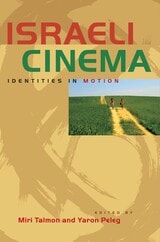
Israeli Cinema
Identities in MotionEdited by Miri Talmon and Yaron Peleg
University of Texas Press, 2011
With top billing at many film forums around the world, as well as a string of prestigious prizes, including consecutive nominations for the Best Foreign Film Oscar, Israeli films have become one of the most visible and promising cinemas in the first decade of the twenty-first century, an intriguing and vibrant site for the representation of Israeli realities. Yet two decades have passed since the last wide-ranging scholarly overview of Israeli cinema, creating a need for a new, state-of-the-art analysis of this exciting cinematic oeuvre.
The first anthology of its kind in English, Israeli Cinema: Identities in Motion presents a collection of specially commissioned articles in which leading Israeli film scholars examine Israeli cinema as a prism that refracts collective Israeli identities through the medium and art of motion pictures. The contributors address several broad themes: the nation imagined on film; war, conflict, and trauma; gender, sexuality, and ethnicity; religion and Judaism; discourses of place in the age of globalism; filming the Palestinian Other; and new cinematic discourses. The authors' illuminating readings of Israeli films reveal that Israeli cinema offers rare visual and narrative insights into the complex national, social, and multicultural Israeli universe, transcending the partial and superficial images of this culture in world media.

Jill Johnston in Motion
Dance, Writing, and Lesbian LifeClare Croft
Duke University Press, 2024

John Updike's Rabbit Tetralogy
Mastered Irony in MotionMarshall Boswell
University of Missouri Press, 2001
Early in his career, John Updike announced his affinity with the Christian existentialism of Soren Kierkegaard, Paul Tillich, Karl Barth, and others. Because of this, many of Updike's critics have interpreted his work from within a Christian existentialist context. Yet Kierkegaard and Barth provide Updike with much more than a mere context, for their dialectical thinking serves as the springboard for Updike's own unique dialectical vision, a complex matrix of ethical precepts, theological beliefs, and aesthetic principles that governs nearly all of his literary output. Nowhere else in his immense corpus is this vision more clearly and thoroughly expressed than in his four Rabbit novels, which were gathered into the single volume Rabbit Angstrom in 1995. However, because Updike's critics have chosen to read the Rabbit novels as discrete, freestanding texts, they have by and large failed to extract the precepts of this private vision.
In John Updike's Rabbit Tetralogy, Marshall Boswell redresses this imbalance by treating the Rabbit tetralogy as a single, unified "mega-novel." He demonstrates that, taken together as a single work, the four discrete sections of the tetralogy not only provide a coherent and complete articulation of Updike's unique existential vision but also compose a unified work of remarkable formal complexity. Boswell brings to Updike's work the concept of "mastered irony," a term coined by Kierkegaard to describe the presentation of two legitimate but contradictory sides of an issue. In the Rabbit novels, these issues range from adultery to drug addiction, from race to redemption, with each issue examined through the refracting lens of Updike's own ironic method. Boswell shows that although each of the four individual Rabbit novels confirms this dialectical strategy in a unique way, the completed tetralogy comprises an additional series of dialectical pairs that sustain, rather than resolve, thematic and formal tension. Ultimately, the structure of the finished "mega-novel" echoes the work's thematic rationale.
To help readers who are interested in a particular Rabbit novel, Boswell devotes a chapter to each individual section of the tetralogy. At the same time, he treats each novel as an integral part of the more comprehensive whole. Honoring the full complexity of Updike's provocative thinking without losing sight of the tetralogy's popular appeal, John Updike's Rabbit Tetralogy makes a valuable addition to the study of Updike's work.
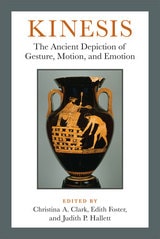
Kinesis
The Ancient Depiction of Gesture, Motion, and EmotionChristina A. Clark, Edith Foster, and Judith P. Hallett, editors
University of Michigan Press, 2015
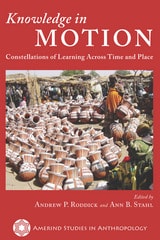
Knowledge in Motion
Constellations of Learning Across Time and PlaceEdited by Andrew P. Roddick and Ann B. Stahl
University of Arizona Press, 2019
In the last twenty-five years, scholars from a number of disciplines have explored “situated learning,” specifically investigating how learning relates to social reproduction and daily life. In Knowledge in Motion, contributors focus on learning through time and at a variety of scales, particularly as they relate to power and politics, with implications for emergent communities and constellations of practice.
This volume brings together archaeologists, historians, and cultural anthropologists to examine communities engaged in a range of learning practices around the globe, from Africa to the Americas. Contributors draw on the growing interdisciplinary scholarship on situated learning to explore those processes in relation to power and broader forces that shape knowledge during times of turbulent change.
Enriching the diversity of regions and disciplines, Knowledge in Motion focuses on how learning, knowledge transmission, and the emergent qualities of communities and constellations of practice are shaped by changing spheres of interaction or other unstable events and influences. The contributions forge productive theories and methodologies for exploring situated learning and its broad-ranging outcomes.
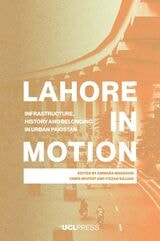
Lahore in Motion
Infrastructure, History and Belonging in Urban PakistanEdited by Ammara Maqsood, Chris Moffat, and Fizzah Sajjad
University College London, 2025
Follow Lahore’s Orange Line metro corridor to discover the tensions between development and displacement, progress and preservation, in one of the world’s great metropolises.
Lahore is a city in constant flux, and the frictions that characterize urban life are vividly apparent along the tracks of its first metro rail corridor, opened in 2020. Lahore in Motion follows the Orange Line’s 27-kilometer path, bringing together reflections from academics, activists, artists, and architects on the ways that infrastructure shapes urban belonging. The book offers a novel methodology for assessing how this mega-project has reconfigured neighborhoods, sparked new desires for modernity, and deepened existing social differences while destabilizing others.
Each chapter unfolds through the lens of a particular metro stop, providing intimate glimpses into the frictions generated by development where connectivity and fragmentation, aspiration and dispossession collide. Engaging with broader debates on urban transformation in the Global South, Lahore in Motion goes against familiar narratives of top-down development, revealing a city animated by resistance and reinventing itself in response. An eye-opening, beautifully written work for all interested in urbanism, infrastructure, politics, and the intimate rhythms of everyday life in one of the world’s most dynamic cities.

Lake Michigan in Motion
Responses of an Inland Sea to Weather, Earth-Spin, and Human ActivitiesClifford H. Mortimer
University of Wisconsin Press, 2004
Language in Motion
Exploring the Nature of SignJerome D. Schein
Gallaudet University Press, 1995
This enjoyable book first introduces sign language and communication, follows with a history of sign languages in general, then delves into the structure of ASL. Later chapters outline the special skills of fingerspelling and assess the academic offshoot of artificial sign systems and their value to young deaf children.
Language in Motion offers for consideration the process required to learn sign language and putting sign language to work to communicate in the Deaf community. Appendices featuring the manual alphabets of three countries and a notation system developed to write signs complete this enriching book. Its delightful potpourri of entertaining, accessible knowledge makes it a perfect primer for those interested in learning more about sign language, Deaf culture, and Deaf communities.

Love Songs in Motion
Voicing Intimacy in SomalilandChristina J. Woolner
University of Chicago Press, 2023
At first listen, both music and talk about love are conspicuously absent from Somaliland’s public soundscapes. The lingering effects of war, the contested place of music in Islam, and gendered norms of emotional expression limit opportunities for making music and sharing personal feelings. But while Christina J. Woolner was researching peacebuilding in Somaliland’s capital, Hargeysa, she kept hearing snippets of songs. Almost all of these, she learned, were about love. In these songs, poets, musicians, and singers collaborate to give voice to personal love aspirations and often painful experiences of love-suffering. Once in circulation, the intimate and heartfelt voices of love songs provide rare and deeply therapeutic opportunities for dareen-wadaag (feeling-sharing). In a region of political instability, these songs also work to powerfully unite listeners on the basis of shared vulnerability, transcending social and political divisions and opening space for a different kind of politics.
Taking us from 1950s recordings preserved on dusty cassettes to new releases on YouTube and live performances at Somaliland’s first postwar music venue—where the author herself eventually takes the stage—Woolner offers an account of love songs in motion that reveals the capacity of music to connect people and feelings across time and space, creating new possibilities for relating to oneself and others.
Making Movement Modern
Science, Politics, and the Body in MotionWhitney E. Laemmli
University of Chicago Press, 2026
In the early twentieth century, human bodily movement garnered interest among researchers who were convinced that understanding and controlling it could help govern an increasingly frazzled, fragmented world. Making Movement Modern traces one movement visualization technique, Labanotation, from its origins in expressionist dance, Austro-Hungarian military discipline, and contemporary physiology to its employment in factories and offices a half-century later. Frustrated by societies that seemed plagued by regimentation and alienation, the users of Laban-inspired systems—from artists and scientists to factory owners, politicians, lawyers, anthropologists, psychiatrists, and computer scientists—hoped to provide opportunities for individual expression while simultaneously harnessing movement to serve the needs of larger communities, businesses, and states.
Making Movement Modern reveals how Labanotation’s creator, choreographer Rudolf Laban, and his acolytes offered this system to a surprising variety of individuals and groups. It was a technique that promised liberation through expressive movement; it was also a means of organizing fascist displays of pure “Aryan” culture. The book explores these political ambiguities as Laban-based systems entered postwar society in the United States and the United Kingdom, where they were used to document disappearing folk cultures, treat Holocaust survivors, and make even the dullest, most repetitive work feel spiritually meaningful. Central to these efforts were vast programs to collect and store new kinds of personal movement data, and this history also has much to tell us about mass data collection today. This is a book for anyone interested in the relationship between art, science, data, and the human body across the tumultuous twentieth century.
Managing the Infosphere
Governance, Technology, and Cultural Practice in MotionStephen D. McDowell, Philip E. Steinberg and Tami K. Tomasello
Temple University Press, 2007
The authors argue that the roles of these systems in cyberspace cannot be fully understood unless they are seen as mutually constituting each other in specific historical structures, institutions, and practices. With vision and insight, the authors look beyond the Internet to examine the entire networked world, from cell phones and satellites to global tourism and business travel.
Meaning in Motion
New Cultural Studies of DanceJane C. Desmond, ed.
Duke University Press, 1997
Writing from a broad range of perspectives, contributors from disciplines as varied as art history and anthropology, dance history and political science, philosophy and women’s studies chart the questions and challenges that mark this site. How does dance enact or rework social categories of identity? How do meanings change as dance styles cross borders of race, nationality, or class? How do we talk about materiality and motion, sensation and expressivity, kinesthetics and ideology? The authors engage these issues in a variety of contexts: from popular social dances to the experimentation of the avant-garde; from nineteenth-century ballet and contemporary Afro-Brazilian Carnival dance to hip hop, the dance hall, and film; from the nationalist politics of folk dances to the feminist philosophies of modern dance. Giving definition to a new field of study, Meaning in Motion broadens the scope of dance analysis and extends to cultural studies new ways of approaching matters of embodiment, identity, and representation.
Contributors. Ann Cooper Albright, Evan Alderson, Norman Bryson, Cynthia Cohen Bull, Ann Daly, Brenda Dixon Gottschild, Susan Foster, Mark Franko, Marianne Goldberg, Amy Koritz, Susan Kozel, Susan Manning, Randy Martin, Angela McRobbie, Kate Ramsey, Anna Scott, Janet Wolff
Modern Dance, Negro Dance
Race in MotionSusan Manning
University of Minnesota Press, 2006
Modernity in Motion
Reading Gerald Vizenor in Global ContextsDavid J. Carlson
Michigan State University Press, 2026
Modernity in Motion offers a groundbreaking exploration of Anishinaabe writer Gerald Vizenor’s richly layered body of work spanning fiction, nonfiction, and poetry. Through the lens of transnational Indigenous studies, this compelling study reveals how Vizenor’s concept of transmotion, which he defines as the interplay between local and global identities, reconstructs modernity as a dynamic force of transformation.
Close readings illuminate Vizenor’s radical storytelling, which bridges seemingly disparate worlds: the White Earth Reservation, Nazi-occupied Paris, post-Hiroshima Japan, and beyond. By weaving these far-flung geographies into unexpected constellations, Vizenor challenges readers to rethink Indigenous history, sovereignty, and creative expression within a global framework.
Positioned at the intersection of tribal-centric and world literature paradigms, Modernity in Motion is essential reading for scholars of Indigenous studies and comparative literature.

Montaigne in Motion
Jean Starobinski
University of Chicago Press, 1985
Educated in the humanities and trained in psychiatry, Jean Starobinski is a central figure in the Geneva School of criticism. His classic work, Montaigne in Motion, is a subtly conceived and elegantly written study of the Essais of Montaigne, whose deceptively plainspoken meditations have entranced readers and stimulated philosophers since their first publication in 1580 and 1595.
Here Starobinski offers a decidedly postmodern reading of Montaigne. In chapters dealing with the themes of public and private life, friendship, death, the body, and love, Starobinski reveals much that will remind us that Montaigne’s thought is as apropos to our time as it was to his own.
“The most important contribution to Montaigne studies since Friedrich’s work . . . . [It] will be the critical framework in which scholars will discuss Montaigne in the years to come.”—Choice
“Starobinski brings Montaigne to life by treating him as our contemporary and asking him modern questions.”—Hudson Review
Motion Vision
Design of compact motion sensing solutions for navigation of autonomous systemsJ. Kolodko
The Institution of Engineering and Technology, 2005
Motion
American Sports PoemsNoah Blaustein
University of Iowa Press, 2001
Sports have long served as inspiration for poetry-the ancient Greeks wrote odes in praise of their athletes-so it is little surprise that in a culture as obsessed with athletes as our own sports would exert an influence on contemporary poets. Motion: American Sports Poems rescues sports from our society's focus on superstars, multimillion-dollar contracts, and gold medals to capture champions and losers, competitors and spectators in moments that are anything but fleeting.
As Noah Blaustein points out in his preface, among the many parallels made between sports and poetry is the idea of transcendence. Forged from the most basic elements of sport-energy, movement, and rhythm-the poems in this anthology reflect something universal: sport as metaphor, sport as struggle, sport as the battleground for mythic figures and local heroes.
The often celebrated sports-baseball, boxing, football, and basketball-are here along with unexpected pastimes like surfing, skateboarding, tennis, soccer, karate, rock climbing, bowling, and curling. Young and old, black and white, male and female, the poets in this anthology celebrate everyone who has come together in the shimmy and shake and sweat of sport.
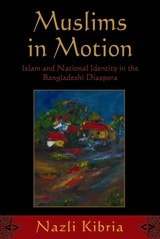
Muslims in Motion
Islam and National Identity in the Bangladeshi DiasporaKibria, Nazli
Rutgers University Press, 2011
In Muslims in Motion, Nazli Kibria provides a comparative look at Bangladeshi Muslims in different global contexts--including Britain, the U.S., the Middle East, and Malaysia. Kibria examines international migrant flows from Bangladesh, and considers how such migrations continue to shape Islamization in these areas. Having conducted more than 200 in-depth interviews, she explores how, in societies as different as these, migrant Muslims, in their everyday lives, strive to achieve economic gains, sustain community and family life, and realize a sense of dignity and honor.
Muslims in Motion offers fresh insights into the prominence of Islam in these communities, especially an Islam defined by fundamentalist movements and ideologies. Kibria also focuses on the complex significance of nationality--with rich analyses of the diaspora, the role of gender and class, and the multiple identities of the migrants, she shows how nationality can be both a critical source of support and also of difficulty for many in their efforts to attain lives of dignity. By bringing to life a vast range of experiences, this book challenges prevailing stereotypes of Muslims.

Nature and Motion in the Middle Ages
James A. Weisheipl
Catholic University of America Press, 2018
Nonfiction in Motion
Connecting Preschoolers with Nonfiction Books through MovementJulie Dietzel-Glair
American Library Association, 2016
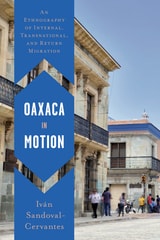
Oaxaca in Motion
An Ethnography of Internal, Transnational, and Return MigrationIván Sandoval-Cervantes
University of Texas Press, 2022
Migration is typically seen as a transnational phenomenon, but it happens within borders, too. Oaxaca in Motion documents a revealing irony in the latter sort: internal migration often is global in character, motivated by foreign affairs and international economic integration, and it is no less transformative than its cross-border analogue.
Iván Sandoval-Cervantes spent nearly two years observing and interviewing migrants from the rural Oaxacan town of Santa Ana Zegache. Many women from the area travel to Mexico City to work as domestics, and men are encouraged to join the Mexican military to fight the US-instigated “war on drugs” or else leave their fields to labor in industries serving global supply chains. Placing these moves in their historical and cultural context, Sandoval-Cervantes discovers that migrants’ experiences dramatically alter their conceptions of gender, upsetting their traditional notions of masculinity and femininity. And some migrants bring their revised views with them when they return home, influencing their families and community of origin. Comparing Oaxacans moving within Mexico to those living along the US West Coast, Sandoval-Cervantes clearly demonstrates the multiplicity of answers to the question, “Who is a migrant?”
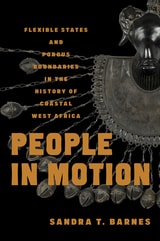
People in Motion
Flexible States and Porous Boundaries in the History of Coastal West AfricaSandra T. Barnes
University of Wisconsin Press, 2026
Beginning in the late fifteenth century, more than two million people were taken from areas that lay behind the Bight of Benin, enslaved, and forced into the perilous Middle Passage bound for the New World. While a vast swath of scholarly work on this region has explored the relationships among the transatlantic slave trade’s ruling elites and overseas merchants, the practices that shaped the region’s political and cultural dynamics, especially those that dealt with other kinds of trade, have yet to be thoroughly examined.
Sandra T. Barnes offers a history focused on the Benin Region’s patchwork of small states and ports that saw a constant movement of people and goods for centuries. As such, this book widens the lens of scholarship to include people of all social levels behind the political rivalries and dynamic changes that marked the period. Barnes concentrates on protective relationships and the violence people were forced to endure during a fast-moving, tumultuous period of history, examining how they organized their lives and why this mattered. The result is a refreshingly original work that challenges long-held assumptions about West Africa’s past, explaining what life was like for people on the coast during the transatlantic slave trade.
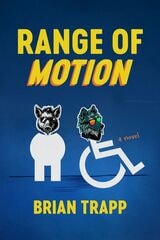
Range of Motion
A NovelBrian Trapp
Acre Books, 2025
Twin A and Twin B. That’s what Michael and Sal’s neuroscientist father irreverently calls them. The boys are born moments apart, but baby Sal’s brain scan shows a bleed. He has severe cerebral palsy and intellectual disabilities.
Told through multiple perspectives—Gabe, the boys’ father; Hannah, their mother; and Michael—this debut novel follows the Mitchell family from the boys’ infancy to the cusp of adulthood as they all try to interpret what Sal, who speaks only eight words, is thinking and feeling. The twins’ upbringing in suburban Ohio is familiar and unfamiliar, ordinary and extraordinary, as this middle-class family navigates the challenges and rewards of nurturing a special-needs human with a killer dimple who is utterly and winningly himself: sweet, stubborn, mischievous, impenetrable, and above all, very funny.
Michael feels that he alone understands Sal and devotes himself to giving his brother a voice in the “normal” world until he grows up and can’t “hear” his twin anymore—his worst fear. Their mother, a teacher who has given up her career for caregiving, and their father, who is determined to succeed in his research, also struggle with the balance of sacrifice and duty and love, especially as Sal’s health deteriorates. Before Michael leaves for college, the twins spend a final week together at a summer camp for people with disabilities, and Sal does something that changes their lives forever.
Transforming perceptions of disability and interdependence through tender attention to detail, Range of Motion is wrenching, beautiful, and sharply comic.
Reasoning with the Infinite
From the Closed World to the Mathematical UniverseMichel Blay
University of Chicago Press, 1998
"One of Michael Blay's many fine achievements in Reasoning with the Infinite is to make us realize how velocity, and later instantaneous velocity, came to play a vital part in the development of a rigorous mathematical science of motion."—Margaret Wertheim, New Scientist
Reflection-in-Motion
Reimagining Reflection in the Writing ClassroomJaclyn Fiscus-Cannaday
Utah State University Press, 2024
underrepresented viewpoints about how reflection works in the writing classroom. Jaclyn Fiscus-Cannaday examines how its availability is subject to teacher/student power dynamics, the literacies welcomed (or not) in the class, the past and present pedagogies that students are engaging with and attending to, and the interactions among humans, materials, and emotions within the rhetorical context. She adopts an intersectional feminist perspective for an inclusive view of how practitioners name, identify, and practice reflection in the everyday moments of writing classrooms.
Fiscus-Cannaday invokes a Black feminist qualitative research method that Venus Evans-Winters calls a “mosaic.” When researchers collect both traditional and nontraditional texts to create a full view of students’ and teachers’ interviews at three institutions (a Hispanic Serving Institution, a Historically Black College and University, and an Asian American Native American Pacific Islander Serving Institution), she finds that practitioners often build definitions from past experiences with reflection—and then use those definitions as terministic screens to decide if an activity can be named, identified, and practiced as reflection. These definitions hold different rhetorical effects: reflection-for-introspection, reflection-for-learning, reflection-for-mindfulness, and reflection-for-awareness.
Reflection is used for these different rhetorical effects, but because classrooms so often focus on the Westernized view and its emphasis on growth, reflection has the underused and undertheorized potential rhetorical effect of helping students investigate their identities and positionalities, acknowledge deep-rooted ideologies, and consider new perspectives so they can better work across difference. Reflection-in-Motion will inspire teachers and writing program administrators to listen to how students define and practice reflection and why—thus making room for more capacious definitions of reflection and student-centered practices of what reflection can do and be.
Set in Motion
Essays, Interviews, and DialoguesA. R. Ammons
University of Michigan Press, 1996

The Motion Of Light In Water
Sex And Science Fiction Writing In The East VillageSamuel R. Delany
University of Minnesota Press, 2004
Winner of the Hugo Award for Non-fiction
The unexpurgated edition of the award-winning autobiography
Born in New York City’s black ghetto Harlem at the start of World War II, Samuel R. Delany married white poet Marilyn Hacker right out of high school. The interracial couple moved into the city’s new bohemian quarter, the Lower East Side, in summer 1961. Through the decade’s opening years, new art, new sexual practices, new music, and new political awareness burgeoned among the crowded streets and cheap railroad apartments. Beautifully, vividly, insightfully, Delany calls up this era of exploration and adventure as he details his development as a black gay writer in an open marriage, with tertiary walk-ons by Bob Dylan, Stokely Carmichael, W. H. Auden, and James Baldwin, and a panoply of brilliantly drawn secondary characters.

The Novel in Motion
An Approach to Modern FictionRichard Pearce
The Ohio State University Press, 1900
Truth in Motion
The Recursive Anthropology of Cuban DivinationMartin Holbraad
University of Chicago Press, 2012
Vision in Motion
Streams of Sensation and Configurations of TimeEdited by Michael F. Zimmermann
Diaphanes, 2015
Bringing together a renowned international group of contributors, Vision in Motion explores one of the most vexing problems in the study of vision and cognition: To make sense of the sensations we experience when we see something, we must configure many moments into a synchronous image. This volume offers a critical reexamination of seeing that restores a concept of “vision in motion” that avoids reducing the sensations we experience to narrative chronological sequencing. The contributors draw on Hume, Bergson, and Deleuze, among others, to establish a nuanced idea of how we perceive.
Words in Motion
Toward a Global LexiconCarol Gluck and Anna Lowenhaupt Tsing, eds.
Duke University Press, 2009
Such words as security in Brazil, responsibility in Japan, community in Thailand, and hijāb in France changed the societies in which they moved even as the words were changed by them. Some words threatened to launch wars, as injury did in imperial Britain’s relations with China in the nineteenth century. Others, such as secularism, worked in silence to agitate for political change in twentieth-century Morocco. Words imposed or imported from abroad could be transformed by those who wielded them to oppose the very powers that first introduced them, as happened in Turkey, Indonesia, and the Philippines. Taken together, this selection of fourteen essays reveals commonality as well as distinctiveness across modern societies, making the world look different from the interdisciplinary and transnational perspective of “words in motion.”
Contributors. Mona Abaza, Itty Abraham, Partha Chatterjee, Carol Gluck, Huri Islamoglu, Claudia Koonz, Lydia H. Liu, Driss Maghraoui, Vicente L. Rafael, Craig J. Reynolds, Seteney Shami, Alan Tansman, Kasian Tejapira, Anna Lowenhaupt Tsing