Results by title
162 books match the query 'Comparative Politics' and 6 start with l
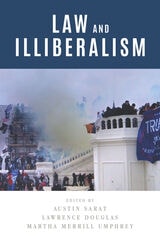
Law and Illiberalism
Edited by Austin Sarat, Lawrence Douglas, and Martha Merrill Umphrey
University of Massachusetts Press, 2022
Does the law shield citizens from authoritarian regimes? Are the core beliefs of classical liberalism—namely the rights of all individuals and constraints on state power—still protected by law? Liberalism and its expansion of rights could not exist without the legal system, and unsurprisingly, many scholars have explored the relationship between law and liberalism. However, the study of law and illiberalism is a relatively recent undertaking, a project that takes on urgency in light of the rise of authoritarian powers, among them Donald Trump’s administration, Viktor Orban’s Hungary, Recep Erdogan’s Turkey, and Jair Bolsanoro’s Brazil.
In this volume, six penetrating essays explore the dynamics of the law and illiberal quests for power, examining the anti-liberalism of neoliberalism; the weaponization of “free speech”; the role of the administrative state in current crises of liberal democracy; the broad and unstoppable assault on facts, truth, and reality; and the rise of conspiracism leading up to the Capitol insurrection. In addition to the editors, contributors include Sharon Krause, Elizabeth Anker, Jeremy Kessler, Lee McIntyre, and Nancy Rosenblum.

Law, Liberty, and the Pursuit of Terrorism
Roger Douglas
University of Michigan Press, 2014
Roger Douglas compares responses to terrorism by five liberal democracies—the United States, the United Kingdom, Canada, Australia, and New Zealand—over the past 15 years. He examines each nation’s development and implementation of counterterrorism law, specifically in the areas of information-gathering, the definition of terrorist offenses, due process for the accused, detention, and torture and other forms of coercive questioning.
Douglas finds that terrorist attacks elicit pressures for quick responses, often allowing national governments to accrue additional powers. But emergencies are neither a necessary nor a sufficient condition for such laws, which may persist even after fears have eased. He argues that responses are influenced by both institutional interests and prior beliefs, and complicated when the exigencies of office and beliefs point in different directions. He also argues that citizens are wary of government’s impingement on civil liberties and that courts exercise their capacity to restrain the legislative and executive branches. Douglas concludes that the worst antiterror excesses have taken place outside of the law rather than within, and that the legacy of 9/11 includes both laws that expand government powers and judicial decisions that limit those very powers.
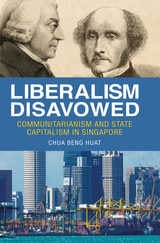
Liberalism Disavowed
Communitarianism and State Capitalism in SingaporeBeng Huat Chua
National University of Singapore Press, 2018
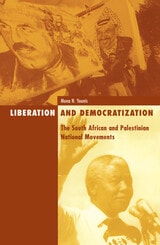
Liberation and Democratization
The South African and Palestinian National MovementsMona N. Younis
University of Minnesota Press, 2000
The first comprehensive comparison of two of the century’s most important liberation movements.
Arising in the 1910s and emerging as legitimate governing bodies in the 1990s, the South African and the Palestinian national liberation movements have exhibited remarkable parallels over the course of their development. The fortunes of the African National Congress and the Palestinian Liberation Organization, however, have proven strikingly different. How the movements, despite similar circumstances and experiences, have arrived at such dissimilar outcomes is described in Liberation and Democratization.
Younis traces the evolution of the movements, from early domination by elites to the ascendancy of mass-based forces in their last phases of expansion. She shows how this latest shift, accompanied by a democratization of the process of liberation, made the movements more effective in the 1980s. Liberation and Democratization also identifies dissimilarities—the balance of class forces and resources—that led to the A.N.C.’s greater success relative to the P.L.O.’s achievements. The first comprehensive comparison of two of the most significant liberation movements of this century, Younis’s work brings to light problems and dynamics that will remain at work well into the future.
Like Cattle and Horses
Nationalism and Labor in Shanghai, 1895-1927S. A. Smith
Duke University Press, 2002
While the massive wave of labor protest in the 1920s was principally an expression of militant nationalism rather than of class consciousness, Smith argues, elements of a precarious class identity were in turn forged by the very discourse of nationalism. By linking work-related demands to the defense of the nation, anti-imperialist nationalism legitimized participation in strikes and sensitized workers to the fact that they were worthy of better treatment as Chinese citizens. Smith shows how the workers’ refusal to be treated “like cattle and horses” (a phrase frequently used by workers to describe their condition) came from a new but powerfully felt sense of dignity. In short, nationalism enabled workers to interpret the anger they felt at their unjust treatment in the workplace in political terms and to create a link between their position as workers and their position as members of an oppressed nation. By focusing on the role of the working class, Like Cattle and Horses is one of very few studies that examines nationalism “from below,” acknowledging the powerful agency of nonelite forces in promoting national identity.
Like Cattle and Horses will interest historians of labor, modern China, and nationalism, as well as those engaged in the study of revolutions and revolt.
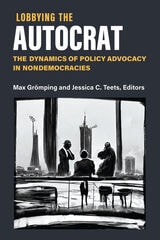
Lobbying the Autocrat
The Dynamics of Policy Advocacy in NondemocraciesMax Grömping and Jessica C. Teets, Editors
University of Michigan Press, 2023
Although authoritarian countries often repress independent citizen activity, lobbying by civil society organizations is actually a widespread phenomenon. Using case studies such as China, Russia, Belarus, Cambodia, Malaysia, Montenegro, Turkey, and Zimbabwe, Lobbying the Autocrat shows that citizen advocacy organizations carve out niches in the authoritarian policy process, even influencing policy outcomes. The cases cover a range of autocratic regime types (one-party, multi-party, personalist) on different continents, and encompass different systems of government to explore citizen advocacy ranging from issues such as social welfare, women’s rights, election reform, environmental protection, and land rights. They show how civil society has developed adaptive capacities to the changing levels of political repression and built resilience through ‘tactful contention’ strategies. Thus, within the bounds set by the authoritarian regimes, adaptive lobbying may still bring about localized responsiveness and representation.
However, the challenging conditions of authoritarian advocacy systems identified throughout this volume present challenges for both advocates and autocrats alike. The former are pushed by an environment of constant threat and uncertainty into a precarious dance with the dictator: just the right amount of acquiescence and assertiveness, private persuasion and public pressure, and the flexibility to change quickly to suit different situations. An adaptive lobbyist survives and may even thrive in such conditions, while others often face dire consequences. For the autocrat on the other hand, the more they stifle the associational sphere in an effort to prevent mass mobilization, the less they will reap the informational benefits associated with it. This volume synthesizes the findings of the comparative cases to build a framework for understanding how civil society effectively lobbies inside authoritarian countries.