190 books match the query 'Critical theory' and 6 start with l
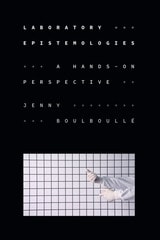
cover of Laboratory Epistemologies: A Hands-On Perspective

Laboratory Epistemologies

A Hands-On Perspective

Jenny Boulboullé

Duke University Press, 2024
In Laboratory Epistemologies: A Hands-On Perspective, Jenny Boulboullé examines the significance of hands-on experiences in contemporary life sciences laboratories. Addressing the relationship between contemplation and manipulation in epistemology, Boulboullé combines participant observations in molecular genetics labs and microbiological cleanrooms with a longue durée study of the history and philosophy of science. She radically rereads Descartes’s key epistemological text Meditations on First Philosophy, reframing the philosopher as a hands-on knowledge maker. With this reading, Boulboullé subverts the pervasive modern conception of the disembodied knower and puts the hands-on experimenter at the heart of life sciences research. In so doing, she contributes a theoretical model for understanding how life processes on cellular and molecular levels are manually produced in today’s techno-scientific spaces. By reassessing the Cartesian legacy and arguing that epistemology should be grounded in the standpoint of a hands-on practitioner, Boulboullé offers the philosophical and historical foundation to understand and study contemporary life sciences research as multisensory embodied practices.
[more]
cover of Late Theory: Fredric Jameson, or The Persistence of Reading

Late Theory

Fredric Jameson, or The Persistence of Reading

Phillip E. Wegner

University of Minnesota Press, 2026

A bold, dialectic engagement with Fredric Jameson’s thought

Fredric Jameson (1934–2024) is widely regarded as the most influential literary and cultural theorist of the past fifty years. The culmination of more than three decades of sustained engagement with Jameson’s work, Late Theory offers a critical response to his late writings, namely the final volumes of his “Poetics of Social Forms,” to develop an original and dialectical reading practice in conversation with his evolving thought.

Jameson’s final works bring renewed clarity to three foundational concerns that structure his intellectual legacy. These are the problem of periodization and the challenge of grasping the present as a historical category, the dangers posed by the rise of moralizing modes of critique in literary and cultural studies, and the radical interpretive potential unlocked by allegory and the semiotic method. Phillip E. Wegner shows how these late interventions mark not a conclusion but an extension of Jameson’s long-standing project: envisioning the dialectic as a living, collective form of reasoning—a “thought mode of the future” capable of transforming our lives.

At its core, Late Theory is a passionate argument for cultural and aesthetic education as a practice of solidarity and imagination. Foregrounding Jameson’s enduring effort to build heterogeneous communities of readers committed to shared inquiry, Wegner affirms the urgency of reading, teaching, and thinking together in a moment of crisis for the university and global culture.

Retail e-book files for this title are screen-reader friendly with images accompanied by short alt text and/or extended descriptions.
[more]
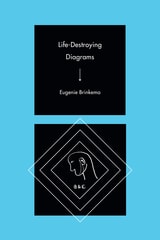
cover of Life-Destroying Diagrams

Life-Destroying Diagrams

Eugenie Brinkema

Duke University Press, 2021
In Life-Destroying Diagrams, Eugenie Brinkema brings the insights of her radical formalism to bear on supremely risky terrain: the ethical extremes of horror and love. Through close readings of works of film, literature, and philosophy, she explores how diagrams, grids, charts, lists, abecedaria, toroids, tempos, patterns, colors, negative space, lengths, increments, and thresholds attest to formal logics of torture and cruelty, violence and finitude, friendship and eros, debt and care. Beginning with a wholesale rethinking of the affect of horror, orienting it away from entrenched models of feeling toward impersonal schemes and structures, Brinkema moves outward to consider the relation between objects and affects, humiliation and metaphysics, genre and the general, bodily destruction and aesthetic generation, geometry and scenography, hatred and value, love and measurement, and, ultimately, the tensions, hazards, and speculative promise of formalism itself. Replete with etymological meditations, performative typography, and lyrical digressions, Life-Destroying Diagrams is at once a model of reading without guarantee and a series of generative experiments in the writing of aesthetic theory.
[more]
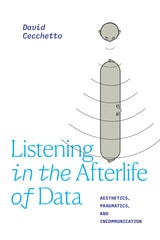
cover of Listening in the Afterlife of Data: Aesthetics, Pragmatics, and Incommunication

Listening in the Afterlife of Data

Aesthetics, Pragmatics, and Incommunication

David Cecchetto

Duke University Press, 2022
In Listening in the Afterlife of Data, David Cecchetto theorizes sound, communication, and data by analyzing them in the contexts of the practical workings of specific technologies, situations, and artworks. In a time he calls the afterlife of data—the cultural context in which data’s hegemony persists even in the absence of any belief in its validity—Cecchetto shows how data is repositioned as the latest in a long line of concepts that are at once constitutive of communication and suggestive of its limits. Cecchetto points to the failures and excesses of communication by focusing on the power of listening—whether through wearable technology, internet-based artwork, or the ways in which computers process sound—to pragmatically comprehend the representational excesses that data produces. Writing at a cultural moment in which data has never been more ubiquitous or less convincing, Cecchetto elucidates the paradoxes that are constitutive of computation and communication more broadly, demonstrating that data is never quite what it seems.
[more]
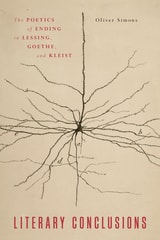
cover of Literary Conclusions: The Poetics of Ending in Lessing, Goethe, and Kleist

Literary Conclusions

The Poetics of Ending in Lessing, Goethe, and Kleist

Oliver Simons

Northwestern University Press, 2022

Endings are not just singular moments in time but the outcomes of a process. And whatever a book’s conclusion, its form has a history. Literary Conclusions presents a new theory of textual endings in eighteenth-century literature and thought. Analyzing essential works by Gotthold Ephraim Lessing, Johann Wolfgang von Goethe, and Heinrich von Kleist, Oliver Simons shows how the emergence of new kinds of literary endings around 1800 is inextricably linked to the history of philosophical and scientific concepts.

Simons examines the interrelations of Lessing’s literary endings with modes of logical conclusion; he highlights how Goethe’s narrative closures are forestalled by an uncontrollable vital force that was discussed in the sciences of the time; and he reveals that Kleist conceived of literary genres themselves as forms of reasoning. Kleist’s endings, Simons demonstrates, mark the beginning of modernism. Through close readings of these authors and supplemental analyses of works by Walter Benjamin, Friedrich Hölderlin, and Georg Wilhelm Friedrich Hegel, he crafts an elegant theory of conclusions that revises established histories of literary genres and forms.
[more]
cover of Living On After Failure: Affective Structures of Modern Life

Living On After Failure

Affective Structures of Modern Life

Irving Goh

Duke University Press, 2025

In Living On After Failure, Irving Goh dwells with failure and all of its negative affects. Goh does not seek a theorization of failure as something to overcome or turn into a recuperative philosophy or progress narrative. Rather, he engages with the ontological condition of failure as a process of staying with the impasse that failure brings. Drawing on the thought of Berlant, Derrida, Foucault, and Nancy, Goh examines works by contemporary writers like Ottessa Moshfegh, Rachel Cusk, Édouard Levé, Yiyun Li, and Kate Zambreno. He guides readers through stages of reckoning with failure as an immersive impasse: flopping, drifting itself, a dark care of the self, melodrama, and postscripting. By unsettling the failure/success binary, Goh provides those who cannot shake off their sense of failure, or who refuse the narratives of progress or success and their ideologies of grit and resilience, with discursive and affective spaces in which to attend to their desire to be attached to their failures.
[more]