Results by title
744 books match the query 'Culture' and 21 start with l
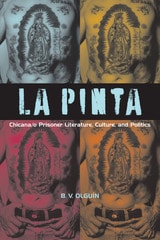
La Pinta
Chicana/o Prisoner Literature, Culture, and PoliticsBy B. V. Olguín
University of Texas Press, 2009
In this groundbreaking study based on archival research about Chicana and Chicano prisoners—known as Pintas and Pintos—as well as fresh interpretations of works by renowned Pinta and Pinto authors and activists, B. V. Olguín provides crucial insights into the central roles that incarceration and the incarcerated have played in the evolution of Chicana/o history, cultural paradigms, and oppositional political praxis.
This is the first text on prisoners in general, and Chicana/o and Latina/o prisoners in particular, that provides a range of case studies from the nineteenth century to the present. Olguín places multiple approaches in dialogue through the pairing of representational figures in the history of Chicana/o incarceration with specific themes and topics. Case studies on the first nineteenth-century Chicana prisoner in San Quentin State Prison, Modesta Avila; renowned late-twentieth-century Chicano poets Raúl Salinas, Ricardo Sánchez, and Jimmy Santiago Baca; lesser-known Chicana pinta and author Judy Lucero; and infamous Chicano drug baron and social bandit Fred Gómez Carrasco are aligned with themes from popular culture such as prisoner tattoo art and handkerchief art, Hollywood Chicana/o gangxploitation and the prisoner film American Me, and prisoner education projects.
Olguín provides a refreshing critical interrogation of Chicana/o subaltern agency, which too often is celebrated as unambiguously resistant and oppositional. As such, this study challenges long-held presumptions about Chicana/o cultures of resistance and proposes important explorations of the complex and contradictory relationship between Chicana/o agency and ideology.
Labor of Fire
The Ontology of Labor between Economy and CultureBruno Gullì
Temple University Press, 2005
Gullì lays the groundwork for his book by offering a critique of productive labor, and then maps out his productive/living labor distinction in detail, reviewing the work of Marx and others.
Labor's Lot
The Power, History, and Culture of Aboriginal ActionElizabeth A. Povinelli
University of Chicago Press, 1994
In Labor's Lot, Povinelli shows how everyday activities shape Aboriginal identity and provide cultural meaning. She focuses on the Belyuen women's interactions with the countryside and on Belyuen conflicts with the Australian government over control of local land. Her analysis raises serious questions about the validity of Western theories about labor and culture and their impact on Aboriginal society.
Povinelli's focus on women's activities provides an important counterpoint to recent works centering on male roles in hunter-gatherer societies. Her unique "cultural economy" approach overcomes the dichotomy between the two standard approaches to these studies. Labor's Lot will engage anyone interested in indigenous peoples or in the relationship between culture and economy in contemporary social practice.

Language Wars
The Role of Media and Culture in Global Terror and Political ViolenceJeff Lewis
Pluto Press, 2005

Language, Culture, and Mind
Edited by Michel Achard and Suzanne Kemmer
CSLI, 2003
Latino Los Angeles in Film and Fiction
The Cultural Production of Social AnxietyIgnacio López-Calvo
University of Arizona Press, 2014
Latino Los Angeles in Film and Fiction sets out to reconfigure the scope of Latino literary and cultural studies. Integrating histories of different regions and nations, the book sets the interplay of unresolved contradictions in this particular metropolitan area. The novelists studied here stem from multiple areas, including the U.S. Southwest, Guatemala, and Chile. The study also incorporates non-Latino writers who have contributed to the Latino culture of the city.
The first chapter examines Latino cultural production from an ecocritical perspective on urban interethnic relations. Chapter 2 concentrates on the representation of daily life in the barrio and the marginalization of Latino urban youth. The third chapter explores the space of women and how female characters expand their area of operations from the domestic space to the public space of both the barrio and the city.
A much-needed contribution to the fields of urban theory, race critical theory, Chicana/o–Latina/o studies, and Los Angeles writing and film, López-Calvo offers multiple theoretical perspectives—including urban theory, ecocriticism, ethnic studies, gender studies, and cultural studies— contextualized with notions of transnationalism and post-nationalism.
Law in the Domains of Culture
Austin Sarat and Thomas R. Kearns, Editors
University of Michigan Press, 2000
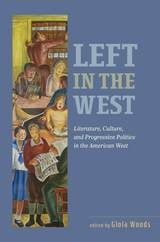
Left in the West
Literature, Culture, and Progressive Politics in the American WestGioia Woods
University of Nevada Press, 2018
From the early 19th century to the present, a remarkably complex and varied body of literary and cultural production has emerged out of progressive social movements. While the literary left in the West shared many interests with other regional expressions—labor, class, anti-fascism, and anti-imperialism, the influence of Manifest Destiny—the distinct history of settler colonialism in western territories caused western leftists to develop concerns unique to the region.
Chapters in the volume provide an impressive range of analysis, covering artists and movements from suffragist writers to bohemian Californian photographers, from civil rights activists to popular folk musicians, from Latinx memoirists to Native American experimental writers, to name just a few.
The unique consideration of the West as a socio-political region establishes a framework for political critique that moves beyond class consequences, anti-fascism, and civil liberties, and into distinct Western concerns such as Native American sovereignty, environmental exploitation, and the legacies of settler colonialism. What emerges is a deeper understanding of the region and its unique people, places, and concerns.
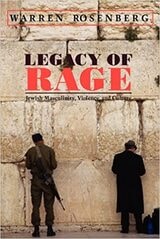
Legacy of Rage
Jewish Masculinity, Violence, and CultureWarren Rosenberg
University of Massachusetts Press, 2009
From Biblical depictions of heroic warriors like King David to the medieval Jewish legend of the Golem (a fierce man of clay created by Cabalistic magic) to the fictional Alexander Portnoy, Jewish ideas of manhood reflect a simultaneous resistance and attraction to violence. According to Rosenberg, it is an ambivalence shaped by millennia of oppression as well as by the clash of Western ideas of masculinity with Eastern European rabbinical injunctions against violent action. The result has been not only gender confusion, but a suppressed rage evident in a broad range of texts created by Jewish men, from nineteenth-century Yiddish stories to contemporary Hollywood films. Isaac Babel, Henry Roth, Norman Mailer, Saul Bellow, Philip Roth, David Mamet, Barry Levinson, and Steven Spielberg are just some of the writers and filmmakers whose lives and works are marked by this legacy of rage.
Yet if the need to affirm masculinity through violence remains an unacknowledged aspect of Jewish male identity, Rosenberg argues, it is not a historical inevitability. As the work of Cynthia Ozick and Tony Kushner suggests, it is possible to construct new ideas of Jewish manhood by exposing the hidden fallacies of the old.
Lesbian Rule
Cultural Criticism and the Value of DesireAmy Villarejo
Duke University Press, 2003
Integrating cinema studies, queer and feminist theory, and cultural studies, Villarejo illuminates the contexts within which the lesbian is rendered visible. Toward that end, she analyzes key portrayals of lesbians in public culture, particularly in documentary film. She considers a range of films—from documentaries about Cuba and lesbian pulp fiction to Exile Shanghai and The Brandon Teena Story—and, in doing so, brings to light a nuanced economy of value and desire.
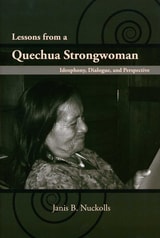
Lessons from a Quechua Strongwoman
Ideophony, Dialogue, and PerspectiveJanis B. Nuckolls
University of Arizona Press, 2010
This book is a fascinating look at ideophones—words that communicate succinctly through imitative sound qualities. They are at the core of Quechua speakers’ discourse—both linguistic and cultural—because they allow agency and reaction to substances and entities as well as beings. Nuckolls shows that Luisa Cadena’s utterances give every individual, major or minor, a voice in her narrative. Sometimes as subtle as a barely felt movement or unintelligible sound, the language supports an amazingly wide variety of voices.
Cadena’s narratives and commentaries on everyday events reveal that sound imitation through ideophones, representations of dialogues between humans and nonhumans, and grammatical distinctions between a speaking self and an other are all part of a language system that allows for the possibility of shared affects, intentions, moral values, and meaningful, communicative interactions between humans and nonhumans.
Let's Speak Twi
A Proficiency Course in Akan Language and CultureAdams Bodomo, Charles Marfo, and Lauren Hall-Lew
CSLI, 2010
Let’s Speak Twi is an introductory language-learning textbook for speakers of English and other languages who seek proficiency in Akan Twi, the most widely used and understood native language of Ghana. Included in the book are several practice exercises and activities; an extensive range of culturally relevant topics and dialogues; lists of idiomatic, colloquial, and euphemistic expressions; a reference glossary; and tips on culturally appropriate behavior.
Liberalism and the Culture of Security
The Nineteenth-Century Rhetoric of ReformKatherine Henry
University of Alabama Press, 2011
Rethinking the language of liberty, protection, and citizenship in nineteenth-century America.
Figures of protection and security are everywhere in American public discourse, from the protection of privacy or civil liberties to the protection of marriage or the unborn, and from social security to homeland security. Liberalism and the Culture of Security traces a crucial paradox in historical and contemporary notions of citizenship: in a liberal democratic culture that imagines its citizens as self-reliant, autonomous, and inviolable, the truth is that claims for citizenship—particularly for marginalized groups such as women and slaves—have just as often been made in the name of vulnerability and helplessness.
Katherine Henry traces this turn back to the eighteenth-century opposition of liberty and tyranny, which imagined our liberties as being in danger of violation by the forces of tyranny and thus in need of protection. She examines four particular instances of this rhetorical pattern. The first chapters show how women’s rights and antislavery activists in the antebellum era exploited the contradictions that arose from the liberal promise of a protected citizenry: first by focusing primarily on arguments over slavery in the 1850s that invoke the Declaration of Independence, including Harriet Beecher Stowe’s fiction and Frederick Douglass’s “Fourth of July” speech; and next by examining Angelina Grimké’s brief but intense antislavery speaking career in the 1830s.
New conditions after the Civil War and Emancipation changed the way arguments about civic inclusion and exclusion could be advanced. Henry considers the issue of African American citizenship in the 1880s and 1890s, focusing on the mainstream white Southern debate over segregation and the specter of a tyrannical federal government, and then turning to Frances E. W. Harper’s fictional account of African American citizenship in Iola Leroy. Finally, Henry examines Henry James’s 1886 novel The Bostonians, in which arguments over the appropriate role of women and the proper place of the South in post–Civil War America are played out as a contest between Olive Chancellor and Basil ransom for control over the voice of the eloquent girl Verena Tarrant.
Libraries As Agencies Of Culture
(Volume 42, No. 3 Of American Studies)Thomas Augst
University of Wisconsin Press, 2002
Life and Times of Cultural Studies
The Politics and Transformation of the Structures of KnowledgeRichard E. Lee
Duke University Press, 2003
Lee tracks the intellectual project of cultural studies as it developed over three decades, beginning with its institutional foundation at the University of Birmingham’s Centre for Contemporary Cultural Studies (CCCS). He links work at the CCCS to the events of 1968 and explores cultural studies’ engagement with theory in the debates on structuralism. He considers the shift within the discipline away from issues of working-class culture toward questions of identity politics in the fields of race and gender. He follows the expansion of the cultural studies project from Britain to Australia, Canada, South Africa, and the United States. Contextualizing the development and spread of cultural studies within the longue durée structures of knowledge in the modern world-system, Lee assesses its past and future as an agent of political and social change.
Limits to Culture
Urban Regeneration vs. Dissident ArtMalcolm Miles
Pluto Press, 2015
Limits to Liberation after Apartheid
Citizenship, Governance, & CultureSteven L. Robins
Ohio University Press, 2005
Lives in Two Languages
An Exploration of Identity and CultureLinda Watkins-Goffman
University of Michigan Press, 2001
Lives in Two Languages focuses on the experience of multicultural authors--like Richard Rodriguez, Amy Tan, Eva Hoffman, Chang-rae Lee, and Julia Alvarez--whose experiences can be related to anyone who has moved from one culture or subculture to another. As such, this text is an excellent comprehensive introduction to the multicultural experience for teachers and educators in all disciplines, as well as of interest to anyone interested in language culture and psychological process of identity.
Locating Cultural Creativity
John Liep
Pluto Press, 2001
Loft Living
Culture and Capital in Urban ChangeZukin, Sharon
Rutgers University Press, 2014

Loft Living
Culture and Capital in Urban ChangeZukin, Sharon
Rutgers University Press, 1989