Results by title
126 books match the query 'Decolonization' and 2 start with l
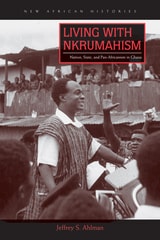
Living with Nkrumahism
Nation, State, and Pan-Africanism in GhanaJeffrey S. Ahlman
Ohio University Press, 2017
In the 1950s, Ghana, under the leadership of Kwame Nkrumah and the Convention People’s Party, drew the world’s attention as anticolonial activists, intellectuals, and politicians looked to it as a model for Africa’s postcolonial future. Nkrumah was a visionary, a statesman, and one of the key makers of contemporary Africa. In Living with Nkrumahism, Jeffrey S. Ahlman reexamines the infrastructure that organized and consolidated Nkrumah’s philosophy into a political program. Ahlman draws on newly available source material to portray an organizational and cultural history of Nkrumahism. Taking us inside bureaucracies, offices, salary structures, and working routines, he painstakingly reconstructs the political and social milieu of the time and portrays a range of Ghanaians’ relationships to their country’s unique position in the decolonization process. Through fine attunement to the nuances of statecraft, he demonstrates how political and philosophical ideas shape lived experience. Living with Nkrumahism stands at the crossroads of the rapidly growing fields of African decolonization, postcolonial history, and Cold War studies. It provides a much-needed scholarly model through which to reflect on the changing nature of citizenship and political and social participation in Africa and the broader postcolonial world.
[more]
Lusophone Africa
Beyond IndependenceFernando Arenas
University of Minnesota Press, 2010
Lusophone Africa: Beyond Independence is a study of the contemporary cultural production of Portuguese-speaking Africa and its critical engagement with globalization in the aftermath of colonialism, especially since the advent of multiparty politics and market-oriented economies.
Exploring the evolving relationship of Lusophone Africa with Portugal, its former colonial power, and Brazil, Fernando Arenas situates the countries on the geopolitical map of contemporary global forces. Drawing from popular music, film, literature, cultural history, geopolitics, and critical theory to investigate the postcolonial condition of Portuguese-speaking Africa, Arenas offers an entirely original discussion of world music phenomenon Cesária Évora, as well as the most thorough examination to date of Lusophone African cinema and of Angolan post-civil-war fiction.
Throughout, Arenas evokes the rich multidimensionality of this community of African nations as a whole and of its individual parts: Angola, Cape Verde, Guinea-Bissau, and Mozambique, and São Tomé and Príncipe since they gained their independence in the mid-1970s. In doing so, he puts forth a conceptual framework for understanding, for the first time, recent cultural and historical developments in Portuguese-speaking Africa.
[more]