453 books match the query 'Economic policy' and 17 start with l
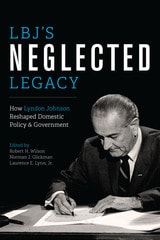
cover of LBJ's Neglected Legacy: How Lyndon Johnson Reshaped Domestic Policy and Government

LBJ's Neglected Legacy

How Lyndon Johnson Reshaped Domestic Policy and Government

Edited by Robert H. Wilson, Norman J. Glickman, and Laurence E. Lynn, Jr.

University of Texas Press, 2015

During the five full years of his presidency (1964–1968), Lyndon Johnson initiated a breathtaking array of domestic policies and programs, including such landmarks as the Civil Rights Act, Head Start, Food Stamps, Medicare and Medicaid, the Immigration Reform Act, the Water Quality Act, the Voting Rights Act, Social Security reform, and Fair Housing. These and other “Great Society” programs reformed the federal government, reshaped intergovernmental relations, extended the federal government’s role into new public policy arenas, and redefined federally protected rights of individuals to engage in the public sphere. Indeed, to a remarkable but largely unnoticed degree,Johnson’s domestic agenda continues to shape and influence current debates on major issues such as immigration, health care, higher education funding, voting rights, and clean water, even though many of his specific policies and programs have been modified or, in some cases, dismantled since his presidency.

LBJ’s Neglected Legacy examines the domestic policy achievements of one of America’s most effective, albeit controversial, leaders. Leading contributors from the fields of history, public administration, economics, environmental engineering, sociology, and urban planning examine twelve of LBJ’s key domestic accomplishments in the areas of citizenship and immigration, social and economic policy, science and technology, and public management. Their findings illustrate the enduring legacy of Johnson’s determination and skill in taking advantage of overwhelming political support in the early years of his presidency to push through an extremely ambitious and innovative legislative agenda, and emphasize the extraordinary range and extent of LBJ’s influence on American public policy and administration.
[more]
cover of Labor and the Chinese Revolution: Class Strategies and Contradictions of Chinese Communism, 1928–1948

Labor and the Chinese Revolution

Class Strategies and Contradictions of Chinese Communism, 1928–1948

S. Bernard Thomas

University of Michigan Press, 1983
In the two-decade period from 1928 to 1948, the proletarian themes and issues underlying the Chinese Communist Party’s ideological utterances were shrouded in rhetoric designed, perhaps, as much to disguise as to chart actual class strategies. Rhetoric notwithstanding, a careful analysis of such pronouncements is vitally important in following and evaluating the party’s changing lines during this key revolutionary period. The function of the “proletariat” in the complex of policy issues and leadership struggles which developed under the precarious circumstances of those years had an importance out of all proportion to labor’s relatively minor role in the post-1927 Communist led revolution. [1, 2]
[more]
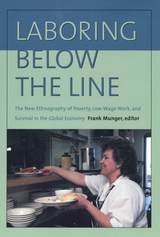
cover of Laboring Below the Line: The New Ethnography of Poverty, Low-Wage Work, and Survival in the Global Economy

Laboring Below the Line

The New Ethnography of Poverty, Low-Wage Work, and Survival in the Global Economy

Frank Munger

Russell Sage Foundation, 2002
As the distribution of wealth between rich and poor in the United States grew more and more unequal over the past twenty years, this economic gap assumed a life of its own in the popular culture. The news and entertainment media increasingly portrayed the lives of the poor with such stereotypes as the lazy welfare mother and the thuggish teen, offering Americans few ways to learn how the "other half" really lives. Laboring Below the Line works to bridge this gap by synthesizing a wide range of qualitative scholarship on the working poor. The result is a coherent, nuanced portrait of how life is lived below the poverty line, and a compelling analysis of the systemic forces in which poverty is embedded, and through which it is perpetuated. Laboring Below the Line explores the role of interpretive research in understanding the causes and effects of poverty. Drawing on perspectives of the working poor, welfare recipients, and marginally employed men and women, the contributors—an interdisciplinary roster of ethnographers, oral historians, qualitative sociologists, and narrative analysts—dissect the life circumstances that affect the personal outlook, ability to work, and expectations for the future of these people. For example, Carol Stack views the work aspirations of an Oakland teenager for whom a job is important, even though it strains her academic performance. And Ruth Buchanan looks at low-wage telemarketing workers who are attempting to move up the economic ladder while balancing family, education, and other important commitments. What emerges is a compelling picture of low-wage workers—one that illustrates the precarious circumstances of individuals struggling with the economic conditions and institutions that surround them Each chapter also explores the capacity for economic survival from a different angle, with ancillary commentary complementing the ethnographies with perspectives from other fields of study, such as economics. At this moment of governmental retrenchment, ethnography's complex, nonstereotypical portraits of individual people fighting against poverty are especially important. Laboring Below the Line reveals the ambiguities of real lives, the potential for individuals to change in unexpected ways, and the even greater intricacy of the collective life of a community.
[more]
cover of Law and Economic Policy in America: The Evolution of the Sherman Antitrust Act

Law and Economic Policy in America

The Evolution of the Sherman Antitrust Act

William Letwin

University of Chicago Press, 1981
William Letwin's thorough, carefully argued, and elegantly written work is the only book length study of the Sherman Antitrust Act, a law designed to shape the economic life of a large complex society through maintaining the "correct" level of competition in the economy. This is a superb history and complete analysis of the Act, from its English and American common law antecedents to the events that led to the first revisions of the Act in the form of the Clayton Antitrust and Federal Trade Commission Acts.
[more]
cover of Law and the Economy in Colonial India

Law and the Economy in Colonial India

Tirthankar Roy and Anand V. Swamy

University of Chicago Press, 2021

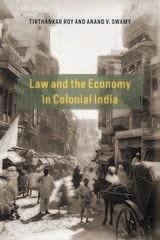
Since the economic reforms of the 1990s, India’s economy has grown rapidly. To sustain growth and foreign investment over the long run requires a well-developed legal infrastructure for conducting business, including cheap and reliable contract enforcement and secure property rights. But it’s widely acknowledged that India’s legal infrastructure is in urgent need of reform, plagued by problems, including slow enforcement of contracts and land laws that differ from state to state. How has this situation arisen, and what can boost business confidence and encourage long-run economic growth?
           
Tirthankar Roy and Anand V. Swamy trace the beginnings of the current Indian legal system to the years of British colonial rule. They show how India inherited an elaborate legal system from the British colonial administration, which incorporated elements from both British Common Law and indigenous institutions. In the case of property law, especially as it applied to agricultural land, indigenous laws and local political expediency were more influential in law-making than concepts borrowed from European legal theory. Conversely, with commercial law, there was considerable borrowing from Europe. In all cases, the British struggled with limited capacity to enforce their laws and an insufficient knowledge of the enormous diversity and differentiation within Indian society. A disorderly body of laws, not conducive to production and trade, evolved over time. Roy and Swamy’s careful analysis not only sheds new light on the development of legal institutions in India, but also offers insights for India and other emerging countries through a look at what fosters the types of institutions that are key to economic growth.
[more]
cover of Law of Accumulation and Breakdown of the Capitalist System

Law of Accumulation and Breakdown of the Capitalist System

Henryk Grossmann

Pluto Press, 1992

[more]
cover of Law, Legislation and Liberty, Volume 1: Rules and Order

Law, Legislation and Liberty, Volume 1

Rules and Order

F. A. Hayek

University of Chicago Press, 1978

This volume represents the first section of F. A. Hayek's comprehensive three-part study of the relations between law and liberty. Rules and Order constructs the framework necessary for a critical analysis of prevailing theories of justice and of the conditions which a constitution securing personal liberty would have to satisfy.
[more]
cover of Law, Legislation and Liberty, Volume 2: The Mirage of Social Justice

Law, Legislation and Liberty, Volume 2

The Mirage of Social Justice

F. A. Hayek

University of Chicago Press, 1977

F. A. Hayek made many valuable contributions to the field of economics as well as to the disciplines of philosophy and politics. This volume represents the second of Hayek's comprehensive three-part study of the relations between law and liberty. Here, Hayek expounds his conviction that he continued unexamined pursuit of "social justice" will contribute to the erosion of personal liberties and encourage the advent of totalitarianism.
[more]
cover of Law, Legislation and Liberty, Volume 3: The Political Order of a Free People

Law, Legislation and Liberty, Volume 3

The Political Order of a Free People

F. A. Hayek

University of Chicago Press, 1981
Incisive, straightforward, and eloquent, this third and concluding volume of F. A. Hayek's comprehensive assessment of the basic political principles which order and sustain free societies contains the clearest and most uncompromising exposition of the political philosophy of one of the world's foremost economists.
[more]
cover of Law, Legislation, and Liberty, Volume 19

Law, Legislation, and Liberty, Volume 19

F. A. Hayek

University of Chicago Press, 2021

A new edition of F. A. Hayek’s three-part opus Law, Legislation, and Liberty, collated in a single volume
In this critical entry in the University of Chicago’s Collected Works of F. A. Hayek series, political philosopher Jeremy Shearmur collates Hayek’s three-part study of law and liberty and places Hayek’s writings in careful historical context. Incisive and unrestrained, Law, Legislation, and Liberty is Hayek at his late-life best, making it essential reading for understanding the philosopher’s politics and worldview. 

These three volumes constitute a scaling up of the framework offered in Hayek’s famed The Road to Serfdom. Volume 1, Rules and Order, espouses the virtues of classical liberalism; Volume 2, The Mirage of Social Justice, examines the societal forces that undermine liberalism and, with it, liberalism’s capacity to induce “spontaneous order”; and Volume 3, The Political Order of a Free People, proposes alternatives and interventions against emerging anti-liberal movements, including a rule of law that resides in stasis with personal freedom. 

Shearmur’s treatment of this challenging work—including an immersive new introduction, a conversion of Hayek’s copious endnotes to footnotes, corrections to Hayek’s references and quotations, and the provision of translations to material that Hayek cited only in languages other than English—lends it new importance and accessibility. Rendered anew for the next generations of scholars, this revision of Hayek’s Law, Legislation, and Liberty is sure to become the standard.
[more]
cover of Leading Questions: How Hegemony Affects the International Political Economy

Leading Questions

How Hegemony Affects the International Political Economy

Robert Pahre

University of Michigan Press, 1999

Leadership has long been an important subject in the study of international economic relations. Many scholars give American leadership credit for strong economic growth in western Europe and Japan after World War II. Other scholars have accused leading nations of using their power to the detriment of foreign countries. For example, it is often argued that a failure of both British and American leadership was a cause of the Great Depression of the 1930s.
In Leading Questions, Robert Pahre develops a series of formal models to determine under what conditions leadership will be beneficial or harmful for the international political economy. He begins with a simple model of collective action and then adds leadership, security concerns, cooperation, and multilateral regimes to this basic model. He tests each model against a different historical period between 1815 and 1967.
Pahre's findings challenge conventional wisdom on international leadership. He finds that a leading state harms others when it has many allies but is good for the international political economy when it lacks allies. Leaders are less likely to engage in international cooperation than are other states, but having a leader in the system makes cooperation among follower states more likely. Cooperation by others may cause the leader to join a system of multilateral cooperation.
Pahre presents the technical material in an accessible style. By challenging the conventional interpretations of political economy in several historical periods, Leading Questions will be of interest not only to political scientists but also to economists and historians.
Robert Pahre is Associate Professor of Political Science, University of Illinois at Urbana-Champaign.
[more]
cover of Left Behind: Latin America and the False Promise of Populism

Left Behind

Latin America and the False Promise of Populism

Sebastian Edwards

University of Chicago Press, 2010

The political and economic history of Latin America has been marked by great hopes and even greater disappointments. Despite abundant resources—and a history of productivity and wealth—in recent decades the region has fallen further and further behind developed nations, surpassed even by other developing economies in Southeast Asia and elsewhere.

In Left Behind, Sebastian Edwards explains why the nations of Latin America have failed to share in the fruits of globalization and forcefully highlights the dangers of the recent turn to economic populism in the region. He begins by detailing the many ways Latin American governments have stifled economic development over the years through excessive regulation, currency manipulation, and thoroughgoing corruption. He then turns to the neoliberal reforms of the early 1990s, which called for the elimination of deficits, lowering of trade barriers, and privatization of inefficient public enterprises—and which, Edwards argues, held the promise of freeing Latin America from the burdens of the past. Flawed implementation, however, meant the promised gains of globalization were never felt by the mass of citizens, and growing frustration with stalled progress has led to a resurgence of populism throughout the region, exemplified by the economic policies of Venezuela’sHugo Chávez. But such measures, Edwards warns, are a recipe for disaster; instead, he argues, the way forward for Latin America lies in further market reforms, more honestly pursued and fairly implemented. As an example of the promise of that approach, Edwards points to Latin America's giant, Brazil, which under the successful administration of President Luis Inácio da Silva (Lula) has finally begun to show signs of reaching its true economic potential.

As the global financial crisis has reminded us, the risks posed by failing economies extend far beyond their national borders. Putting Latin America back on a path toward sustained growth is crucial not just for the region but for the world, and Left Behind offers a clear, concise blueprint for the way forward.

[more]
cover of Legacies of the War on Poverty 

Legacies of the War on Poverty 

Martha J. Bailey

Russell Sage Foundation, 2013
Many believe that the War on Poverty, launched by President Johnson in 1964, ended in failure. In 2010, the official poverty rate was 15 percent, almost as high as when the War on Poverty was declared. Historical and contemporary accounts often portray the War on Poverty as a costly experiment that created doubts about the ability of public policies to address complex social problems. Legacies of the War on Poverty, drawing from fifty years of empirical evidence, documents that this popular view is too negative. The volume offers a balanced assessment of the War on Poverty that highlights some remarkable policy successes and promises to shift the national conversation on poverty in America. Featuring contributions from leading poverty researchers, Legacies of the War on Poverty demonstrates that poverty and racial discrimination would likely have been much greater today if the War on Poverty had not been launched. Chloe Gibbs, Jens Ludwig, and Douglas Miller dispel the notion that the Head Start education program does not work. While its impact on children’s test scores fade, the program contributes to participants’ long-term educational achievement and, importantly, their earnings growth later in life. Elizabeth Cascio and Sarah Reber show that Title I legislation reduced the school funding gap between poorer and richer states and prompted Southern school districts to desegregate, increasing educational opportunity for African Americans. The volume also examines the significant consequences of income support, housing, and health care programs. Jane Waldfogel shows that without the era’s expansion of food stamps and other nutrition programs, the child poverty rate in 2010 would have been three percentage points higher. Kathleen McGarry examines the policies that contributed to a great success of the War on Poverty: the rapid decline in elderly poverty, which fell from 35 percent in 1959 to below 10 percent in 2010. Barbara Wolfe concludes that Medicaid and Community Health Centers contributed to large reductions in infant mortality and increased life expectancy. Katherine Swartz finds that Medicare and Medicaid increased access to health care among the elderly and reduced the risk that they could not afford care or that obtaining it would bankrupt them and their families. Legacies of the War on Poverty demonstrates that well-designed government programs can reduce poverty, racial discrimination, and material hardships. This insightful volume refutes pessimism about the effects of social policies and provides new lessons about what more can be done to improve the lives of the poor.
[more]
cover of Lessons from East Asia

Lessons from East Asia

Danny M. Leipziger, Editor

University of Michigan Press, 2001

This compilation of case studies and cross-country essays focuses on the role of public policy in the experience of East Asian economies. A major theme running through the volume is regional learning and regional contagion -- the spread of that learning. Beginning with the model and experience of Japan and continuing with the impressive achievements of countries originally considered unviable in the 1950s and 1960s, like Korea and Taiwan, contributors demonstrate how regional policy lessons permeated borders easily. The 1980s brought further lessons and flows of capital to the second generation of rapid industrializers. And the 1990s have seen regional contagion benefit new aspirants like Vietnam. As the chapters cumulatively reveal, however, the transferability of lessons depends on the institutional framework in which policy is formulated, the consistency of policy, and the quality of implementation. Part 1 includes the case studies for the first generation of rapidly developing East Asian economics -- the tigers -- while Part 2 incorporates the later generation success stories -- the cubs -- plus the Philippines, a country only now beginning to show significant progress. Part 3 includes cross-country essays on public investment, foreign direct investment, and cross-country patterns that synthesize the lessons learned and propose actions for other development aspirants to pursue. The essays aim to fill two major gaps -- the paucity of country-specific work on the institutional side of development policy and the failure to explain the mixed record of industrial policies in East Asia. The volume will appeal to students, scholars, and policymakers in development economics. This title was formally part of the Studies in International Trade Policy Series, now called Studies in International Economics.
[more]
cover of Limits and Possibilities: The Crisis of Yugoslav Socialism and State Socialist Systems

Limits and Possibilities

The Crisis of Yugoslav Socialism and State Socialist Systems

Bogdan Denitch

University of Minnesota Press, 1990

Limits and Possibilities was first published in 1990. Minnesota Archive Editions uses digital technology to make long-unavailable books once again accessible, and are published unaltered from the original University of Minnesota Press editions.

The nature of the Eastern European Socialist state and its potential for transformation without sacrificing its specific identity is the subject of extensive current debate. Limits and Possibilities is the first book to be written that deals conceptually and historically with the myriad kinds of change a state might undergo. Bogdon Denitch has chosen the Yugoslavian model to frame his analysis because it initiated these "modernizing" changes in the 1960s and can therefore provide a case study of the limits of reforms possible in Communist regimes. In using the Yugoslav case paradigmatically, the volume addresses in a more general sense the issues of decentralization, autonomy for nonparty and nonstate institutions, multi-ethnicity, new social movements, including the "greens," and the role of women and women's movements.
[more]
cover of Lincoln and the Economics of the American Dream

Lincoln and the Economics of the American Dream

Gabor S. Boritt

University of Illinois Press, 1994

This unique exploration of Lincoln's economic beliefs shows how they helped shape his view of slavery, his conduct of the war, and most fundamentally his understanding of what the United States was and could become.
[more]
cover of Locating the Proper Authorities: The Interaction of Domestic and International Institutions

Locating the Proper Authorities

The Interaction of Domestic and International Institutions

Daniel W. Drezner, Editor

University of Michigan Press, 2002

In an era of democratization and globalization, the number of decision makers has multiplied exponentially. Parliamentarians, bureaucrats, international secretariats, regional governors, and nongovernmental organizations have all gained influence at the expense of heads of state. How do these competing layers of authority bargain with each other to govern? International relations theorists have traditionally focused on how leaders' domestic constraints affect their bargaining position internationally. However, there has been much less work on the flip side of this question--how foreign policy leaders can use international institutions as a means of circumventing or co-opting domestic opposition. Locating the Proper Authorities offers some preliminary answers, drawn from a number of theoretical perspectives by the contributors to this volume.
Written by some of the most promising theorists in the field of international relations, the essays in Locating the Proper Authorities address a broad array of substantive issue areas, including humanitarian intervention, trade dispute settlement, economic development, democratic transition, and security cooperation. This broad case selection has the virtue of incorporating developing countries, which are too often ignored in international relations, as well as less well-known international organizations. Each chapter examines the mechanisms and strategies through which policy entrepreneurs use international organizations as a means of bypassing or overcoming opposition to policy change. By examining the effects of different institutional design features, Locating the Proper Authorities helps us understand the variety of influence mechanisms through which international institutions shape the interaction of policy initiators and ratifiers.
Daniel W. Drezner is Assistant Professor of Political Science, University of Chicago.
[more]