Results by title
79 books match the query 'Election' and 5 start with l
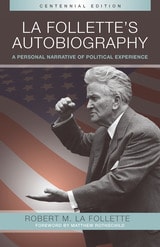
La Follette’s Autobiography
A Personal Narrative of Political ExperiencesRobert M. La Follette; Foreword by Matthew Rothschild
University of Wisconsin Press, 2013
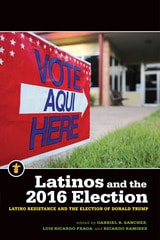
Latinos and the 2016 Election
Latino Resistance and the Election of Donald TrumpGabriel R. Sanchez
Michigan State University Press, 2020
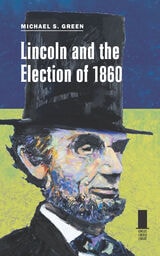
Lincoln and the Election of 1860
Michael S. Green
Southern Illinois University Press, 2011
Although Lincoln rose to national prominence in 1858 during his debates with Stephen Douglas, he was unable to publicly stump for the presidency in a time when personal campaigning for the office was traditionally rejected. This limitation did nothing to check Lincoln’s ambitions, however, as he consistently endeavored to place himself in the public eye while stealthily pulling political strings behind the scenes. Green demonstrates how Lincoln drew upon his considerable communication abilities and political acumen to adroitly manage allies and enemies alike, ultimately uniting the Republican Party and catapulting himself from his status as one of the most unlikely of candidates to his party’s nominee at the national convention.
As the general election campaign progressed, Lincoln continued to draw upon his experience from three decades in Illinois politics to unite and invigorate the Republican Party. Democrats fell to divisions between North and South, setting the stage for a Republican victory in November—and for the most turbulent times in U.S. history.
Moving well beyond a study of the man to provide astute insight into the era’s fiery political scene and its key players, Green offers perceptive analysis of the evolution of American politics and Lincoln’s political career, the processes of the national and state conventions, how political parties selected their candidates, national developments of the time and their effects on Lincoln and his candidacy, and Lincoln’s own sharp—and often surprising—assessments of his opponents and colleagues. Green frequently employs Lincoln’s own words to afford an intimate view into the political savvy of the future president.
The pivotal election of 1860 previewed the intelligence, patience, and shrewdness that would enable Lincoln to lead the United States through its greatest upheaval. This exciting new book brings to vivid life the cunning and strength of one of America’s most intriguing presidents during his journey to the White House.
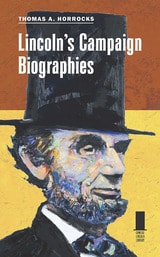
Lincoln's Campaign Biographies
Thomas A. Horrocks
Southern Illinois University Press, 2014
During the 1860 and 1864 presidential campaigns, Abraham Lincoln was the subject of over twenty campaign biographies. In this innovative study, Thomas A. Horrocks examines the role that these publications played in shaping an image of Lincoln that would resonate with voters and explores the vision of Lincoln that the biographies crafted, the changes in this vision over the course of four years, and the impact of these works on the outcome of the elections.
Horrocks investigates Lincoln’s campaign biographies within the context of the critical relationship between print and politics in nineteenth-century America and compares the works about Lincoln with other presidential campaign biographies of the era. Horrocks shows that more than most politicians of his day, Lincoln deeply appreciated and understood the influence and the power of the printed word.
The 1860 campaign biographies introduced to America “Honest Abe, the Rail Splitter,” a trustworthy, rugged candidate who appealed to rural Americans. When Lincoln ran for reelection in 1864, the second round of campaign biographies complemented this earlier portrait of Lincoln with a new, paternal figure, “Father Abraham,” more appropriate for Americans enduring a bloody civil war. Closing with a consideration of the influence of these publications on Lincoln’s election and reelection, Lincoln’s Campaign Biographies provides a new perspective for those seeking a better understanding of the sixteenth president and two of the most critical elections in American history.
Lincoln's Rise to Eloquence
How He Gained the Presidential NominationD. Leigh Henson
University of Illinois Press, 2024
Insightful and revealing, Lincoln’s Rise to Eloquence follows Lincoln from his early career through the years-long clashes with Stephen A. Douglas to trace the future president’s evolution as a communicator and politician.