Results by title
681 books match the query 'English language' and 18 start with l
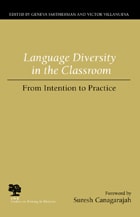
Language Diversity in the Classroom
From Intention to PracticeEdited by Geneva Smitherman and Victor Villanueva. Foreword by Suresh Canagarajah
Southern Illinois University Press, 2003
It’s no secret that, in most American classrooms, students are expected to master standardized American English and the conventions of Edited American English if they wish to succeed. Language Diversity in the Classroom: From Intention to Practice works to realign these conceptions through a series of provocative yet evenhanded essays that explore the ways we have enacted and continue to enact our beliefs in the integrity of the many languages and Englishes that arise both in the classroom and in professional communities.
Edited by Geneva Smitherman and Victor Villanueva, the collection was motivated by a survey project on language awareness commissioned by the National Council of Teachers of English and the Conference on College Composition and Communication.
All actively involved in supporting diversity in education, the contributors address the major issues inherent in linguistically diverse classrooms: language and racism, language and nationalism, and the challenges in teaching writing while respecting and celebrating students’ own languages. Offering historical and pedagogical perspectives on language awareness and language diversity, the essays reveal the nationalism implicit in the concept of a “standard English,” advocate alternative training and teaching practices for instructors at all levels, and promote the respect and importance of the country’s diverse dialects, languages, and literatures.
Contributors include Geneva Smitherman, Victor Villanueva, Elaine Richardson, Victoria Cliett, Arnetha F. Ball, Rashidah Jammi` Muhammad, Kim Brian Lovejoy, Gail Y. Okawa, Jan Swearingen, and Dave Pruett.
The volume also includes a foreword by Suresh Canagarajah and a substantial bibliography of resources about bilingualism and language diversity.
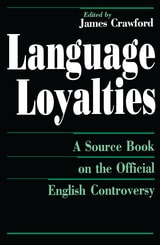
Language Loyalties
A Source Book on the Official English ControversyEdited by James Crawford
University of Chicago Press, 1992
Supporters argue that English has always been our common language—a means of resolving conflicts in a nation of diverse racial, ethnic, and religious groups, and an essential tool of social mobility and cultural integration. Opponents charge that the amendment is unnecessary and that it threatens civil rights, educational opportunities, and free speech, wrapping racist biases in a cloak of patriotism.
Language Loyalties: A Source Book on the Official English Controversy provides a balanced, comprehensive guide to this complex and often confusing debate. It is an essential handbook and reference for advocates, educators, policymakers, jurists, scholars, and citizens who seek to join this debate fully informed. Addressing the issues involved in developing America's first planned national language policy, James Crawford has expertly collected and introduced more than eighty-five source documents and articles.
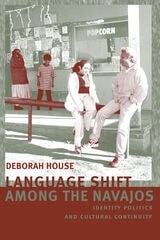
Language Shift among the Navajos
Identity Politics and Cultural ContinuityDeborah House
University of Arizona Press, 2002
Language Shift among the Navajos provides a close look at the ideological factors that intervene between the desire of the Navajos to maintain their language as an important aspect of their culture and their actual linguistic practice. Based on more than ten years of fieldwork within a Navajo institution and community, it points to ideologies held by Navajo people about their unequal relationship with the dominant American society as a primary factor in the erosion of traditional language use. House suggests that the Navajos employ their own paradigm—Sa’ah Naagháí Bik’eh Hózhóón—to learn both Western language and culture and their own without denigrating either perspective. By building on the traditional Navajo belief in harmony and balance, she advocates that those who value the language should use and teach it not just in school but also in the home, in the ceremonial hogans, and among those who cherish their heritage. Now is the time when language choices and behavior will influence whether the Navajo language lives or dies. House's book carries important lessons for anyone concerned with cultural continuity. It is a wake-up call for educators, youth, politicians, or family and community members who value Native language and culture. It remains to be seen in what language that call will be answered.
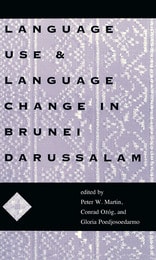
Language Use and Language Change in Brunei Darussalam
Mis Sea#100Peter W. Martin
Ohio University Press, 1996
The oil-rich sultanate of Brunei Darussalam is located on the northern coast of Borneo between the two Malaysian states of Sarawak and Sabah. Though the country is small in size and in population, the variety of language use there provides a veritable laboratory for linguists in the fields of Austronesian linguistics, bilingual studies, and sociolinguistic studies, particularly those dealing with language shift.
This useful reference is divided into three sections: one on varieties of the Malay language used in the country, one on other indigenous languages, and one on the role and form of the English used there. Contributors to the collection include Bruneian scholars as well as established experts in the fields of Austronesian linguistics, sociolinguistics studies, and the description of new varieties of English.
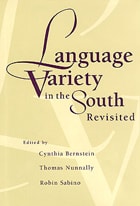
Language Variety in the South Revisited
Cynthia Bernstein
University of Alabama Press, 1994
Top linguists from diverse fields address language varieties in the South.
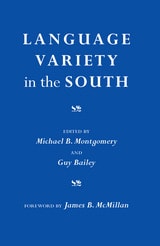
Language Variety in the South
Perspectives in Black and WhiteMichael B. Montgomery
University of Alabama Press, 1986
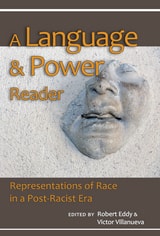
Language and Power Reader
Representations of Race in a "Post-Racist" EraRobert Eddy
Utah State University Press, 2014
A Language and Power Reader organizes reading and writing activities for undergraduate students, guiding them in the exploration of racism and cross-racial rhetorics.
Introducing texts written from and about versions of English often disrespected by mainstream Americans, A Language and Power Reader highlights English dialects and discourses to provoke discussions of racialized relations in contemporary America. Thirty selected readings in a range of genres and from writers who work in ?alternative? voices (e.g., Pidgin, African American Language, discourse of international and transnational English speakers) focus on disparate power relations based on varieties of racism in America and how those relations might be displayed, imposed, or resisted across multiple rhetorics. The book also directs student participation and discourse. Each reading is followed by comments and guides to help focus conversation.
Research has long shown that increasing a student?s metalinguistic awareness improves a student?s writing. No other reader available at this time explores the idea of multiple rhetorics or encourages their use, making A Language and Power Reader a welcome addition to writing classrooms.
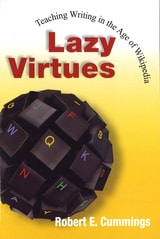
Lazy Virtues
Teaching Writing in the Age of WikipediaRobert E. Cummings
Vanderbilt University Press, 2008
Focusing largely on the controversial website Wikipedia, the author explores the challenges confronting teachers of college writing in the increasingly electronic and networked writing environments their students use every day. Rather than praising or condemning that site for its role as an encyclopedia, Cummings instead sees it as a site for online collaboration between writers and a way to garner audience for student writing.
Applying an understanding of Commons-Based Peer Production theory, as developed by Yochai Benkler, this text is arranged around the following propositions:
-- Commons-Based Peer Production is a novel economic phenomenon which informs our current teaching model and describes a method for making sense of future electronic developments.
-- College writers are motivated to do their best work when they write for an authentic audience, external to the class.
-- Writing for a networked knowledge community invites students to participate in making knowledge, rather than only consuming it.
-- A plan for integrating networked writing for an external audience helps students understand the transition from high school to college writing.
-- Allowing students to review and self-select points of entry into electronic discourse fosters "laziness," or a new work dynamic where writers seek to better understand their own creativity in terms of a project's demands.
Lazy Virtues offers networked writing assignments to foster development of student writers by exposing them to the demands of professional audiences, asking them to identify and assess their own creative impulses in terms of a project's needs, and removing the writing teacher from the role of sole audience.
Learning from the Mess
Method/ological Praxis in Rhetoric and Writing StudiesAshley J. Holmes
University Press of Colorado, 2024
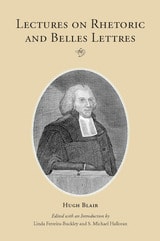
Lectures on Rhetoric and Belles Lettres
Hugh Blair. Edited by Linda Ferreira-Buckley and S. Michael Halloran
Southern Illinois University Press, 2005
This new edition of Hugh Blair’s Lectures on Rhetoric and Belles Lettres, edited by Linda Ferreira-Buckley and S. Michael Halloran, answers the need for a complete, reliable text. The book seeks to generate a renewed interest in Blair by provoking new inquiries into the tradition of belletristic rhetoric and by serving as both aid and incentive to others who may join in the project of improving understanding of this landmark rhetorical scholarship.
This editioncontains forty-seven lectures and remains faithful to the text of the 1785 London edition. The editors contextualize Hugh Blair’s motivations and thinking by providing in their introduction an extended account of Blair’s life and era. The bibliography of works by and about Blair is an invaluable aid, surpassing previous research on Blair.
Although the extent of its influence cannot be measured fully, Blair’s Lectures on Rhetoric and Belles Lettres was undoubtedly a primary vehicle for introducing many eighteenth- and nineteenth-century scholars to classical rhetoric and French belletristic rhetoric—its success due in part to the ease with which the lectures combine neoclassical and Enlightenment thought, accommodating emerging social concerns. Ferreira-Buckley and Halloran’s extensive treatment revives the tradition of belletristic rhetoric, improving the understanding of Blair’s place in the study of eighteenth- and nineteenth-century discourse, while finding him relevant in the twenty-first century.
Lexical Change and Variation in the Southeastern United States, 1930-1990
Ellen Johnson
University of Alabama Press, 1996
This book discusses words used in the Southeast and how they have changed
during the 20th century. It also describes how the lexicon varies according
to the speaker's age, race, education, sex, and place of residence
(urban versus rural; coastal versus piedmont versus mountain). Data collected
in the 1930s as part of the Linguistic Atlas of the Middle and South Atlantic
States project were compared with data collected in 1990 from similar speakers
in the same communities.
The results show that region was the most important
factor in differentiating dialects in the 1930s but that it is the least
important element in the 1990s, with age, education, race, and age all
showing about the same influence on the use of vocabulary. An appendix
contains a tally of the responses given by 78 speakers to 150 questions
about vocabulary items, along with speakers' commentary. Results
from the 1930s may be compared to those from 1990, making this a treasure
trove for anyone interested in regional terms or in how our speech is changing
as the South moves from an agricultural economy through industrialization
and into the information age.
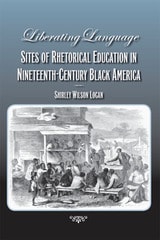
Liberating Language
Sites of Rhetorical Education in Nineteenth-Century Black AmericaShirley Wilson Logan
Southern Illinois University Press, 2008
Liberating Language identifies experiences of nineteenth-century African Americans—categorized as sites of rhetorical education—that provided opportunities to develop effective communication and critical text-interpretation skills. Author Shirley Wilson Logan considers how nontraditional sites, which seldom involved formal training in rhetorical instruction, proved to be effective resources for African American advancement.
Logan traces the ways that African Americans learned lessons in rhetoric through language-based activities associated with black survival in nineteenth-century America, such as working in political organizations, reading and publishing newspapers, maintaining diaries, and participating in literary societies. According to Logan, rhetorical training was manifested through places of worship and military camps, self-education in oratory and elocution, literary societies, and the black press. She draws on the experiences of various black rhetors of the era, such as
Frederick Douglass, Frances Harper, Fanny Coppin, Charles Chesnutt, Ida B. Wells, and the lesser-known Oberlin-educated Mary Virginia Montgomery, Virginia slave preacher "Uncle Jack," and former slave "Mrs. Lee."
Liberating Language addresses free-floating literacy, a term coined by scholar and writer Ralph Ellison, which captures the many settings where literacy and rhetorical skills were acquired and developed, including slave missions, religious gatherings, war camps, and even cigar factories. In Civil War camp- sites, for instance, black soldiers learned to read and write, corresponded with the editors of black newspapers, edited their own camp-based papers, and formed literary associations.
Liberating Language outlines nontraditional means of acquiring rhetorical skills and demonstrates how African Americans, faced with the lingering consequences of enslavement and continuing oppression, acquired rhetorical competence during the late eighteenth century and throughout the nineteenth century.
Listening Myths
Applying Second Language Research to Classroom TeachingSteven Brown
University of Michigan Press, 2011
This volume was conceived as a "best practices" resource for teachers of ESL listening courses in the way that Vocabulary Myths by Keith S. Folse (and Writing Myths by Joy Reid) is one for reading and vocabulary teachers. It was written to help ensure that teachers of listening are not perpetuating the myths of teaching listening.
Both the research and pedagogy in this book are based on the newest research in the field of second language acquisition. Steven Brown is the author of the Active Listening textbook series and is a teacher trainer.
The myths debunked in this book are:
§ Listening is the same as reading.
§ Listening is passive.
§ Listening equals comprehension.
§ Because L1 language ability is effortlessly acquired, L2 listening ability is too.
§ Listening means listening to conversations.
§ Listening is an individual, inside-the-head process.
§ Students should only listen to authentic materials.
§ Listening can’t be taught
Listening to Our Elders
Working and Writing for ChangeSamantha Blackmon, Cristina Kirklighter, and Steve Parks, eds.
Utah State University Press, 2011
In 2011, the National Council of Teachers of English (NCTE) turned one hundred years old. But our profession is endlessly beginning, constantly transforming itself and its purpose as new voices and identities claim their rights in our classrooms and in our country. The recognition of such claims, however, does not occur without a struggle, without collective work.
Listening to our Elders attempts to capture the history of those collective moments where teachers across grade levels and institutions of higher education organized to insure that the voices, heritages, and traditions of their students and colleagues were recognized within our professional organizations as a vital part of our classrooms and our discipline. In doing so, Listening to Our Elders demonstrates this recognition was not always easily given. Instead, whether the issue was race, sexuality, class, or disability, committed activist organizations have often had to push against the existing limits of our field and its organizations to insure a broader sense of common responsibility and humanity was recognized.
Listening to Our Elders features interviews with Malea Powell (Native American Caucus), Joyce Rain Anderson (Native American Caucus), Jeffery Paul Chan (Asian/Asian American), James Hill (Black Caucus), James Dolmage (Committee for Disability Issue in College Composition), Geneva Smitherman (Language Policy Commitee), Carlota Cárdenas de Dwyer (Latino/a Caucus), Victor Villanueva (Latino/a Caucus), Louise Dunlap (Progressive Caucus), Karen Hollis (Progressive Caucus), Louie Crew (Queer Caucus), William Thelin (Working Class Culture and Pedagogy SIG), Bill Macauley (Working Class Culture and Pedagogy SIG).
Literacy and Deaf People
Cultural and Contextual PerspectivesBrenda Jo Brueggemann
Gallaudet University Press, 2004
This compelling collection advocates for an alternative view of deaf people’s literacy, one that emphasizes recent shifts in Deaf cultural identity rather than a student’s past educational context as determined by the dominant hearing society. Divided into two parts, the book opens with four chapters by leading scholars Tom Humphries, Claire Ramsey, Susan Burch, and volume editor Brenda Jo Brueggemann. These scholars use diverse disciplines to reveal how schools where deaf children are taught are the product of ideologies about teaching, about how deaf children learn, and about the relationship of ASL and English.
Part Two features works by Elizabeth Engen and Trygg Engen; Tane Akamatsu and Ester Cole; Lillian Buffalo Tompkins; Sherman Wilcox and BoMee Corwin; and Kathleen M. Wood. The five chapters contributed by these noteworthy researchers offer various views on multicultural and bilingual literacy instruction for deaf students. Subjects range from a study of literacy in Norway, where Norwegian Sign Language recently became the first language of instruction for deaf pupils, to the difficulties faced by deaf immigrant and refugee children who confront institutional and cultural clashes. Other topics include the experiences of deaf adults who became bilingual in ASL and English, and the interaction of the pathological versus the cultural view of deafness. The final study examines literacy among Deaf college undergraduates as a way of determining how the current social institution of literacy translates for Deaf adults and how literacy can be extended to deaf people beyond the age of 20.

Literacy in American Schools
Learning to Read and WriteEdited by Nancy L. Stein
University of Chicago Press, 1986
Literacy, Sexuality, Pedagogy
Theory and Practice for Composition StudiesJonathan Alexander
Utah State University Press, 2008
In Literacy, Sexuality, Pedagogy, Jonathan Alexander argues for the development of students' "sexual literacy." Such a literacy is not just concerned with developing fluency with sexuality as a "hot" topic, but with understanding the intimate interconnectedness of sexuality and literacy in Western culture. Using the work of scholars in queer theory, sexuality studies, and the New Literacy Studies, Alexander unpacks what he sees as a crucial--if often overlooked--dimension of literacy: the fundamental ways in which sexuality has become a key component of contemporary literate practice, of the stories we tell about ourselves, our communities, and our political investments.
Alexander then demonstrates through a series of composition exercises and writing assignments how we might develop students' understanding of sexual literacy. Examining discourses of gender, heterosexuality, and marriage allows students (and instructors) a critical opportunity to see how the languages we use to describe ourselves and our communities are saturated with ideologies of sexuality. Understanding how sexuality is constructed and deployed as a way to "make meaning" in our culture gives us a critical tool both to understand some of the fundamental ways in which we know ourselves and to challenge some of the norms that govern our lives. In the process, we become more fluent with the stories that we tell about ourselves and discover how normative notions of sexuality enable (and constrain) narrations of identity, culture, and politics. Such develops not only our understanding of sexuality, but of literacy, as we explore how sexuality is a vital, if vexing, part of the story of who we are.
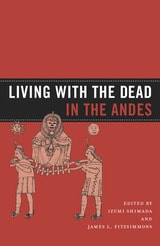
Living with the Dead in the Andes
Edited by Izumi Shimada and James L. Fitzsimmons
University of Arizona Press, 2015
Living with the Dead in the Andes considers recent research by archaeologists, bioarchaeologists, ethnographers, and ethnohistorians whose work reveals the diversity and complexity of the dead-living interaction. The book’s contributors reap the salient results of this new research to illuminate various conceptions and treatments of the dead: “bad” and “good” dead, mummified and preserved, the body represented by art or effigies, and personhood in material and symbolic terms.
Death does not end or erase the emotional bonds established in life, and a comprehensive understanding of death requires consideration of the corpse, the soul, and the mourners. Lingering sentiment and memory of the departed seems as universal as death itself, yet often it is economic, social, and political agendas that influence the interactions between the dead and the living.
Nine chapters written by scholars from diverse countries and fields offer data-rich case studies and innovative methodologies and approaches. Chapters include discussions on the archaeology of memory, archaeothanatology (analysis of the transformation of the entire corpse and associated remains), a historical analysis of postmortem ritual activities, and ethnosemantic-iconographic analysis of the living-dead relationship. This insightful book focuses on the broader concerns of life and death.