122 books match the query 'English poetry' and 4 start with l
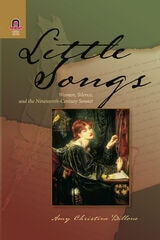
cover of LITTLE SONGS: WOMEN, SILENCE, AND THE NINETEENTH-CENTURY SONNET

LITTLE SONGS

WOMEN, SILENCE, AND THE NINETEENTH-CENTURY SONNET

AMY CHRISTINE BILLONE

The Ohio State University Press, 2002
In Little Songs: Women, Silence, and the Nineteenth-Century Sonnet, Amy Christine Billone analyzes the bond between lyric poetry and silence in women’s sonnets ranging from the late eighteenth-century works of Charlotte Smith, Helen Maria Williams, and Anna Maria Smallpiece to Victorian texts by Elizabeth Barrett, Christina Rossetti, Isabella Southern, and other, lesser-known female poets. Although scholars acknowledge that women initiated the sonnet revival in England, Little Songs is the only major study of nineteenth-century female sonneteers.
 
Billone argues not that women’s sonnets overcame silence in favor of lyrical speech during the nineteenth-century sonnet revival, but rather that women simultaneously posited both muteness and volubility through style and theme. In opposition to criticism that stresses a modern shift from compensatory to non-consolatory poems of mourning, Billone demonstrates how women invented contemporary elegiac poetics a century in advance.
 
Adding to critical interest in the alliance between silence and literature, this book offers a complex study of the overwhelming impact that silence makes, not only on British women’s poetry, but also on the development of modern poetry and intellectual inquiry. Ultimately, Little Songs illustrates how the turn away from the kind of silence that preoccupied nineteenth-century women poets introduced the start of twentieth-century thought.
[more]
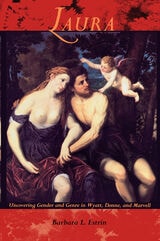
cover of Laura: Uncovering Gender and Genre in Wyatt, Donne and Marvell

Laura

Uncovering Gender and Genre in Wyatt, Donne and Marvell

Barbara L. Estrin

Duke University Press, 1994

How do men imagine women? In the poetry of Petrarch and his English successors—Wyatt, Donne, and Marvell—the male poet persistently imagines pursuing a woman, Laura, whom he pursues even as she continues to deny his affections. Critics have long held that, in objectifying Laura, these male-authored texts deny the imaginative, intellectual, and physical life of the woman they idealize. In Laura, Barbara L. Estrin counters this traditional view by focusing not on the generative powers of the male poet, but on the subjectivity of the imagined woman and the imaginative space of the poems she occupies.
Through close readings of the Rime sparse and the works of Wyatt, Donne, and Marvell, Estrin uncovers three Lauras: Laura-Daphne, who denies sexuality; Laura-Eve, who returns the poet’s love; and Laura-Mercury, who reinvents her own life. Estrin claims that in these three guises Laura subverts both genre and gender, thereby introducing multiple desires into the many layers of the poems. Drawing upon genre and gender theories advanced by Jean-François Lyotard and Judith Butler to situate female desire in the poem’s framework, Estrin shows how genre and gender in the Petrarchan tradition work together to undermine the stability of these very concepts.
Estrin’s Laura constitutes a fundamental reconceptualization of the Petrarchan tradition and contributes greatly to the postmodern reassessment of the Renaissance period. In its descriptions of how early modern poets formulate questions about sexuality, society and poetry, Laura will appeal to scholars of the English and Italian Renaissance, of gender studies, and of literary criticism and theory generally.
[more]
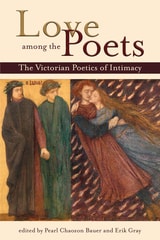
cover of Love among the Poets: The Victorian Poetics of Intimacy

Love among the Poets

The Victorian Poetics of Intimacy

Pearl Chaozon Bauer; Erik Gray

Ohio University Press, 2024
British literature of the Victorian period has always been celebrated for the quality, innovativeness, and sheer profusion of its love poetry. Every major Victorian poet produced notable poems about love. This includes not only canonical figures, such as Alfred Lord Tennyson, Robert and Elizabeth Barrett Browning, and Christina Rossetti, but also lesser-known poets whose works have only recently become widely recognized and studied, such as Augusta Webster and the many often anonymous working-class poets whose verses filled the pages of popular periodicals. Modern critics have claimed, convincingly, that love poetry is not just one strain of Victorian poetry among many; it is arguably its representative, even definitive, mode. This collection of essays reconsiders the Victorian poetry of love and, just as importantly, of intimacy—a more inclusive term that comprehends not only romance but love for family, for God, for animals, and for language itself. Together the essays seek to define a poetics of intimacy that arose during the Victorian period and that continues today, a set of poetic structures and strategies by which poets can represent and encode feelings of love. There exist many studies of intimate relations (especially marriage) in Victorian novels. But although poetry rivals the novel in the depth and diversity of its treatment of love, marriage, and intimacy, that aspect of Victorian verse has remained underexamined. Love among the Poets offers an expansive critical overview. With its slate of distinguished contributors, including scholars from the US, Canada, Britain, and Australia, the volume is a wide-ranging account of this vital era of poetry and of its importance for the way we continue to write, love, and live today.
[more]
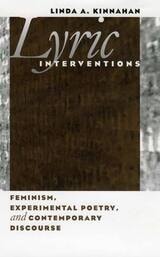
cover of Lyric Interventions: Feminism, Experimental Poetry, Discourse

Lyric Interventions

Feminism, Experimental Poetry, Discourse

Linda A. Kinnahan

University of Iowa Press, 1998

Lyric Interventions explores linguistically innovative poetry by contemporary women in North America and Britain whose experiments give rise to fresh feminist readings of the lyric subject. The works discussed by Linda Kinnahan explore the lyric subject in relation to the social: an “I” as a product of social discourse and as a conduit for change.

Contributing to discussions of language-oriented poetries through its focus on women writers and feminist perspectives, this study of lyric experimentation brings attention to the cultural contexts of nation, gender, and race as they significantly shift the terms by which the “experimental” is produced, defined, and understood.

This study focuses upon lyric intervention in distinct but related spheres as they link public and ideological norms of identity. Firstly, lyric innovations with visual and spatial realms of cultural practice and meaning, particularly as they naturalize ideologies of gender and race in North America and the post-colonial legacies of the Caribbean, are investigated in the works of Barbara Guest, Kathleen Fraser, Erica Hunt, and M. Nourbese Philip. Secondly, experimental engagements with nationalist rhetorics of identity, marking the works of Carol Ann Duffy, Denise Riley, Wendy Mulford, and Geraldine Monk, are explored in relation to contemporary evocations of “self” in Britain. And thirdly, in discussions of all of the poets, but particularly accenuated in regard to Guest, Fraser, Riley, Mulford, and Monk, formal experimentation with the lyric “I” is considered through gendered encounters with critical and avant-garde discourses of poetics.

Throughout the study, Kinnahan seeks to illuminate and challenge the ways in which visual and verbal constructs function to make “readable” the subjectivities historically supporting white, male-centered power within the worlds of art, poetry, social locations, or national policy. The potential of the feminist, innovative lyric to generate linguistic surprise simultaneously with engaging risky strategies of social intervention lends force and significance to the public engagement of such poetic experimentation.

This fresh, energetic study will be of great interest to literary critics and womens studies scholars, as well as poets on both sides of the Atlantic.
[more]