Results by title
135 books match the query 'Faith' and 4 start with l
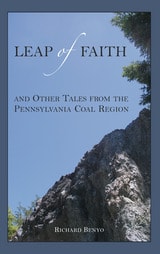
Leap of Faith
Richard Benyo
University of Scranton Press, 2009
Eastern Pennsylvania during the 1950s: King Coal has been dethroned, the railroads are all but defunct, and the region is in an economic depression. Fathers are forced to commute many miles to work, while at home the kids know no other pastime but to run wild in the woods. From the same author who intrigued readers with his whimsical stories of childhood in Jim Thorpe Never Slept Here comes an all-new batch of coming-of-age tales in Leap of Faith.
In these eight stories, the adults are often offstage, leaving the children to make up the rules as they go. From the story of an unrepentant bully who gets more than he deserves to the tale of a boy who finds serenity in short bursts of flight, Richard Benyo captures a time and a place where small triumphs are enormous, where the strong rule and the swift survive, and where the outside world—beyond the mountains that enclose Mauch Chunk, Pennsylvania—seldom intrudes.
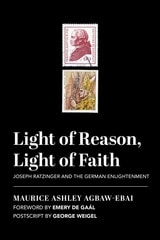
Light of Reason, Light of Faith
Joseph Ratzinger and the German EnlightenmentMaurice Ashley Agbaw-Ebai
St. Augustine's Press, 2021
Ratzinger’s extraordinary and sympathetic understanding of the sources of contemporary secularism equipped him to appreciate the gains of the Enlightenment, while still being a fierce critic of the losses humanity has suffered when reason falsely excludes faith. Fr. Agbaw-Ebai’s account reveals Ratzinger, in relation to his various interlocutors, to be the truly “enlightened” one because he demonstrates a truly balanced understanding of the human mind. To be truly rational one must be able to hold to faith and reason both, reason informed by faith in Jesus Christ.
A particular merit of this book is Agbaw-Ebai’s presentation of Ratzinger’s treatment of the German Enlightenment’s greatest contributors: Kant, Nietzche, Hegel and Habermas, among others. In the postscript George Weigel characterizes what this study accomplishes in the larger framework of scholarship. “[Ratzinger’s] position remains too often misunderstood, and sometimes deliberately misinterpreted, throughout the whole Church. And to misunderstand, or misinterpret, Ratzinger is to misunderstand or misinterpret both the modern history of theology and the Second Vatican Council.” Agbaw-Ebai masterfully positions Ratzinger correctly in the history of ideas, and exhibits why Ratzinger will be remembered as one of its main players. Pure rationalists and true believers are equally indebted to him.
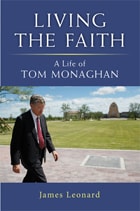
Living the Faith
A Life of Tom MonaghanJames Leonard
University of Michigan Press, 2012
Who is Tom Monaghan?
Is he the four-year-old kid whose father died on Christmas Eve and whose mother sent him to an orphanage and then a juvenile detention home?
Is he the entrepreneurial genius who built Domino's Pizza from a hole-in-the-wall pizzeria in Michigan into an American brand as world-conquering as Ford or Coke?
Is he the religious visionary who sold Domino's for $1 billion to create an orthodox Catholic university, law school, and special interest law firm with the goal of transforming America to reflect his conservative values?
He's all that and more. With extensive interviews with friends and enemies plus unprecedented access to the man himself, but wholly without his authorization, Living the Faith illuminates Tom Monaghan, the man and the myth.
Living the Faithis the much-needed, definitive biography of one of the most fascinating and controversial figures in the realms of American business and religion. Through eighteen hard-boiled chapters, journalist James Leonard follows Monaghan on his path from a heartbroken kid who climbed into his father's coffin to the business tycoon who purchased the world-champion Detroit Tigers and spent a fortune on his own air force, navy, and island to the religious visionary who founded a university to make saints and a public interest law firm to overturn evolution.
A sympathetic but critical perspective of the man and his works, this book is for believers, nonbelievers, and agnostics; for conservatives, liberals, and independents; for the rich, the poor, and the shrinking middle class. Mainly, however, this book is for those who want the facts about Tom Monaghan—and the truth about the effect religion had on one man and the effect that man had on the world.
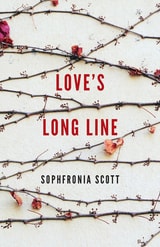
Love’s Long Line
Sophfronia Scott
The Ohio State University Press, 2018
Sophfronia Scott turns an unflinching eye on her life to deliver a poignant collection of essays ruminating on faith, motherhood, race, and the search for meaningful connection in an increasingly disconnected world.
In Love’s Long Line, Scott contemplates what her son taught her about grief after the shootings at his school, Sandy Hook Elementary; how a walk with Lena Horne became a remembrance of love for Scott’s illiterate and difficult steelworker father; the unexpected heartache of being a substitute school bus driver; and the satisfying fantasy of paying off a mortgage. Scott’s road is also a spiritual journey ignited by an exploration of her first name, the wonder of her physical being, and coming to understand why her soul must dance like Saturday Night Fever’s Tony Manero.
Inspired by Annie Dillard’s observation in Holy the Firm that we all “reel out love’s long line alone . . . like a live wire loosed in space to longing and grief everlasting,” Scott’s essays acknowledge the loneliness, longing, and grief exacted by a fearless engagement with the everyday world. But she shows that by holding the line, there is an abundance of joy and forgiveness and grace to be had as well.