Results by title

6 books match the query 'Gynecology'
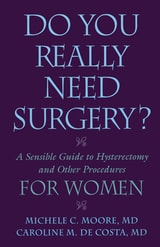
cover of Do You Really Need Surgery?: A Sensible Guide to Hysterectomy and Other Procedures for Women

Do You Really Need Surgery?

A Sensible Guide to Hysterectomy and Other Procedures for Women

Michele C. Moore, M.D., FAAFP and Caroline M. de Costa

Rutgers University Press, 2004

At last, here is a user-friendly guide to gynecologic surgery. The authors' guiding principle is that each woman for whom any kind of surgery is recommended should be well informed about the indications, the risks, and the expected results.

Using anecdotes drawn from a combined fifty years of experience, doctors Moore and de Costa provide clear and accurate information about women's anatomy, physiology, common gynecological ailments, diagnosis, alternative treatments, and, finally, full details about surgery itself. Among the surgeries discussed are removal of the uterus (hysterectomy), removal of the ovaries (oophorectomy), and removal of fibroids. The various ways of performing these procedures are examined, including minimally invasive surgery done through the laparoscope.

The authors also help the patient through the post-operative phase, revealing what to expect, how to make the recovery easier, and how to take care of yourself after the surgery. The result is a book that empowers women as they weigh their options with regard to gynecologic surgery.
[more]
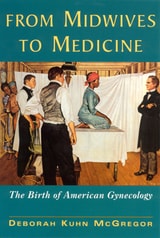
cover of From Midwives to Medicine: The Birth of American Gynecology

From Midwives to Medicine

The Birth of American Gynecology

McGregor, Deborah K

Rutgers University Press, 1998

From Midwives to Medicine examines the development of modern medical treatment of women and the related history of women's health in the mid-1800s. McGregor looks not only at the medical figures who devised and practiced the innovative therapist, but also at the history of the patient experience in the development and the professionalization of a medical specialty. In exploring the controversial career of J. Marion Sims, "the father of gynecology," and the history of the Woman's Hospital of the State of New York, McGregor chronicles the emergence of a practice involving previously untried medical techniques and the use of experimentation on patients according to a social hierarchy based on race and sex.

Using patient records and archival material from the female governors and administrators at the hospital, From Midwives to Medicine shows how a new medical practice developed out of the changing patterns and historical experiences of childbirth, as well as out of the context of the social relations f the sexes. Sim's patients were slave women in the antebellum South, poor Irish immigrants in the industrial North, and upper-class white. Protestant, Manhattan socialites who sought help for their "hysterical" symptoms. During his career, which began in the South and flourished at the Women's Hospital in New York. Sims performed and perfected his technique to "cure" vesico-vaginal fistulas, the tears of childbirth, from which so many women suffered. But Sims achieved these successes on the operating table only after years of practicing his "silver suture" technique on unanesthetized slave women, who he believed "by the nature of their race... had a specific physiological tolerance for pain unknown to whites."
[more]
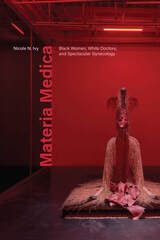
cover of Materia Medica: Black Women, White Doctors, and Spectacular Gynecology

Materia Medica

Black Women, White Doctors, and Spectacular Gynecology

Nicole N. Ivy

Duke University Press, 2026

In 1840, a young doctor named James Marion Sims established the surgery practice in Montgomery, Alabama at which he and his mentee, Nathan Bozeman, developed the field of gynecology through experimentation on black enslaved women. In Materia Medica, Nicole N. Ivy investigates how the bodies of the enslaved provided a physical terrain upon and through which white male fantasies of mastery, practice, and perfection could be played out. Through an interdisciplinary methodology that brings feminist historiography, critical race theory, visual culture studies, and literary studies to bear on the history of transatlantic slavery and medicine, Ivy places Sims’s and Bozeman’s clinic in the context of the flourishing antebellum slave market and demonstrates how black women were made to move as both currency and commodity through the circuit of medical knowledge production. Spanning nineteenth-century medical manuals to twenty-first-century creative works, Materia Medica ultimately considers what the memorials to Sims and the enslaved women he examined tells us about the challenges of representing difficult histories and reflects on artistic possibilities for historical reckoning.
[more]
cover of Midwife to the Queen of France: Diverse Observations

Midwife to the Queen of France

Diverse Observations

Louise Bourgeois

Iter Press, 2017

Diverse Observations is a groundbreaking book available for the first time in English. Written by a midwife committed to improving the care of women and newborns, it records the evolution of Bourgeois’s practice and beliefs, comments on changing attitudes related to reproductive health, and critiques the gendered elitism of the early modern medical hierarchy
[more]
cover of Public Privates: Performing Gynecology from Both Ends of the Speculum

Public Privates

Performing Gynecology from Both Ends of the Speculum

Terri Kapsalis

Duke University Press, 1997

In Public Privates, a book about looking and being looked at, about speculums, spectacles, and spectators, about display, illumination, and reflection, Terri Kapsalis makes visible the practices and representations of gynecology. The quintessential examination of women, gynecology is not simply the study of women’s bodies, but also serves to define and constitute them. Any critical analysis of gynecology is therefore, as Kapsalis affirms, an investigation of what it means to be female. In this respect she considers the public exposure of female "privates" in the performance of the pelvic exam.
From J. Marion Sims’s surgical experiments on unanesthetized slave women in the mid-nineteenth century, to the use of cadavers and prostitutes to teach medical students gynecological techniques, Kapsalis focuses on the ways in which women and their bodies have been treated by the medical establishment. Removing gynecology from its private cover within clinic walls and medical textbook pages, she decodes the gynecological exam, seizing on its performative dimension. She considers traditional medical practices and the dynamics of "proper" patient performance; non-traditional practices such as cervical self-exam; and incarnations of the pelvic examination outside the bounds of medicine, including its appearance in David Cronenberg’s film Dead Ringers and Annie Sprinkle’s performance piece "Public Cervix Announcement."
Confounding the boundaries that separate medicine, art, and pornography, revealing the potent cultural attitudes and anxieties about women, female bodies, and female sexuality that permeate the practice of gynecology, Public Privates concludes by locating a venue from which challenging, alternative performances may be staged.

[more]
cover of Unseen Flesh: Gynecology and Black Queer Worth-Making in Brazil

Unseen Flesh

Gynecology and Black Queer Worth-Making in Brazil

Nessette Falu

Duke University Press, 2023

In Unseen Flesh Nessette Falu explores how Black lesbians in Brazil define and sustain their well-being and self-worth against persistent racial, sexual, class, and gender-based prejudice. Focusing on the trauma caused by interactions with gynecologists, Falu draws on in-depth ethnographic work among the Black lesbian community to reveal their profoundly negative affective experiences within Brazil’s deeply biased medical system. In the face of such entrenched, intersectional intimate violence, Falu’s informants actively pursue well-being in ways that channel their struggle for self-worth toward broader goals of social change, self care, and communal action. Demonstrating how the racist and heteronormative underpinnings of gynecology erase Black lesbian subjecthood through mental, emotional, and physical traumas, Falu explores the daily resistance and abolitionist practices of worth-making that claim and sustain Black queer identity and living. Falu rethinks the medicalization of race, sex, and gender in Brazil and elsewhere while offering a new perspective on Black queer life through well-being grounded in relationships, socioeconomic struggles, the erotic, and freedom strivings.
[more]