Results by title
167 books match the query 'Gardening' and 6 start with l
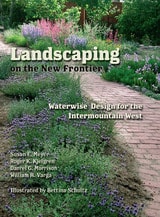
Landscaping on the New Frontier
Waterwise Design for the Intermountain WestSusan E. Meyer, Roger K. Kjelgren, Darrel G. Morrison, and William A. Varga
Utah State University Press, 2009
In this book you will learn how to use natural landscapes to inspire your own designed landscape around your business or home and yard. Included are design principles, practical ideas, and strong examples of what some homeowners have already done to convert traditional "bluegrass" landscapes into ones that are more expressive of theWest. Landscaping on the new Frontier also offers an approach to irrigation that minimizes the use of supplemental water yet ensures the survival of plants during unusually dry periods. You will learn how to combine ecological principles with design principles to create beautiful home landscapes that require only minimal resources to maintain.
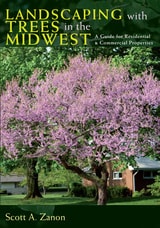
Landscaping with Trees in the Midwest
A Guide for Residential and Commercial PropertiesScott A. Zanon
Ohio University Press, 2014
Trees not only add beauty and value to property but also enhance the physical environment by providing shade, reflecting heat, and blocking wind. Choosing the right trees for the right location and conditions, however, is not always easy: each species has its own requirements for sunlight, water, drainage, and protection.
Landscaping with Trees in the Midwest: A Guide for Residential and Commercial Properties describes sixty-five desirable tree species, their characteristics, and their uses. More than 325 color photographs illustrate the appearance of each species through the seasons—including height, shape, bark, flowers, and fall colors—as well as other factors that influence selection and siting in order to help the landscape professional or homeowner make informed choices.
This guidebook also considers trees as a factor in overall environmental health and gives special consideration to the effects of the emerald ash borer, which continues to wreak havoc in wooded areas of the Midwest, offering replacement alternatives for vulnerable areas. In addition to the text and photos, the book includes a table of growth rates and sizes, a map of hardiness zones, and other valuable reference tools.
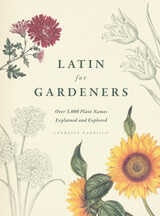
Latin for Gardeners
Over 3,000 Plant Names Explained and ExploredLorraine Harrison
University of Chicago Press, 2012
Since Latin became the standard language for plant naming in the eighteenth century, it has been intrinsically linked with botany. And while mastery of the classical language may not be a prerequisite for tending perennials, all gardeners stand to benefit from learning a bit of Latin and its conventions in the field. Without it, they might buy a Hellebores foetidus and be unprepared for its fetid smell, or a Potentilla reptans with the expectation that it will stand straight as a sentinel rather than creep along the ground.
An essential addition to the gardener’s library, this colorful, fully illustrated book details the history of naming plants, provides an overview of Latin naming conventions, and offers guidelines for pronunciation. Readers will learn to identify Latin terms that indicate the provenance of a given plant and provide clues to its color, shape, fragrance, taste, behavior, functions, and more.
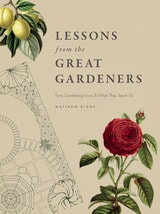
Lessons from the Great Gardeners
Forty Gardening Icons and What They Teach UsMatthew Biggs
University of Chicago Press, 2016
Entries for each gardening great highlight their iconic plants and garden designs, revealing both the gardeners’ own influences and the seeds—sometimes literal—that they sowed for gardens yet to sprout. From André Le Nôtre in seventeenth-century France, who drew on his training as an architect and hydraulic engineer to bring the topiary form to Vaux-le-Vicomte and Versailles, to the work of High Line and Lurie Garden designer Piet Oudolf, and Thomas Jefferson’s advice on creating protected garden microclimates for help growing early crops and tender fruit like figs (with peas, a Jefferson favorite), Lessons from the Great Gardeners is a resource as rich as the soil from which it springs.
Featuring lush illustrations harvested from the archives of the Royal Horticultural Society, as well as sections on a dozen international gardens that showcase the lessons of the greats, this homage to the love of good, clean dirt is sure to inspire readers to get out in the sun and dig.
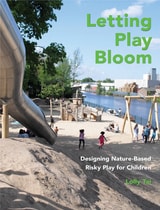
Letting Play Bloom
Designing Nature-Based Risky Play for ChildrenLolly Tai
Temple University Press, 2022
Children love to play in risky—often misunderstood to mean unsafe—ways. It is often how they learn. Research shows that activities like climbing on trees and boulders, hiking in nature, and playing in a creek are excellent ways for kids to develop their creativity and their senses, because playing outdoors evokes different sights, sounds, smells, and textures.
Letting Play Bloom analyzes five outstanding case studies of children’s nature-based risky play spaces—the Slide Hill at Governors Island in New York, the Berkeley (CA) Adventure Playground, and Wildwoods at Fernbank Museum in Atlanta, as well as sites in the Netherlands and Australia. Author Lolly Tai provides detailed explanations of their background and design, and what visitors can experience at each site.
She also outlines the six categories of risky—not hazardous—play, which involve great heights, rapid speeds, dangerous tools, dangerous elements, rough-and-tumble play, and wandering or getting lost. These activities allow children to explore and challenge themselves (testing their limits) to foster greater self-worth while also learning valuable risk-management skills such as dealing with fear-inducing situations.
Filled with more than 200 photographs, Letting Play Bloom advocates for a thoughtful landscape design process that incorporates the specific considerations children need to fully experience the thrill that comes from playing in nature.
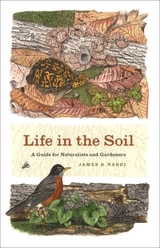
Life in the Soil
A Guide for Naturalists and GardenersJames B. Nardi
University of Chicago Press, 2007
Leonardo da Vinci once mused that “we know more about the movement of celestial bodies than about the soil underfoot,” an observation that is as apt today as it was five hundred years ago. The biological world under our toes is often unexplored and unappreciated, yet it teems with life. In one square meter of earth, there lives trillions of bacteria, millions of nematodes, hundreds of thousands of mites, thousands of insects and worms, and hundreds of snails and slugs. But because of their location and size, many of these creatures are as unfamiliar and bizarre to us as anything found at the bottom of the ocean.
Lavishly illustrated with nearly three hundred color illustrations and masterfully-rendered black and white drawings throughout, Life in the Soil invites naturalists and gardeners alike to dig in and discover the diverse community of creatures living in the dirt below us. Biologist and acclaimed natural history artist James B. Nardibegins with an introduction to soil ecosystems, revealing the unseen labors of underground organisms maintaining the rich fertility of the earth as they recycle nutrients between the living and mineral worlds. He then introduces readers to a dazzling array of creatures: wolf spiders with glowing red eyes, snails with 120 rows of teeth, and 10,000-year-old fungi, among others. Organized by taxon, Life in the Soil covers everything from slime molds and roundworms to woodlice and dung beetles, as well as vertebrates from salamanders to shrews. The book ultimately explores the crucial role of soil ecosystems in conserving the worlds above and below ground.
A unique and illustrative introduction to the many unheralded creatures that inhabit our soils and shape our environment aboveground, Life in the Soil will inform and enrich the naturalist in all of us.