Results by title
73 books match the query 'German literature' and 2 start with l
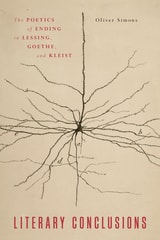
Literary Conclusions
The Poetics of Ending in Lessing, Goethe, and KleistOliver Simons
Northwestern University Press, 2022
Endings are not just singular moments in time but the outcomes of a process. And whatever a book’s conclusion, its form has a history. Literary Conclusions presents a new theory of textual endings in eighteenth-century literature and thought. Analyzing essential works by Gotthold Ephraim Lessing, Johann Wolfgang von Goethe, and Heinrich von Kleist, Oliver Simons shows how the emergence of new kinds of literary endings around 1800 is inextricably linked to the history of philosophical and scientific concepts.
Simons examines the interrelations of Lessing’s literary endings with modes of logical conclusion; he highlights how Goethe’s narrative closures are forestalled by an uncontrollable vital force that was discussed in the sciences of the time; and he reveals that Kleist conceived of literary genres themselves as forms of reasoning. Kleist’s endings, Simons demonstrates, mark the beginning of modernism. Through close readings of these authors and supplemental analyses of works by Walter Benjamin, Friedrich Hölderlin, and Georg Wilhelm Friedrich Hegel, he crafts an elegant theory of conclusions that revises established histories of literary genres and forms.
Simons examines the interrelations of Lessing’s literary endings with modes of logical conclusion; he highlights how Goethe’s narrative closures are forestalled by an uncontrollable vital force that was discussed in the sciences of the time; and he reveals that Kleist conceived of literary genres themselves as forms of reasoning. Kleist’s endings, Simons demonstrates, mark the beginning of modernism. Through close readings of these authors and supplemental analyses of works by Walter Benjamin, Friedrich Hölderlin, and Georg Wilhelm Friedrich Hegel, he crafts an elegant theory of conclusions that revises established histories of literary genres and forms.
[more]
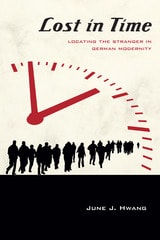
Lost in Time
Locating the Stranger in German ModernityJune J. Hwang
Northwestern University Press, 2014
June J. Hwang’s provocative Lost in Time explores discourses of timelessness in the works of central figures of German modernity such as Walter Benjamin, Georg Simmel, Siegfried Kracauer, and Helmuth Plessner, as well as those of Alfred Döblin, Joseph Roth, and Hugo Bettauer. Hwang argues that in the Weimar Republic the move toward ahistoricization is itself a historical phenomenon, one that can be understood by exploring the intersections of discourses about urban modernity, the stranger, and German Jewish identity.
These intersections shed light on conceptions of German Jewish identity that rely on a negation of the specific and temporal as a way to legitimize a historical outsider position, creating a dynamic position that simultaneously challenges and acknowledges the limitations of an outsider’s agency. She reads these texts as attempts to transcend the particular, attempts that paradoxically reveal the entanglement of the particular and the universal.
[more]