129 books match the query 'God' and 2 start with l
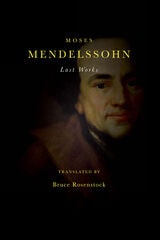
cover of Last Works

Last Works

Moses Mendelssohn. Translated by Bruce Rosenstock

University of Illinois Press, 2012
Moses Mendelssohn (1729–1786) was the central figure in the emancipation of European Jewry. His intellect, judgment, and tact won the admiration and friendship of contemporaries as illustrious as Johann Gottfried Herder, Gotthold Ephraim Lessing, and Immanuel Kant. His enormously influential Jerusalem (1783) made the case for religious tolerance, a cause he worked for all his life.
 
Last Works includes, for the first time complete and in a single volume, the English translation of Morning Hours: Lectures on the Existence of God (1785) and To the Friends of Lessing (1786). Bruce Rosenstock has also provided an historical introduction and an extensive philosophical commentary to both texts.
 
At the center of Mendelssohn's last works is his friendship with Lessing. Mendelssohn hoped to show that he, a Torah-observant Jew, and Lessing, Germany's leading dramatist, had forged a life-long friendship that held out the promise of a tolerant and enlightened culture in which religious strife would be a thing of the past.
 
Lessing's death in 1781 was a severe blow to Mendelssohn. Mendelssohn wrote his last two works to commemorate Lessing and to carry on the work to which they had dedicated much of their lives. Morning Hours treats a range of major philosophical topics: the nature of truth, the foundations of human knowledge, the basis of our moral and aesthetic powers of judgment, the reality of the external world, and the grounds for a rational faith in a providential deity. It is also a key text for Mendelssohn's readings of Spinoza. In To the Friends of Lessing, Mendelssohn attempts to unmask the individual whom he believes to be the real enemy of the enlightened state: the Schwärmer, the religious fanatic who rejects reason in favor of belief in suprarational revelation.
[more]
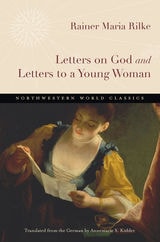
cover of Letters on God and Letters to a Young Woman

Letters on God and Letters to a Young Woman

Rainer Maria Rilke, Translated from the German by Annemarie S. Kidder

Northwestern University Press, 2012

For Rainer Maria Rilke, letter writing was a discipline and art unto itself. Some seven thousand of his letters have survived, among them works of profound beauty and insight to rival his poems and fiction. For the first time, this volume makes available to an English-speaking audience two of the earliest collections of Rilke letters published after his death, each with a nuanced introduction and notes by Annemarie S. Kidder.

The thematic collection Letters on God contains two letters by Rilke, the first an actual letter written during World War I, in 1915 in Munich, the second a fictional one composed after the war, in 1922 at Muzot in Switzerland. In these letters, Rilke builds on the mystical view of God conceived in The Book of Hours, but he moves beyond it, demonstrating a unique vision of God and Christ, the church and religious experience, friendship and death.

Like his famous Letters to a Young Poet, Rilke’s Letters to a Young Woman presents an intimate series of letters written to a young admirer. The nine letters collected here were written to Lisa Heise over the course of five years, from 1919 to 1924. Though Rilke and Heise never met, the poet emerges in these letters as a compassionate listener and patient teacher who with levelheaded sensitivity affirms and guides the movements of another person’s soul.

[more]