Results by title
56 books match the query 'Great Basin' and 4 start with l
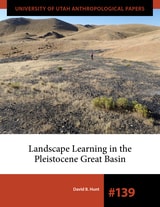
Landscape Learning in the Pleistocene Great Basin
David B. Hunt
University of Utah Press, 2025
As pioneering hunter-gatherer populations moved into unfamiliar regions, they faced the challenge of locating critical resources like food, water, and raw materials for tools, shelter, and clothing. While their descendants would eventually benefit from the accumulation of this knowledge over time, these first colonizers were forced to learn a new landscape from scratch. In Landscape Learning in the Pleistocene Great Basin, David B. Hunt proposes a quantitative model to explain the adaptive behaviors of the first groups of humans to settle in a particular area, a concept known as “landscape learning.”
Hunt seeks insight into the initial development of adaptive strategies related to the procurement of essential resources within a region. Incorporating data from archaeological investigation at the Old River Bed Delta in Utah and focusing specifically on the lithics recovered, Hunt develops what he terms the Discoverability Model. He proposes this model as a way for archaeologists to begin quantifying the qualitative aspects of colonization and landscape learning models.
Hunt seeks insight into the initial development of adaptive strategies related to the procurement of essential resources within a region. Incorporating data from archaeological investigation at the Old River Bed Delta in Utah and focusing specifically on the lithics recovered, Hunt develops what he terms the Discoverability Model. He proposes this model as a way for archaeologists to begin quantifying the qualitative aspects of colonization and landscape learning models.
[more]
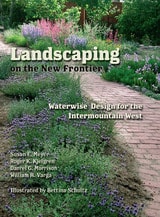
Landscaping on the New Frontier
Waterwise Design for the Intermountain WestSusan E. Meyer, Roger K. Kjelgren, Darrel G. Morrison, and William A. Varga
Utah State University Press, 2009
A practical volume for the home or business owner on landscaping with native, drought-tolerant plants in the Rocky Mountain West. Filled with color illustrations, photos, and design sketches, over 100 native species are described, while practical tips on landscape design, water-wise irrigation, and keeping down the weeds are provided.
In this book you will learn how to use natural landscapes to inspire your own designed landscape around your business or home and yard. Included are design principles, practical ideas, and strong examples of what some homeowners have already done to convert traditional "bluegrass" landscapes into ones that are more expressive of theWest. Landscaping on the new Frontier also offers an approach to irrigation that minimizes the use of supplemental water yet ensures the survival of plants during unusually dry periods. You will learn how to combine ecological principles with design principles to create beautiful home landscapes that require only minimal resources to maintain.
In this book you will learn how to use natural landscapes to inspire your own designed landscape around your business or home and yard. Included are design principles, practical ideas, and strong examples of what some homeowners have already done to convert traditional "bluegrass" landscapes into ones that are more expressive of theWest. Landscaping on the new Frontier also offers an approach to irrigation that minimizes the use of supplemental water yet ensures the survival of plants during unusually dry periods. You will learn how to combine ecological principles with design principles to create beautiful home landscapes that require only minimal resources to maintain.
[more]
Late Holocene Research on Foragers and Farmers in the Desert West
Barbara J. Roth and Maxine E. McBrinn
University of Utah Press, 2015
This book brings together the work of archaeologists investigating prehistoric hunter-gatherers (foragers) and early farmers in both the Southwest and the Great Basin. Most previous work on this topic has been regionally specific, with researchers from each area favoring a different theoretical approach and little shared dialogue. Here the studies of archaeologists working in both the Southwest and the Great Basin are presented side by side to illustrate the similarities in environmental challenges and cultural practices of the prehistoric peoples who lived in these areas and to explore common research questions addressed by both regions.
Three main themes link these papers: the role of the environment in shaping prehistoric behavior, flexibility in foraging and farming adaptations, and diversity in settlement strategies. Contributors cover a range of topics including the varied ways hunter-gatherers adapted to arid environments, the transition from hunting and gathering to farming and the reasons for it, the variation in early farmers across the Southwest and Great Basin, and the differing paths followed as they developed settled villages.
Three main themes link these papers: the role of the environment in shaping prehistoric behavior, flexibility in foraging and farming adaptations, and diversity in settlement strategies. Contributors cover a range of topics including the varied ways hunter-gatherers adapted to arid environments, the transition from hunting and gathering to farming and the reasons for it, the variation in early farmers across the Southwest and Great Basin, and the differing paths followed as they developed settled villages.
[more]
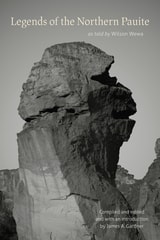
Legends of the Northern Paiute
as told by Wilson WewaWilson Wewa
Oregon State University Press, 2017
Legends of the Northern Paiute shares and preserves twenty-one original and previously unpublished Northern Paiute legends, as told by Wilson Wewa, a spiritual leader and oral historian of the Warm Springs Paiute. These legends were originally told around the fires of Paiute camps and villages during the “story-telling season” of winter in the Great Basin of the American West. They were shared with Paiute communities as a way to pass on tribal visions of the “animal people” and the “human people,” their origins and values, their spiritual and natural environment, and their culture and daily lives.
The legends in this volume were recorded, transcribed, reviewed, and edited by Wilson Wewa and James Gardner. Each legend was recorded, then read and edited out loud, to respect the creativity, warmth, and flow of Paiute storytelling. The stories selected for inclusion include familiar characters from native legends, such as Coyote, as well as intriguing characters unique to the Northern Paiute, such as the creature embodied in the Smith Rock pinnacle, now known as Monkey Face, but known to the Paiutes in Central Oregon as Nuwuzoho the Cannibal.
Wewa’s apprenticeship to Northern Paiute culture began when he was about six years old. These legends were passed on to him by his grandmother and other tribal elders. They are now made available to future generations of tribal members, and to students, scholars, and readers interested in Wewa’s fresh and authentic voice. These legends are best read and appreciated as they were told—out loud, shared with others, and delivered with all of the verve, cadence, creativity, and humor of original Paiute storytellers on those clear, cold winter nights in the high desert.
[more]