Results by title
715 books match the query 'Higher' and 19 start with l
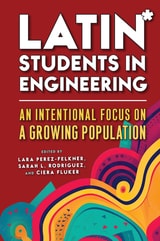
Latin* Students in Engineering
An Intentional Focus on a Growing PopulationLara Perez-Felkner
Rutgers University Press, 2024
Winner of the American Association of Hispanics in Higher Education Edited Volume Book of the Year Award
Winner of the 2026 Distinguished Contributions to Gender Equity in Educational Research Award from the American Educational Research Association
The growing population of engineering students who identify as Latin* are underrepresented in the field of engineering. Latin* refers to an individual of Latin American origin or descent, without restricting to a specific gender. The asterisk (*) includes related identity terms such as Latina/é/o/u/x.There is, however, a rising need to train U.S. students in engineering skills to meet the demands of our increasingly technological workforce. Structurally excluding Latin* students hinders their economic and educational opportunities in engineering. Latin* Students in Engineering examines the state of Latin* engineering education at present as well as considerations for policy and practice regarding engineering education aimed at enhancing opportunity and better serving Latin* students. The essays in this volume first consider, theoretically and empirically, the experiences of Latin* students in engineering education and then expand beyond the student level to focus on institutional and social structures that challenge Latin* students' success and retention. Finally, it illuminates emergent work and considers future research, policy, and practice.
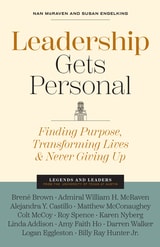
Leadership Gets Personal
Finding Purpose, Transforming Lives, and Never Giving UpNan McRaven and Susan Engelking
University of Texas Press, 2026
How the University of Texas shaped twelve people who changed the world.
College is a time for personal growth. But any Biology 101 student knows that growth (personal or otherwise) requires the right environment. Collecting the revealing and deeply personal stories of twelve UT alumni who became leaders in their fields, Leadership Gets Personal honors the transformative impact of the Forty Acres on those who learn and grow there.
Matthew McConaughey, Academy Award-winning actor and #1 New York Times best-selling author, was destined for law school, but with the encouragement of his UT community, he realized he was a born storyteller. Brené Brown, author of the #1 New York Times bestseller Dare to Lead, struggled for years before finding her purpose in the Social Work Department. Dr. Amy Ho knew she wanted to change the American health care system, and at UT she gained the confidence and skills to make a difference. Astronaut Karen Nyberg was a shy kid; her UT graduate studies propelled her to space. And Darren Walker would go on to become president of the Ford Foundation, taking inspiration from the financial aid counselors who made sure he got the education he yearned for. For these and other outstanding alumni profiled here, the road was often rocky. Through perseverance, humility, and collaboration, they learned not only to exercise leadership but to live it.
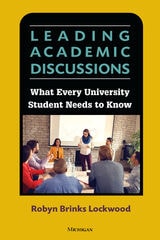
Leading Academic Discussions
What Every University Student Needs to KnowRobyn Brinks Lockwood
University of Michigan Press, 2021
Although discussions are heavily reliant on words, they are also influenced and affected by other verbal cues, such as pronunciation, stress, pitch, or tone. Because speakers need to both notice and use these cues to make their messages clear to other participants, the text addresses these factors as well. Additionally, non-verbal communication plays an essential role as well, so one chapter is devoted to it.
Throughout the text, reflection questions about leading discussions are provided for those who are or hope to be teaching assistants (TAs) and project leads/managers. Video analysis tasks are included to accompany the six mini discussion videos that are open and available at www.press.umich.edu/elt/compsite/leading.
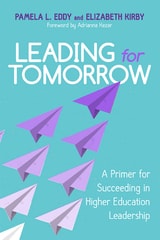
Leading for Tomorrow
A Primer for Succeeding in Higher Education LeadershipPamela L. Eddy
Rutgers University Press, 2020
Using an engaging case study approach, Leading for Tomorrow provides readers with real-world examples that will help them reflect on their own management and communication styles. It also shows newly minted administrators how they can follow best practices while still developing a style of leadership that is authentic and uniquely their own.
The book’s case studies offer practical solutions for how to deal with emerging trends and persistent problems in the field of higher education, from decreasing state funding to political controversies on campus. Leading for Tomorrow gives readers the tools they need to get the best out of their team, manage conflicts, support student success, and instill a campus culture of innovation that will meet tomorrow’s challenges.

Learning Places
The Afterlives of Area StudiesMasao Miyoshi and H.D. Harootunian, eds.
Duke University Press, 2002
A tremendous amount of money flows—particularly within the sphere of East Asian studies, the contributors claim—from foreign agencies and governments to U.S. universities to underwrite courses on their histories and societies. In the process, this volume argues, such funds have gone beyond support to the wholesale subsidization of students in graduate programs, threatening the very integrity of research agendas. Native authority has been elevated to a position of primacy; Asian-born academics are presumed to be definitive commentators in Asian studies, for example. Area studies, the contributors believe, has outlived the original reason for its construction. The essays in this volume examine particular topics such as the development of cultural studies and hyphenated studies (such as African-American, Asian-American, Mexican-American) in the context of the failure of area studies, the corporatization of the contemporary university, the prehistory of postcolonial discourse, and the problematic impact of unformulated political goals on international activism.
Learning Places points to the necessity, the difficulty, and the possibility in higher education of breaking free from an entrenched Cold War narrative and making the study of a specific area part of the agenda of education generally. The book will appeal to all whose research has a local component, as well as to those interested in the future course of higher education generally.
Contributors. Paul A. Bové, Rey Chow, Bruce Cummings, James A. Fujii, Harry Harootunian, Masao Miyoshi, Tetsuo Najita, Richard H. Okada, Benita Parry, Moss Roberts, Bernard S. Silberman, Stefan Tanaka, Rob Wilson, Sylvia Yanagisako, Mitsuhiro Yoshimoto
Learning in the Plural
Essays on the Humanities and Public LifeDavid D. Cooper
Michigan State University Press, 2014
Learning the Possible
Mexican American Students Moving from the Margins of Life to New Ways of BeingReynaldo Reyes III; Foreword by Christian J. Faltis
University of Arizona Press, 2013
Laura, Christina, Luz, Maria, and Ruben, as the author calls them, had daunting challenges: difficulties with English, extremely low self-confidence, teenage motherhood, conflict between gender roles and personal desires, and a history of gang membership. Focusing on the importance of constructing a new identity as a successful student, Reynaldo Reyes III shares with readers the experiences of these marginalized students. Their stories, coupled with perspectives from instructors, CAMP staff and counselors, and the author’s own observations, illustrate the influence of past schooling, the persistence of culture, and the tensions and challenges inherent in developing a new identity.
This is a study of students who came from the margins and, in a very short time, moved toward the mainstream. In the micro view, it provides extraordinarily useful case studies of a successful intervention program in process. In the larger scope, it is a look at the socially constructed nature of possibility, hope, and success.
Learning to Be Latino
How Colleges Shape Identity PoliticsReyes, Daisy Verduzco
Rutgers University Press, 2018
Drawing on extensive ethnographic observations, Reyes shows how college campuses shape much more than students’ academic and occupational trajectories; they mold students’ ideas about inequality and opportunity in America, their identities, and even how they intend to practice politics.
Learning to Lead
Undocumented Students Mobilizing EducationJennifer R. Nájera
Duke University Press, 2024
Leaving College
Rethinking the Causes and Cures of Student AttritionVincent Tinto
University of Chicago Press, 1994

Let’s Be Boldly Bearcat
Kimberlee Dobbs
University of Minnesota Press, 2019
Liberal Education Public Interest
James O. Freedman
University of Iowa Press, 2003
In 1996 James Freedman published Idealism and Liberal Education, which discussed the ideals that shaped his life as an intellectual, a law professor, and a college and university president. In this new collection of essays, he convincingly explores his firm belief that a liberal education is the “surest instrument yet devised for developing those civilizing qualities of mind and character that enable men and women to lead satisfying lives and to make significant contributions to a democratic society.”
Freedman concentrates directly upon the problems facing university presidents and all university administrators. A passionate and beautifully written argument for the benefits of a liberal education, this book
Liberating Service Learning and the Rest of Higher Education Civic Engagement
Randy Stoecker
Temple University Press, 2016
Randy Stoecker has been “practicing” forms of community-engaged scholarship, including service learning, for thirty years now, and he readily admits, “Practice does not make perfect.” In his highly personal critique, Liberating Service Learning and the Rest of Higher Education Civic Engagement, the author worries about the contradictions, unrealized potential, and unrecognized urgency of the causes as well as the risks and rewards of this work.
Here, Stoecker questions the prioritization and theoretical/philosophical underpinnings of the core concepts of service learning: 1. learning, 2. service, 3. community, and 4. change. By “liberating” service learning, he suggests reversing the prioritization of the concepts, starting with change, then community, then service, and then learning. In doing so, he clarifies the benefits and purpose of this work, arguing that it will create greater pedagogical and community impact.
Liberating Service Learning and the Rest of Higher Education Civic Engagement challenges—and hopefully will change—our thinking about higher education community engagement.

Limits of the Numerical
The Abuses and Uses of QuantificationEdited by Christopher Newfield, Anna Alexandrova, and Stephen John
University of Chicago Press, 2022
Numbers are both controlling and fragile. They drive public policy, figuring into everything from college rankings to vaccine efficacy rates. At the same time, they are frequent objects of obfuscation, manipulation, or outright denial. This timely collection by a diverse group of humanists and social scientists challenges undue reverence or skepticism toward quantification and offers new ideas about how to harmonize quantitative with qualitative forms of knowledge.
Limits of the Numerical focuses on quantification in several contexts: climate change; university teaching and research; and health, medicine, and well-being more broadly. This volume shows the many ways that qualitative and quantitative approaches can productively interact—how the limits of the numerical can be overcome through equitable partnerships with historical, institutional, and philosophical analysis. The authors show that we can use numbers to hold the powerful to account, but only when those numbers are themselves democratically accountable.
Lincoln Hall at the University of Illinois
John Hoffmann, Foreword by Richard H. Herman
University of Illinois Press, 2010
Lincoln Hall at the University of Illinois, named to commemorate the centennial of Abraham Lincoln's birth, has long been a familiar landmark on the Urbana-Champaign campus and the home for undergraduate and graduate work in the liberal arts and communication. Funded by the Illinois State Legislature in 1909, the building was dedicated in 1913 on Lincoln's birthday, February 12. In addition to its function as space for offices, classrooms, and departmental libraries, Lincoln Hall was commissioned, designed, and built to convey "the wisdom and patriotism of the democracy of learning."
That spirit of freedom and equality in education was manifest in Lincoln Hall's artistic design, which features terra cotta panels depicting Lincoln's life, quotations from his writings, and portraits of prominent figures of his day. At the outset of the building's conception, Evarts B. Greene, professor of history and dean of the College of Literature and Arts, provided detailed information about Lincoln that defined the building's artistic program. Wishing to retain the dignified simplicity of the overall design, he conferred with W. Carbys Zimmerman, the State Architect, about the nature and placement of the panels and other ornamental details that have become key features of the building's design.
Commemorating the bicentennial of Lincoln's birth, this magisterial volume chronicles the history of Lincoln Hall from its conception to its expansion and its present role on the campus. John Hoffmann identifies each of the building's historical panels and the portraits of Lincoln's contemporaries. Lavishly illustrated to show how much care was taken with the details of the design, this book provides a lasting historical record of the building's century-long place at the University of Illinois.
Supported by the Office of the Chancellor of the University of Illinois at Urbana-Champaign
Literacy, Sexuality, Pedagogy
Theory and Practice for Composition StudiesJonathan Alexander
Utah State University Press, 2008
In Literacy, Sexuality, Pedagogy, Jonathan Alexander argues for the development of students' "sexual literacy." Such a literacy is not just concerned with developing fluency with sexuality as a "hot" topic, but with understanding the intimate interconnectedness of sexuality and literacy in Western culture. Using the work of scholars in queer theory, sexuality studies, and the New Literacy Studies, Alexander unpacks what he sees as a crucial--if often overlooked--dimension of literacy: the fundamental ways in which sexuality has become a key component of contemporary literate practice, of the stories we tell about ourselves, our communities, and our political investments.
Alexander then demonstrates through a series of composition exercises and writing assignments how we might develop students' understanding of sexual literacy. Examining discourses of gender, heterosexuality, and marriage allows students (and instructors) a critical opportunity to see how the languages we use to describe ourselves and our communities are saturated with ideologies of sexuality. Understanding how sexuality is constructed and deployed as a way to "make meaning" in our culture gives us a critical tool both to understand some of the fundamental ways in which we know ourselves and to challenge some of the norms that govern our lives. In the process, we become more fluent with the stories that we tell about ourselves and discover how normative notions of sexuality enable (and constrain) narrations of identity, culture, and politics. Such develops not only our understanding of sexuality, but of literacy, as we explore how sexuality is a vital, if vexing, part of the story of who we are.
Lives in Science
How Institutions Affect Academic CareersJoseph C. Hermanowicz
University of Chicago Press, 2009
What can we learn when we follow people over the years and across the course of their professional lives? Joseph C. Hermanowicz asks this question specifically about scientists and answers it here by tracking fifty-five physicists through different stages of their careers at a variety of universities across the country. He explores these scientists’ shifting perceptions of their jobs to uncover the meanings they invest in their work, when and where they find satisfaction, how they succeed and fail, and how the rhythms of their work change as they age. His candid interviews with his subjects, meanwhile, shed light on the ways career goals are and are not met, on the frustrations of the academic profession, and on how one deals with the boredom and stagnation that can set in once one is established.
An in-depth study of American higher education professionals eloquently told through their own words, Hermanowicz’s keen analysis of how institutions shape careers will appeal to anyone interested in life in academia.
Living When Everything Changed
My Life in AcademiaMary Kay Thompson Tetreault
Rutgers University Press, 2019
In this compelling memoir, Mary Kay Thompson Tetreault describes how a Catholic girl from small-town Nebraska discovered her callings as a feminist, as an academic, and as a university administrator. She recounts her experiences at three very different schools: the small progressive Lewis & Clark College, the massive regional university of Cal State Fullerton, and the rapidly expanding Portland State University. Reflecting on both her accomplishments and challenges, she considers just how much second-wave feminism has transformed academia and how much reform is still needed.
With remarkable candor and compassion, Thompson Tetreault provides an intimate personal look at an era when both women’s lives and university culture changed for good.
The Acknowledgments were inadvertently left out of the first printing of this book. We apologize for the oversight, and offer them here instead. Future printings will include this information. (https://d3tto5i5w9ogdd.cloudfront.net/wp-content/uploads/2019/08/29185420/Thompson-Tetreault-Acknowledgments.pdf)
Living with Moral Disagreement
The Enduring Controversy about Affirmative ActionMichele S. Moses
University of Chicago Press, 2016
Central to Moses’s analysis is the argument that we need to understand disagreements about affirmative action as inherently moral, products of conflicts between deeply held beliefs that shape differing opinions on what justice requires of education policy. As she shows, differing opinions on affirmative action result from different conceptual values, for instance, between being treated equally and being treated as an equal or between seeing race-consciousness as a pernicious political force or as a necessary variable in political equality. As Moses shows, although moral disagreements about race-conscious policies and similar issues are often seen as symptoms of dysfunctional politics, they in fact create rich opportunities for discussions about diversity that nourish democratic thought and life.