Results by title
438 books match the query 'Hispanic & Latino' and 17 start with l
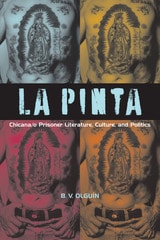
La Pinta
Chicana/o Prisoner Literature, Culture, and PoliticsBy B. V. Olguín
University of Texas Press, 2009
In this groundbreaking study based on archival research about Chicana and Chicano prisoners—known as Pintas and Pintos—as well as fresh interpretations of works by renowned Pinta and Pinto authors and activists, B. V. Olguín provides crucial insights into the central roles that incarceration and the incarcerated have played in the evolution of Chicana/o history, cultural paradigms, and oppositional political praxis.
This is the first text on prisoners in general, and Chicana/o and Latina/o prisoners in particular, that provides a range of case studies from the nineteenth century to the present. Olguín places multiple approaches in dialogue through the pairing of representational figures in the history of Chicana/o incarceration with specific themes and topics. Case studies on the first nineteenth-century Chicana prisoner in San Quentin State Prison, Modesta Avila; renowned late-twentieth-century Chicano poets Raúl Salinas, Ricardo Sánchez, and Jimmy Santiago Baca; lesser-known Chicana pinta and author Judy Lucero; and infamous Chicano drug baron and social bandit Fred Gómez Carrasco are aligned with themes from popular culture such as prisoner tattoo art and handkerchief art, Hollywood Chicana/o gangxploitation and the prisoner film American Me, and prisoner education projects.
Olguín provides a refreshing critical interrogation of Chicana/o subaltern agency, which too often is celebrated as unambiguously resistant and oppositional. As such, this study challenges long-held presumptions about Chicana/o cultures of resistance and proposes important explorations of the complex and contradictory relationship between Chicana/o agency and ideology.
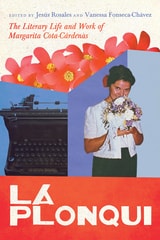
La Plonqui
The Literary Life and Work of Margarita Cota-CárdenasEdited by Jesús Rosales and Vanessa Fonseca-Chávez
University of Arizona Press, 2023
Nicknamed “La Plonky” by her family after a made-up childhood song, Cota-Cárdenas grew up in California, taught almost exclusively in Arizona, and produced five major works (two novels and three books of poetry) that offer an expansive literary production spanning from the 1960s to today. Her perspectives on Chicana identity, the Chicanx movement, and the sociopolitical climate of Arizona and the larger U.S.-Mexico border region represent a significant contribution to the larger body of Chicanx literature. Additionally, the volume explores her perspectives on issues of gender, sexuality, and identity related to the Chicanx experience over time.
Divided into three major parts, this collection begins with an introduction, followed by two testimonial essays written by the author herself and a longtime colleague, as well as an interview with the author. The second section contains nine essays by well-established literary critics that analyze Cota-Cárdenas’s literary output within a Chicano Movement literary context and offer new readings of Cota-Cárdenas’s fiction and poetry. The third part presents poetry and fiction from Cota-Cárdenas, including an excerpt from a work in progress. As a whole, the collection aims to affirm Margarita Cota-Cárdenas’s significant role in shaping the field of Chicana literature and emphasizes the importance of honoring a celebrated author who wrote a majority of her works in Spanish—one of the few Chicana writers to do so.
Contributors
Laura Elena Belmonte
Margarita Cota-Cárdenas
José R. Flores
Vanessa Fonseca-Chávez
Carolyn González
Gabriella Gutiérrez y Muhs
Manuel M. Martín-Rodríguez
Kirsten F. Nigro
Margarita E. Pignataro
Tey Diana Rebolledo
Jesús Rosales
Charles St-Georges
Javier Villarreal
Las Horas Imposibles / The Impossible Hours
Octavio Quintanilla; Translated by Octavio Quintanilla and Natalia Treviño
University of Arizona Press, 2025
Presented in Spanish with English translations, this poetry collection comprises lyric and concrete poems—or frontextos—that explore intimacy and different shades of violence as a means to reconcile the speaker’s sense of belonging in the world. From the opening poem to the last in the first section, Quintanilla captures the perilous journeys that migrants undertake crossing borders as well as the paths that lovers forge to meet their endless longing. These themes are skillfully woven by Quintanilla, guiding us back and forth across the Rio Grande to encounter the apparitions of the disappeared and to witness the willingness of many to risk life and limb for a better life. The second half of the collection is one long poem, a letter addressed to a lost lover who will never get to read the speaker’s secret thoughts. Haunted by loss—of parents, of children, of the self—the speaker reaches an inevitable epiphany: “[A]nd sometimes it’s hard to know / on which side of the river I stand.” Stylistically, these poems destabilize our notions and expectations of genre and lyricism.
Las Horas Imposibles / The Impossible Hours is more than just an exercise in poetic virtuosity; it is an excavation into the complexities of what it means to be a human being in our contemporary world.
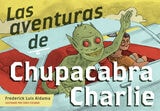
Las aventuras de Chupacabra Charlie
Frederick Luis Aldama / Ilustrado por Chris Escobar
The Ohio State University Press, 2021
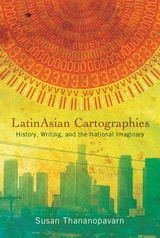
LatinAsian Cartographies
History, Writing, and the National ImaginaryThananopavarn, Susan
Rutgers University Press, 2018
Thananopavarn creates a new “LatinAsian” view of the United States that emphasizes previously suppressed aspects of national history, including imperialism, domestic racism during World War II, Cold War operations in Latin America and Asia, and the politics of borders in an age of globalization. LatinAsian Cartographies ultimately reimagines national narratives in a way that transforms dominant ideas of what it means to be American.
Latinas/os in New Jersey
Histories, Communities, and CulturesAldo A. Lauria Santiago
Rutgers University Press, 2025
Contributors: Yamil Avivi; Jennifer Ayala; Ulla D. Berg; Giovani Burgos; Elsa Candelario; Laura Curran; Lilia Fernández; Ismael García Colón; Olga Jiménez de Wagenheim; Benjamin Lapidus; Aldo A. Lauria Santiago; Johana Londoño; Kathleen Lopez; Giancarlo Muschi; Melanie Z. Plasencia; Ana Y. Ramos-Zayas; Elena Sabogal; Raymond Sanchez Mayers; William Suárez Gómez; Alex F. Trillo; Daniela Valdez; Anil Venkatesh; Lyna L. Wiggins
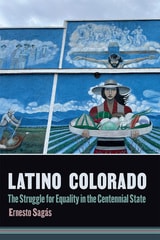
Latino Colorado
The Struggle for Equality in the Centennial StateErnesto Sagás
University Press of Colorado, 2026
Author Ernesto Sagás also explores the ways in which Latinos—as a racialized, subordinate group—have historically interacted with Colorado’s Anglo society in carving out their own spaces while struggling for social and legal equality. He presents a demographic and socioeconomic profile of Latinos in Colorado based on field research and the latest US Census data to dispel common stereotypes while also pointing out areas of concern for state policymakers.
Latino Colorado sheds light on this marginalized community and advances the understanding of the state’s racialized dynamics. It is about everyone in the American West—Anglos, Latinos, and others—and how they interact with and continue to (re)define one another in real and imagined ways in the most mythologized of American regions.
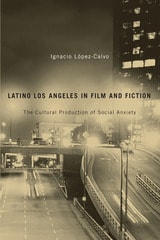
Latino Los Angeles in Film and Fiction
The Cultural Production of Social AnxietyIgnacio López-Calvo
University of Arizona Press, 2014
Latino Los Angeles in Film and Fiction sets out to reconfigure the scope of Latino literary and cultural studies. Integrating histories of different regions and nations, the book sets the interplay of unresolved contradictions in this particular metropolitan area. The novelists studied here stem from multiple areas, including the U.S. Southwest, Guatemala, and Chile. The study also incorporates non-Latino writers who have contributed to the Latino culture of the city.
The first chapter examines Latino cultural production from an ecocritical perspective on urban interethnic relations. Chapter 2 concentrates on the representation of daily life in the barrio and the marginalization of Latino urban youth. The third chapter explores the space of women and how female characters expand their area of operations from the domestic space to the public space of both the barrio and the city.
A much-needed contribution to the fields of urban theory, race critical theory, Chicana/o–Latina/o studies, and Los Angeles writing and film, López-Calvo offers multiple theoretical perspectives—including urban theory, ecocriticism, ethnic studies, gender studies, and cultural studies— contextualized with notions of transnationalism and post-nationalism.
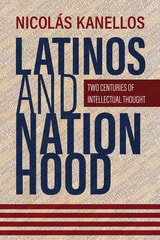
Latinos and Nationhood
Two Centuries of Intellectual ThoughtNicolás Kanellos
University of Arizona Press, 2023
Over the course of two centuries, these Latino or Hispanic intellectuals were natural-born citizens of the United States, immigrants, or political refugees. Many of these intellectuals, whether citizens or not, strove to embrace and enliven such democratic principles as freedom of speech and of the press, the protection of minorities in the Bill of Rights and in subsequent laws, and the protection of linguistic and property rights, among many others, guaranteed by treaties when the United States incorporated their homelands into the Union.
The first six chapters present the work of lesser-known historical figures—most of whom have been consistently ignored by Anglo- and Euro-centric history and whose works have been widely inaccessible until recently—who were revolutionaries, editors of magazines and newspapers, and speechmakers who influenced the development of a Latino consciousness. The last three chapters deal with three foundational figures of the Chicano Movement, the last two of whom either subverted the concept of nationhood or went beyond it to embrace internationalism in an outreach to humanity as a whole.
Latinos and Nationhood sheds new light on the biographies of Félix Varela, José Alvarez de Toledo y Dubois, Francisco Ramírez, Tomás Rivera, Rolando Hinojosa-Smith, and Gloria E. Anzaldúa, among others.
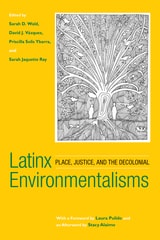
Latinx Environmentalisms
Place, Justice, and the DecolonialSarah D. Wald
Temple University Press, 2019
The whiteness of mainstream environmentalism often fails to account for the richness and variety of Latinx environmental thought. Building on insights of environmental justice scholarship as well as critical race and ethnic studies, the editors and contributors to Latinx Environmentalisms map the ways Latinx cultural texts integrate environmental concerns with questions of social and political justice.
Original interviews with creative writers, including Cherríe Moraga, Helena María Viramontes, and Héctor Tobar, as well as new essays by noted scholars of Latinx literature and culture, show how Latinx authors and cultural producers express environmental concerns in their work. These chapters, which focus on film, visual art, and literature—and engage in fields such as disability studies, animal studies, and queer studies—emphasize the role of racial capitalism in shaping human relationships to the more-than-human world and reveal a vibrant tradition of Latinx decolonial environmentalism.
Latinx Environmentalisms accounts for the ways Latinx cultures are environmental, but often do not assume the mantle of “environmentalism.”
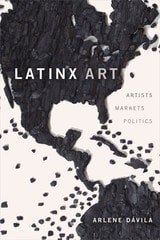
Latinx Art
Artists, Markets, and PoliticsArlene Dávila
Duke University Press, 2020
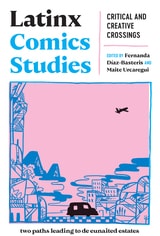
Latinx Comics Studies
Critical and Creative CrossingsFernanda Díaz-Basteris
Rutgers University Press, 2025
This collection moves beyond simply cataloguing and celebrating Latinx representation within comics. It examines how comics by, for, and about Latinx peoples creatively and conceptually experiment with the very boundaries of “Latinx” and portray the diverse lived experiences therein.
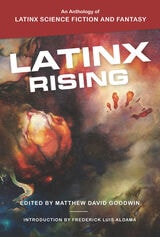
Latinx Rising
An Anthology of Latinx Science Fiction and FantasyEdited by Matthew David Goodwin / Introduction by Frederick Luis Aldama
The Ohio State University Press, 2020
The new and established voices assembled here (including Kathleen Alcalá, Carmen Maria Machado, Ernest Hogan, and other luminaries) invite us to imagine a Latinx past, present, and future that have not been whitewashed by mainstream perspectives. As in the best mixtapes, this anthology moves satisfyingly through the loud and brash, the quiet and thoughtful. There are ghosts, space aliens, robots—and a grandmother who unwittingly saves the universe through her cooking. The result is a deeply pleasurable read that pushes beyond magical realism and social realism to demonstrate all the thrilling possibilities of what Latinx literature can be.

Left Turns in Brown Study
Sandra Ruiz
Duke University Press, 2024
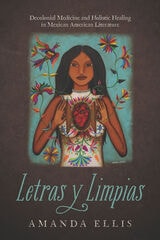
Letras y Limpias
Decolonial Medicine and Holistic Healing in Mexican American LiteratureAmanda Ellis
University of Arizona Press, 2021
Ellis explores the curandera in relationship to decoloniality, bioethics, and the topic of healing while recognizing the limitations and spiritual shortcomings of Western medicine. Ellis argues that our contemporary western health-care system does not know how to fully grapple with illnesses that patients face. Ellis reads the curandera’s perennial representation as an ongoing example of decolonial love useful for deconstructing narrow definitions of health and personhood, and for grappling with the effects of neoliberalism and colonialism on the health-care industry.
Letras y Limpias draws from Chicana feminist theory to assert the importance of the mindbodyspirit connection. Ellis conveys theoretical insights about the continual reimagining of the figure of the curandera as a watermark across Mexican American literary texts. This literary figure points to the oppressive forces that create susto and reminds us that healing work requires specific attention to colonialism, its legacy, and an intentional choice to carry forward the traditional practices rooted in curanderismo passed on from prior generations. By turning toward the figure of the curandera, readers are better poised to challenge prevailing ideas about health, and imagine ways to confront the ongoing problems that coloniality creates. Letras y Limpias shows how the figure of the curandera offers us ways to heal that have nothing to do with copays or medical professionals refusing care, and everything to do with honoring the beauty and complexity of any, every, and all humans.
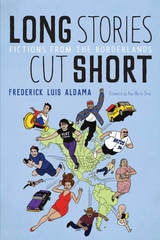
Long Stories Cut Short
Fictions from the BorderlandsFrederick Luis Aldama; Foreword by Ana María Shua
University of Arizona Press, 2017
Xbox videogamer cholo cyberpunks. Infants who read before they talk. Vatos locos, romancing abuelos, border crossers and border smugglers, drug kingpins, Latina motorbike riders, philosophically musing tweens, and so much more.
The stories in this dynamic bilingual prose-art collection touch on the universals of romance, family, migration and expulsion, and everyday life in all its zany configurations. Each glimpse into lives at every stage—from newborns and children to teens, young adults, and the elderly—further submerges readers in psychological ups and downs. In a world filled with racism, police brutality, poverty, and tensions between haves and have-nots, these flashes of fictional insight bring gleaming clarity to life lived where all sorts of borders meet and shift.
Frederick Luis Aldama and graphic artists from Mapache Studios give shape to ugly truths in the most honest way, creating new perceptions, thoughts, and feelings about life in the borderlands of the Américas. Each bilingual prose-art fictional snapshot offers an unsentimentally complex glimpse into what it means to exist at the margins of society today. These unflinching and often brutal fictions crisscross spiritual, emotional, and physical borders as they give voice to all those whom society chooses not to see.
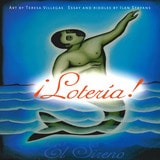
Lotería
Art by Theresa Villegas, Essay and Riddles by Ilan Stavans
University of Arizona Press, 2004
Chips, cards, and a table.
The riddles insightful,
the future, unstable! What is it?
It's Lotería, the Mexican game of chance! For the uninitiated, it might seem like bingo played with a riddling tarot deck. But this enthralling board game is more than entertainment. The images found on its cards—La Virgen, El Pan Dulce, La Telenovela—are miniature reflections of an entire culture, capturing the joys and sorrows of the Mexican people.
Wildly popular on both sides of the border, Lotería cards originated in the Iberian peninsula in the eighteenth century but have been redesigned so many times as to defy expectation, with boards devoted to ecclesiastical figures, soccer idols, and even vaudeville starlets. With the dawn of a new millennium, American artist Teresa Villegas created a new Lotería set that is already gaining popularity in Mexico, and her striking images are also widely exhibited in galleries across the United States.
This gift book, which will bring pleasure and bewilderment to children and adults alike, reproduces more than two dozen of Villegas's 54 colorful cards, pairing them with insightful, humorous riddles written by award-winning author Ilan Stavans. Stavans also revisits his childhood in an essay that examines the role of luck in Mexican life and recreates the sort of poetry jam that often accompanies Lotería contests wherever they might take place. Delve into the emblematic pages of this marvelous volume to find your own Calavera. Let yourself unravel the paths of El Deseo and the mysteries of El Corazón. Before too long, you'll realize that luck is never truly accidental—for a turn at ¡Lotería! is always an opportunity to come face to face with El Destino.