Results by title
679 books match the query 'Historiography' and 25 start with l
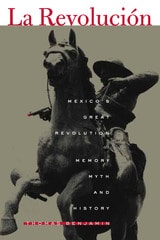
La Revolución
Mexico's Great Revolution as Memory, Myth, and HistoryBy Thomas Benjamin
University of Texas Press, 2000
The 1910 Revolution is still tangibly present in Mexico in the festivals that celebrate its victories, on the monuments to its heroes, and, most important, in the stories and memories of the Mexican people. Yet there has never been general agreement on what the revolution meant, what its objectives were, and whether they have been accomplished.
This pathfinding book shows how Mexicans from 1910 through the 1950s interpreted the revolution, tried to make sense of it, and, through collective memory, myth-making, and history writing, invented an idea called "la Revolución." In part one, Thomas Benjamin follows the historical development of different and often opposing revolutionary traditions and the state's efforts to forge them into one unified and unifying narrative. In part two, he examines ways of remembering the past and making it relevant to the present through fiestas, monuments, and official history. This research clarifies how the revolution has served to authorize and legitimize political factions and particular regimes to the present day. Beyond the Mexican case, it demonstrates how history is used to serve the needs of the present.
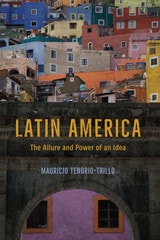
Latin America
The Allure and Power of an IdeaMauricio Tenorio-Trillo
University of Chicago Press, 2017
Tenorio-Trillo builds the book on three interlocking steps: first, an intellectual history of the concept of Latin America in its natural historical habitat—mid-nineteenth-century redefinitions of empire and the cultural, political, and economic intellectualism; second, a serious and uncompromising critique of the current “Latin Americanism”—which circulates in United States–based humanities and social sciences; and, third, accepting that we might actually be stuck with “Latin America,” Tenorio-Trillo charts a path forward for the writing and teaching of Latin American history. Accessible and forceful, rich in historical research and specificity, the book offers a distinctive, conceptual history of Latin America and its many connections and intersections of political and intellectual significance. Tenorio-Trillo’s book is a masterpiece of interdisciplinary scholarship.
Latin Americanism
Roman De La Campa
University of Minnesota Press, 1999
Analyzes the way North American academics have constructed Latin America.
In this timely book, Román de la Campa asks to what degree the Latin America studied in U.S. academies is actually an entity “made in the U.S.A.” He argues that there is an ever-increasing gap between the political, theoretical, and financial pressures affecting the U.S. academy and Latin America’s own cultural, political, and literary practices, and considers what this new Latin Americanism has to say about the claims of poststructuralism, postmodern theory, and deconstruction.
De la Campa focuses on the conduct of Latin American literary criticism in U.S. universities and compares this with the “Latin Americanism” of Latin America itself. He examines the translation of Latin American works into English, the careerism of U.S. intellectuals, the conduct of Latin American literary criticism in English, and the diaspora of Third World intellectuals. In a reconsideration of the vogue in Latin American literature and magical realism in light of new work by theorists residing in Latin America, he contrasts this work with critiques of Latin American discourses in the United States.A critique of postmodern and postcolonial constructions as articulated differently in the United States and Latin America, this hard-hitting but fair-minded book provides a postdeconstructive perspective on culture and literature. ISBN 0-8166-3116-6 Cloth £00.00 $47.95xxISBN 0-8166-3117-4 Paper £00.00 $18.95x224 Pages 5 7/8 x 9 JuneCultural Studies of the Americas Series, volume 3Translation inquiries: University of Minnesota Press
Lessons and Legacies II
Teaching the Holocaust in a Changing WorldDonald G. Schilling
Northwestern University Press, 1998
Lessons and Legacies II focuses on matters unique to Holocaust education. Consisting of selected papers delivered at the second Lessons and Legacies conference in 1992, the volume is organized in three sections: Issues, Resources, and Applications. Taken individually, the essays speak directly to specific concerns surrounding Holocaust education: the growing maturity of the Holocaust as a field of study; the difficult issue of explaining the perpetrators' behavior; the process of decision-making within Jewish communities during the Holocaust; issues of gender and family; the scope and content of survivor literature; and the structure of courses and the implications of being an educator in the field. Taken as a whole, the volume speaks to the reciprocal and mutually reinforcing relationship between teaching and scholarship in this important field.
Lessons and Legacies III
Memory, Memorialization, and DenialPeter Hayes
Northwestern University Press, 1999
A collection of nineteen essays, this book is organized into four sections: the first focuses on how various fields of study can open new perspectives on the Holocaust and sharpen old ones; the second examines culture and politics in Germany before and after 1933; the third addresses the problems associated with the memorialization of those years; and the final section examines the shocking denials of the Holocaust.
Lessons and Legacies IX
Memory, History, and Responsibility: Reassessments of the Holocaust, Implications for the FutureJonathan Petropoulos
Northwestern University Press, 2010
Memory, History, and Responsibility: Reassessments of the Holocaust, Implications for the Future contains the highlights from the ninth "Lessons and Legacies" conference. The conference, held during the height of the genocide in Darfur, sought to reexamine how the darkness of the Holocaust continues to shadow human existence more than sixty years after World War II left the Third Reich in ruins.
The collection opens with Saul Friedländer’s call for interdisciplinary approaches to Holocaust research. The essays that follow draw on the latest methodologies in the fields of history, literature, philosophy, religion, film, and gender studies, among others. Together both the leading scholars of the Holocaust and the next generation of scholars engage the difficult reality—as raised by editors Petropoulos, Rapaport, and Roth in their introduction—that the legacies of the Holocaust have not proved sufficient in intervening against human-made mass death, let alone preventing or eliminating it.
Lessons and Legacies VI
New Currents in Holocaust ResearchJeffry Diefendorf
Northwestern University Press, 2004
Several of the essays-such as one on nonarmed "amidah" or resistance and others on the role of gender in the behavior of perpetrators and victims-provide innovative and potentially significant interpretive frameworks for the field of Holocaust studies. Others; for instance, the rounding up of Jews in Italy, Nazi food policy in Eastern Europe, and Nazi anti-Jewish scholarship, emphasize the importance of new sources for reconstructing the historical record. Still others, including essays on the 1964 Frankfurt trial of Auschwitz guards and on the response of the Catholic Church to the question of German guilt, bring a new depth and sophistication to highly charged, sharply politicized topics. Together these essays will inform the future of the Holocaust in scholarly research and in popular understanding.
Lessons and Legacies VII
The Holocaust in International PerspectiveDagmar Herzog
Northwestern University Press, 2006
A thorough, thoughtful, and insightful introduction clarifies the volume's themes and concisely places them within the larger context of Holocaust scholarship; and an introductory essay by Omer Bartov brings into focus the numerous paradoxes structuring early twenty-first-century retrospective thinking about the significance of the Holocaust as a central theme of the twentieth century.
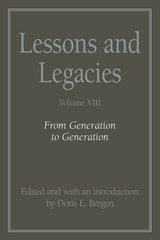
Lessons and Legacies VIII
From Generation to GenerationDoris L. Bergen
Northwestern University Press, 2008
Primo Levi opened his memoir Survival in Auschwitz with a call to remember, reflect upon, and teach about the Holocaust—or to face the rejection of subsequent generations. The transmittal of this urgent knowledge between generations was the theme of the eighth Lessons and Legacies Conference on the Holocaust, and it is the focus of this volume. The circular formulation—from generation to generation—points backward and forward: where do we locate the roots of the Holocaust, and how do its repercussions manifest themselves? The contributors address these questions from various perspectives—history, cultural studies, psychiatry, literature, and sociology. They also bring to bear the personal aspect of associated issues such as continuity and rupture. What has the generation of the Shoah passed on to its descendants? What have subsequent generations taken from these legacies? Contributions by scholars, some of whom are survivors and children of survivors, remind us that the Holocaust does—and must—remain present from generation to generation.
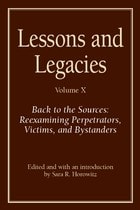
Lessons and Legacies X
Back to the Sources: Reexamining Perpetrators, Victims, and BystandersSara R Horowitz
Northwestern University Press, 2012
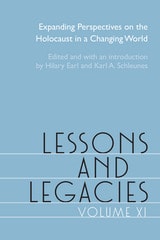
Lessons and Legacies XI
Expanding Perspectives on the Holocaust in a Changing WorldEdited and with an introduction by Hilary Earl and Karl A. Schleunes
Northwestern University Press, 2015
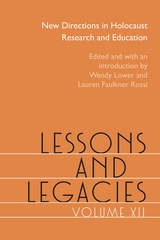
Lessons and Legacies XII
New Directions in Holocaust Research and EducationEdited and with an introduction by Wendy Lower and Lauren Faulkner Rossi
Northwestern University Press, 2017
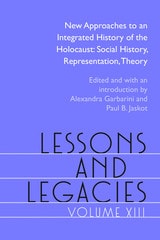
Lessons and Legacies XIII
New Approaches to an Integrated History of the Holocaust: Social History, Representation, TheoryEdited and with an introduction by Alexandra Garbarini and Paul B. Jaskot
Northwestern University Press, 2018
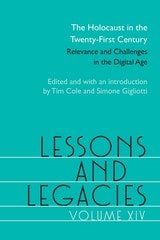
Lessons and Legacies XIV
The Holocaust in the Twenty-First Century; Relevance and Challenges in the Digital AgeEdited and with an introduction by Tim Cole and Simone Gigliotti
Northwestern University Press, 2021
The Holocaust in the Twenty-First Century: Relevance and Challenges in the Digital Age challenges a number of key themes in Holocaust studies with new research. Essays in the section “Tropes Reconsidered” reevaluate foundational concepts such as Primo Levi’s gray zone and idea of the muselmann. The chapters in “Survival Strategies and Obstructions” use digital methodologies to examine mobility and space and their relationship to hiding, resistance, and emigration. Contributors to the final section, “Digital Methods, Digital Memory,” offer critical reflections on the utility of digital methods in scholarly, pedagogic, and public engagement with the Holocaust.
Although the chapters differ markedly in their embrace or eschewal of digital methods, they share several themes: a preoccupation with the experiences of persecution, escape, and resistance at different scales (individual, group, and systemic); methodological innovation through the adoption and tracking of micro- and mezzohistories of movement and displacement; varied approaches to the practice of Saul Friedländer’s “integrated history”; the mainstreaming of oral history; and the robust application of micro- and macrolevel approaches to the geographies of the Holocaust. Taken together, these chapters incorporate gender analysis, spatial thinking, and victim agency into Holocaust studies. In so doing, they move beyond existing notions of perpetrators, victims, and bystanders to portray the Holocaust as a complex and multilayered event.
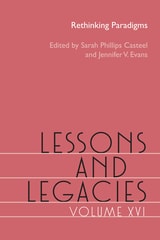
Lessons and Legacies, Volume XVI
Rethinking ParadigmsSarah Phillips Casteel and Jennifer V. Evans
Northwestern University Press, 2027
Bringing forth new perspectives previously unrepresented in Holocaust studies
Lessons and Legacies, Volume XVI: Rethinking Paradigms does the difficult but crucial work of thinking through new methods and modes of representation that speak to where we find ourselves in Holocaust studies today, responding to—and developing new tools to analyze—the shifting shape of Holocaust memory: spatially, temporally, and in and across diverse media. The collection foregrounds the challenges visual sources pose to how we think about the Holocaust, including how it is represented differently in visual media, from photography to graphic novels, and establishes translation as a crucial concept for reframing Holocaust testimony and memory. The contributing authors also model ethical, nuanced ways to conduct comparative, connective work that challenges Eurocentric narratives of the Holocaust. The volume concludes with a section on memory work and activism that approaches the subject of post-1945 memory through different lenses to surface lesser-known aspects of Holocaust history.
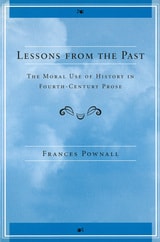
Lessons from the Past
The Moral Use of History in Fourth-Century ProseFrances Pownall
University of Michigan Press, 2003
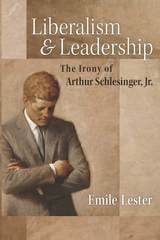
Liberalism and Leadership
The Irony of Arthur Schlesinger, Jr.Emile Lester
University of Michigan Press, 2019
Most scholars and pundits today view Franklin Delano Roosevelt and John F. Kennedy as aggressive liberal leaders, while viewing Schlesinger’s famous histories of their presidencies as celebrations of their steadfast progressive leadership. A more careful reading of Schlesinger’s work demonstrates that he preferred an ironic political outlook emphasizing the virtues of restraint, patience, and discipline. For Schlesinger, Roosevelt and Kennedy were liberal heroes and models as much because they respected the constraints on their power and ideals as because they tested traditional institutions and redefined the boundaries of presidential power.
Aggressive liberalism involves the use of inspirational rhetoric and cunning political tactics to expand civil liberties and insure economic equality. Schlesinger’s emphasis on the crucial role that irony has played and should play in liberalism poses a challenge to the aggressive liberalism advocated by liberal activists, political thinkers, and pundits. That his counsel was grounded in conservative insights as well as liberal values makes it accessible to leaders across the political spectrum.

Living With Africa
Jan M. Vansina
University of Wisconsin Press, 1994
"I'm not an ethnologist, I'm a historian!" Vansina was to repeat again and again to those who assumed that people without written texts have no history. His discovery that he could analyze Kuba oral tradition using the same methods he had learned for interpreting medieval dirges was a historiographical breakthrough, and his first book, Oral Tradition as History, is considered the seminal work that gave the study of precolonial African history both the scholarly justification and the self-confidence it had been lacking.
Living with Africa is a compelling memoir of Vansina's life and career on three continents, interwoven with the story of African history as a scholarly specialty. In the background of his narrative are the collapse of colonialism in Africa and the emergence of newly independent nations; in the foreground are the first conferences on African history, the founding of journals and departments, and the efforts of Africans to establish a history curriculum for the schools in their new nations.
Livy's Written Rome
Mary Jaeger
University of Michigan Press, 1997

London and beyond
Essays in honour of Derek KeeneEdited by Matthew Davies and James A. Galloway
University of London Press, 2012
Lonergan and Historiography
The Epistemological Philosophy of HistoryThomas J. McPartland
University of Missouri Press, 2010
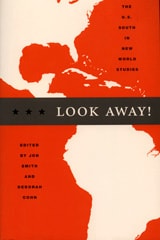
Look Away!
The U.S. South in New World StudiesJon Smith and Deborah Cohn, eds.
Duke University Press, 2004
Look Away! presents work by respected scholars in comparative literature, American studies, and Latin American studies. The contributors analyze how writers—including the Martinican Edouard Glissant, the Cuban-American Gustavo Pérez Firmat, and the Trinidad-born, British V. S. Naipaul—have engaged with the southern United States. They explore William Faulkner’s role in Latin American thought and consider his work in relation to that of Gabriel García Márquez and Jorge Luis Borges. Many essays re-examine major topics in southern U.S. culture—such as race, slavery, slave resistance, and the legacies of the past—through the lens of postcolonial theory and postmodern geography. Others discuss the South in relation to the U.S.–Mexico border. Throughout the volume,the contributors consistently reconceptualize U.S. southern culture in a way that acknowledges its postcolonial status without diminishing its distinctiveness.
Contributors. Jesse Alemán, Bob Brinkmeyer, Debra Cohen, Deborah Cohn, Michael Dash, Leigh Anne Duck, Wendy Faris, Earl Fitz, George Handley, Steve Hunsaker, Kirsten Silva Gruesz, Dane Johnson, Richard King, Jane Landers, John T. Matthews, Stephanie Merrim, Helen Oakley, Vincent Pérez, John-Michael Rivera, Scott Romine, Jon Smith, Ilan Stavans, Philip Weinstein, Lois Parkinson Zamora
Looking South
The Evolution of Latin Americanist Scholarship in the United States, 1850-1975Helen Delpar
University of Alabama Press, 2007
The definitive history of how Latin American studies became a major field in American scholarship.
Looking South: The Evolution of Latin Americanist Scholarship in the United States, 1850-1975 is the first comprehensive history of the development of Latin American studies as a field of academic inquiry in the United States. In this ambitious and insightful work, historian Helen Delpar traces more than a century of intellectual engagement with Latin America, revealing how generations of historians, anthropologists, geographers, economists, sociologists, and political scientists shaped American understandings of the region and transformed Latin American studies into a recognized academic discipline.
A central contribution of the book lies in its exploration of the relationship between scholarship and historical context. Delpar demonstrates that academic interest in Latin America was never isolated from larger political, economic, and cultural developments in the United States. The expansion of hemispheric trade, the Good Neighbor era, World War II, the Cold War, and the Cuban Revolution all influenced how American scholars approached the region and what questions they considered important. By examining these intersections, she reveals how academic knowledge is shaped by changing national priorities, international events, and institutional support networks.
Beyond its contributions to Latin American history, Looking South is a major work of intellectual and academic history. It offers a compelling account of how scholarly fields are created, how academic communities develop, and how knowledge about world regions is produced, organized, and disseminated. Delpar's careful attention to both individual scholars and larger institutional structures makes the book an essential resource for understanding the history of area studies, the social sciences, and higher education in the United States.
Looking South remains an indispensable guide to the origins and evolution of Latin Americanist scholarship. It is essential reading for historians, Latin Americanists, anthropologists, political scientists, educators, and anyone interested in the intellectual history of the Americas and the development of knowledge across national and cultural boundaries.
Lost on the Freedom Trail
The National Park Service and Urban Renewal in Postwar BostonSeth C. Bruggeman
University of Massachusetts Press, 2022
Boston National Historical Park is one of America's most popular heritage destinations, drawing in millions of visitors annually. Tourists flock there to see the site of the Boston Massacre, to relive Paul Revere's midnight ride, and to board Old Ironsides—all of these bound together by the iconic Freedom Trail, which traces the city's revolutionary saga.
Making sense of the Revolution, however, was never the primary aim for the planners who reimagined Boston's heritage landscape after the Second World War. Seth C. Bruggeman demonstrates that the Freedom Trail was always largely a tourist gimmick, devised to lure affluent white Americans into downtown revival schemes, its success hinging on a narrow vision of the city's history run through with old stories about heroic white men. When Congress pressured the National Park Service to create this historical park for the nation's bicentennial celebration in 1976, these ideas seeped into its organizational logic, precluding the possibility that history might prevail over gentrification and profit.

L’Écologique de l’Histoire
Valentin Husson
Diaphanes, 2020
Il y a plaisir à saluer l‘arrivée d’un philosophe tout neuf qui soudain bondit dans le cortège dionysiaque. Plus on est de fous, plus on pense, le proverbe dit vrai et notre temps de misère a plus que besoin de se refaire – s’il se peut – une vigueur spéculative. Il y a plus que du plaisir, une vraie jubilation lorsque le tout neuf philosophe affirme une pensée de la jouissance, de l’abondance et de la dépense au sens de Bataille (ici toujours discrètement mais efficacement présent). Une pensée énergique au sens le plus – oserais-je dire « vitalisant » du terme. L’energeia n’a-t-elle de sens que depuis l’être ? N’y a-t-il pas une autre énergie à penser ? Une énergie non pas de l’être, ni relative à celle extraite de la nature pour des fins productives et économiques, mais une énergie excédentaire, une sorte de « dépense improductive » (Bataille) de la vie ? Une énergie qui serait le luxe biologique du vivant. Ce luxe biologique, Valentin Husson le pense comme – on ne peut plus dire « ontologique » – comme existence en un sens qui se dérobe à Heidegger et à son « sens de l’être » pour affirmer un avoir à être selon lequel l’être se dissipe au-delà de toute consistance tandis que l’avoir à prend toute l’énergie d’une vie en débordante envie d’elle-même. Jean-Luc Nancy