Results by title
395 books match the query 'How' and 8 start with l
Labor's End
How the Promise of Automation Degraded WorkJason Resnikoff
University of Illinois Press, 2022
A forceful intellectual history, Labor's End challenges entrenched assumptions about automation's transformation of the American workplace.

Leading Libraries
How to Create a Service CultureWyoma vanDuinkerken
American Library Association, 2015
Leave Me Alone and I'll Make You Rich
How the Bourgeois Deal Enriched the WorldDeirdre Nansen McCloskey and Art Carden
University of Chicago Press, 2020
For readers looking for a distillation of McCloskey’s magisterial work, Leave Me Alone and I’ll Make You Rich is what you’ve been waiting for. In this lively volume, McCloskey and the economist and journalist Carden bring together the trilogy’s key ideas and its most provocative arguments. The rise of the west, and now the rest, is the story of the rise of ordinary people to a dignity and liberty inspiring them to have a go. The outcome was an explosion of innovation after 1800, and a rise of real income by an astounding 3,000 percent. The Great Enrichment, well beyond the conventional Industrial Revolution, did not, McCloskey and Carden show, come from the usual suspects, capital accumulation or class struggle. It came from the idea of economic liberty in Holland and the Anglosphere, then Sweden and Japan, then Italy and Israel and China and India, an idea that bids fair in the next few generations to raise up the wretched of the earth. The original shift to liberalism arose from 1517 to 1789 from theological and political revolutions in northwest Europe, upending ancient hierarchies. McCloskey and Carden contend further that liberalism and “innovism” made us better humans as well as richer ones. Not matter but ideas. Not corruption but improvement.
Leave Me Alone and I’ll Make You Rich draws in entertaining fashion on history, economics, literature, philosophy, and popular culture, from growth theory to the Simpsons. It is the perfect introduction for a broad audience to McCloskey’s influential explanation of how we got rich. At a time when confidence in the economic system is under challenge, the book mounts an optimistic and persuasive defense of liberal innovism, and of the modern world it has wrought.
Legal Reference for Librarians
How and Where to Find the AnswersPaul D. Healey
American Library Association, 2014
Life in the Hothouse
How a Living Planet Survives Climate ChangeMelanie Lenart
University of Arizona Press, 2010
Life in the Hothouse incorporates Lenart’s extensive knowledge of climate science—including the latest research in climate change—and the most current scientific theories, including Gaia theory, which holds that the Earth has some degree of climate control “built in.” As Lenart points out, scientists have been documenting stronger hurricanes and larger floods for many years. There is a good reason for this, she notes. Hurricanes help cool the ocean surface and clear the air of carbon dioxide, the main greenhouse gas responsible for global warming. From the perspective of Gaia theory, these responses are helping to slow the ongoing global warming and Lenart expounds upon this in a clear and understandable fashion.
There is hope, Lenart writes. If we help sustain Earth's natural defense systems, including wetlands and forests, perhaps Mother Earth will no longer need to rely as much on the cooling effects of what we call "natural disasters"—many of which carry a human fingerprint. At a minimum, she argues, these systems can help us survive the heat.
Listening to Popular Music
Or, How I Learned to Stop Worrying and Love Led ZeppelinTheodore Gracyk
University of Michigan Press, 2007
It has long been assumed that people who prefer Led Zeppelin to Mozart live aesthetically impoverished lives. But why? In Listening to Popular Music, award-winning popular music scholar Theodore Gracyk argues that aesthetic value is just as important in popular listening as it is with “serious” music. And we don’t have to treat popular music as art in order to recognize its worth. Aesthetic values are realized differently in different musical styles, and each requires listening skills that people must learn.
—William Echard, Department of Music, and Institute for Comparative Studies in Literature, Art, and Culture, Carleton University
—Stephen Davies, Department of Philosophy, University of Auckland, and author of The Philosophy of Art
—Mark Katz, Assistant Professor of Music, University of North Carolina at Chapel Hill, and author of Capturing Sound: How Technology Has Changed Music
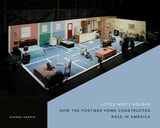
Little White Houses
How the Postwar Home Constructed Race in AmericaDianne Harris
University of Minnesota Press, 2013
A rare exploration of the racial and class politics of architecture, Little White Houses examines how postwar media representations associated the ordinary single-family house with middle-class whites to the exclusion of others, creating a powerful and invidious cultural iconography that continues to resonate today. Drawing from popular and trade magazines, floor plans and architectural drawings, television programs, advertisements, and beyond, Dianne Harris shows how the depiction of houses and their interiors, furnishings, and landscapes shaped and reinforced the ways in which Americans perceived white, middle-class identities and helped support a housing market already defined by racial segregation and deep economic inequalities.
After describing the ordinary postwar house and its orderly, prescribed layout, Harris analyzes how cultural iconography associated these houses with middle-class whites and an ideal of white domesticity. She traces how homeowners were urged to buy specific kinds of furniture and other domestic objects and how the appropriate storage and display of these possessions was linked to race and class by designers, tastemakers, and publishers. Harris also investigates lawns, fences, indoor-outdoor spaces, and other aspects of the postwar home and analyzes their contribution to the assumption that the rightful owners of ordinary houses were white.
Richly detailed, Little White Houses adds a new dimension to our understanding of race in America and the inequalities that persist in the U.S. housing market.
Love, Sex & Tragedy
How the Ancient World Shapes Our LivesSimon Goldhill
University of Chicago Press, 2004
Marx, Clark Gable, George W. Bush, Oscar Wilde, and Freud—Goldhill's range here is enormous, and he takes great delight in tracing both follies and fundamental philosophical questions through the centuries and continents to the birthplace of Western civilization as we know it. Underlying his brisk and learned excursions through history and art is the foundational belief, following Cicero, that learning about the classics makes a critical difference to our self-understanding. Whether we are considering the role of religion in contemporary society, our expectations about the boundaries between public and private life, or even how we spend our free time, recognizing the role of the classics is integral to our comprehension of modern life and our place in it.
When Goldhill asks "Who do you think you are?" he presents us with the rarest of opportunities: the chance to let him lead us, firmly but with a wink, back two thousand years to where we are.