Results by title
260 books match the query 'Human ecology' and 14 start with l

La Selva
Ecology and Natural History of a Neotropical Rain ForestEdited by Lucinda A. McDade, Kamaljit S. Bawa, Henry A. Hespenheide, and Gary S.
University of Chicago Press, 1994
the most intensively studied and best-understood tropical field sites
in the world. For over thirty years, La Selva has been a major focus
of research on rainforest ecology, flora, and fauna. This volume
provides the first comprehensive review of this research, covering La
Selva's geographical history and physical setting, its plant and
animal life, and agricultural development and land use.
Drawing together a wealth of information never before available in a
single volume, La Selva offers a substantive treatment of the
ecology of a rainforest. Part 1 summarizes research on the physical
setting and environment of the rainforest, as well as the history of
the research station. Some chapters in this part focus on climate,
geomorphology, and aquatic systems, while others look at soils,
nutrient acquisition, and cycles of energy.
Part 2 synthesizes what is known about the plant community. It begins
with chapters on vegetation types and plant diversity, and also
explores plant demography, spatial patterns of trees, and the impact
of treefall gaps on forest structure and dynamics. Other chapters
address plant physiological ecology, as well as plant reproductive
systems.
Part 3 covers the animal community, summarizing information on the six
best-known animal taxa of the region: fishes, amphibians, reptiles,
birds, mammals, and butterflies. This part includes an overview of
faunal studies at La Selva and a chapter on animal population biology,
which examines animal demography and abundance, and interactions
between predators and prey. Part 4 addresses interactions between
plants and animals and the effects of these interactions on species
diversity.
Part 5 considers the impact of land use and agricultural development
on La Selva and other areas of Costa Rica. One chapter examines land
colonization and conservation in Sarapiqui, another covers subsistence
and commercial agricultural development in the Atlantic lowlands
region, and a third looks at the forest industry in northeastern Costa
Rica. This part also assesses the role and research priorities of La
Selva.
La Selva provides an introduction to tropical ecology for
students and researchers at La Selva, a major source of comparative
information for biologists working in other tropical areas, and a
valuable resource for conservationists.
Land of Big Rivers
French and Indian Illinois, 1699-1778M. J. Morgan
Southern Illinois University Press, 2010
Drawing on research from a variety of academic fields, such as archaeology, history, botany, ecology, and physical science, M. J. Morgan explores the intersection of people and the environment in early eighteenth-century Illinois Country—a stretch of fecund, alluvial river plain along the Mississippi river. Arguing against the traditional narrative that describes Illinois as an untouched wilderness until the influx of American settlers, Morgan illustrates how the story began much earlier.
She focuses her study on early French and Indian communities, and later on the British, nestled within the tripartite environment of floodplain, riverine cliffs and bluffs, and open, upland till plain/prairie and examines the impact of these diverse groups of people on the ecological landscape. By placing human lives within the natural setting of the period—the abundant streams and creeks, the prairies, plants and wildlife—she traces the environmental change that unfolded across almost a century. She describes how it was a land in motion; how the occupying peoples used, extracted, and extirpated its resources while simultaneously introducing new species; and how the flux and flow of life mirrored the movement of the rivers. Morgan emphasizes the importance of population sequences, the relationship between the aboriginals and the Europeans, the shared use of resources, and the effects of each on the habitat.
Land of Big Rivers is a unique, many-themed account of the big-picture ecological change that occurred during the early history of the Illinois Country. It is the first book to consider the environmental aspects of the Illinois Indian experience and to reconsider the role of the French and British in environmental change in the mid-Mississippi Valley. It engagingly recreates presettlement Illinois with a remarkable interdisciplinary approach and provides new details that will encourage understanding of the interaction between physical geography and the plants, animals, and people in the Illinois Country. Furthermore, it exhibits the importance of looking at the past in the context of environmental transformation, which is especially relevant in light of today’s global climate change.
Landscape With Figures
Nature & Culture New EnglandKent C. Ryden
University of Iowa Press, 2001
Landscape and Interaction. The Troodos Archaeological and Environmental Survey Project, Cyprus. Volume 1. Methodology, Analysis and Interpretation
Michael Given
Council for British Research in the Levant, 2013
Landscapes and Social Transformations on the Northwest Coast
Colonial Encounters in the Fraser ValleyJeff Oliver
University of Arizona Press, 2010
The Fraser Valley has long been a scene of natural resource appropriation—furs and fish, timber and agriculture—with settlement patterns and land claims centering on the use of these materials. Oliver demonstrates how social change and cultural understanding are tied to the way that people use and remake the landscape. Drawing on ethnographic texts, archaeological evidence, cartography, and historical writing, he has created a deep history of the valley that enables us to view how human entanglements with landscape were creative of a variety of contentious issues. By capturing the multiple dynamics that were operating in the past, Oliver shows us not only how landscape transformations were implicated in constructing different perceptions of place but also how such changes influenced peoples’ understanding of history and identity.
This groundbreaking work examines engagement between people and the environment across a variety of themes, from aboriginal appropriation of nature to colonists’ reworking of physical and conceptual geographies, demonstrating the consequences of these interactions as they permeated various social and cultural spheres. It offers a new lens for viewing a region as it provides fresh insight into such topics as landscape change, perceptions of place, and Indigenous-white relations.
Law and the Environment
A Multidisciplinary ReaderRobert Percival
Temple University Press, 1997
Law and the Environment: A Multidisciplinary Reader brings together for the first time some of the most important original work on environmental policy by scientists, ecologists, philosophers, historians, economists, and legal scholars. Each of the book's four parts provides a different focus on the nature and scope of environmental problems and attempts to use public policy to address these concerns. Part I examines how ecology, economics, and ethics analyze environmental problems and why they support collective action to respond to them. Part II examines the history and present state of environmental law, from early attempts to engage the government to current debate over the effectiveness of environmental policy. Part III explores the process by which environmental law gets translated into regulatory policy. Part IV considers the future of environmental law at a time when international environmental concerns have become a major force in global diplomacy and international trade agreements.
In drawing together a wide variety of perspectives on these issues, Robert V. Percival and Dorothy C. Alevizatos offer a comprehensive examination of how society has responded to the difficult challenges posed by environmental problems. The selections provide a rich introduction to the complexities of environmental policy disputes.
Leavetakings
EssaysCorinna Cook
University of Alaska Press, 2020
Legacies of The Basin of Mexico
Carlos E. Cordova
University Press of Colorado, 2023
More than four decades after that book’s publication, the fourteen contributions in this volume review and analyze its theoretical and methodological influence in light of recent research across disciplines. Among a spectrum of authors representing several generations are those who participated directly in the Basin of Mexico surveys—including the late Jeffrey R. Parsons—as well as those who have been actively working on recent projects in the basin and neighboring regions.
Providing a broad and multidisciplinary perspective of the present and future state of research in the area, The Legacies of The Basin of Mexico will be of interest to Mesoamerican and Latin American archaeologists as well as geographers, geologists, historians, and specialists in the study of past environments.
Contributors: Guillermo Acosta Ochoa, Aleksander Borejsza, Destiny Crider, Charles Frederick, Raúl García-Chávez, Larry Gorenflo, Angela Huster, Georgina Ibarra Arzave, Charles Kolb, Frank Lehmkuhl, Abigail Meza Peñaloza, Emily McClung de Tapia, John K. Millhauser, Deborah Nichols, Jeffrey R. Parsons, Serafin Sánchez Pérez, Philipp Schulte, Sergey Sedov, Elizabeth Solleiro Rebolledo, Daisy Valera Fenández, Federico Zertuche
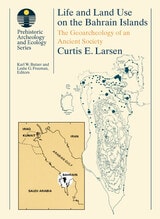
Life and Land Use on the Bahrain Islands
The Geoarchaeology of an Ancient SocietyCurtis E. Larsen
University of Chicago Press, 1983
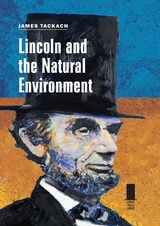
Lincoln and the Natural Environment
James Tackach
Southern Illinois University Press, 2019
In this groundbreaking environmental biography of Abraham Lincoln, James Tackach maps Lincoln’s lifelong relationship with the natural world from his birth and boyhood on Midwestern farms through his political career and presidency dealing with the effects of the Industrial Revolution and the Civil War.
Lincoln was born in a generation that grew up on farms but began to move to cities as industrialization transformed the American economy. Turning away from the outdoor, manual labor of his youth, he chose careers in law and politics but always found solace outside first on the prairies of Illinois and, later, at the woodsy presidential retreat. As Tackach shows, Lincoln relied on examples and metaphors from the natural world in his speeches and writings.
As a member of the Whig Party Lincoln endorsed the Industrial Revolution, which transformed the nation’s economy and its physical, social, and cultural landscapes, and advocated for the creation of railroads, canals, roads, and bridges to facilitate growth and the distribution of products. But he and his party failed to take steps to protect the natural environment. Surveying the destruction of the environment in the mid-nineteenth century, Tackach outlines how some American writers, the first voices for protection and conservation, began to call attention to the results of deforestation and the overhunting of animals during Lincoln’s lifetime.
As commander in chief during the Civil War, Lincoln approved a strategy that included significant infrastructure and environmental damage. In the South, where most of the battles occurred, Union troops burned cities and towns and destroyed plantations, farms, and natural landscapes. Tackach argues that, midway through his presidency, Lincoln seemed to sense that postwar Reconstruction would have to be spiritual, political, economic, and environmental in order to heal the nation’s wounds. He signed the Morrill Act, creating the land-grant colleges, and the environmentally progressive Yosemite Grant Act, which preserved thousands of acres of forest in California.
The first scholar to thoroughly investigate Lincoln’s lifelong relationship with the natural environment, Tackach paints Lincoln’s personal and professional life against the backdrop of nineteenth-century American environmental history, issues, and writers, providing insights into contemporary environmental issues.
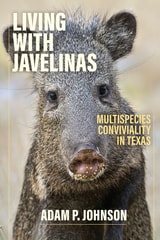
Living with Javelinas
Multispecies Conviviality in TexasAdam P. Johnson
University of Texas Press, 2026
An ethnography on how both humans and javelinas can thrive in shared space.
As human settlements expand into formerly wild lands, coexistence with wildlife is no longer optional––it’s a daily negotiation. In Living with Javelinas, Adam Johnson explores what it means to share space and adapt in a more-than-human world. Often mistaken for wild pigs, javelinas unsettle the boundaries between nuisance and neighbor. Johnson traces the other species that shape their lives––feral hogs, prickly pear, mountain cedar––and examines how folklore, perception, and memory influence human–javelina encounters. Drawing on ethnographic, ecological, and ethological research across Texas, he shows how coexistence becomes a practical, albeit often uneasy, conviviality.
In much of Texas, decades of hunting have made javelinas wary. Through extended time with rancher Roger Gray, who encounters and feeds javelinas daily, Johnson reveals how repeated contact can foster a mutually responsive relationship. Bringing anthropology into dialogue with ecology, Living with Javelinas argues that coexistence is not harmony but an ongoing adjustment. In a time of ecological strain, situated acts of accommodation point toward more ethical and sustainable ways of living together.

Living with the Coast of Alaska
Owen Mason, William Neal, and Orrin H. Pilkey
Duke University Press, 1997
Facing two oceans and three seas, Alaska's coastline stretches through bays, fjords, and around islands for 45,000 miles. Living with the Coast of Alaska, a new volume in the Living with the Shore series, is a user's guide for both present and future inhabitants of Alaska. Providing individual property owners in all regions of the state with the fundamentals of hazard recognition and mitigation strategy, the authors discuss the geological history of Alaska and its relation to the area's cultural history and present customized hazard risk assessments for coastal communities.
Describing the dynamic nature of natural seismic events and coastal processes in Alaska, the authors emphasize the multiplicity of potential effects that result from a unique combination of geology, climate, and the sea. Earthquakes, volcanic eruptions, tsunami waves, avalanches, glacial advances, storm surges, flash flooding, wind channeling, and shoreline erosion combined with human-induced hazards such as oil spills, fire, and beach and offshore mining accidents make living with danger a way of life in Alaska. The authors provide information on federal and state laws and programs regarding natural disasters and coastal zone management as well as practical suggestions for the design and construction of buildings. For private, commercial, and public developments, this book offers a manual to help Alaskans make informed decisions to minimize, if not avoid, damage and danger.
Loss and Wonder at the World’s End
Laura A. Ogden
Duke University Press, 2021
L’Écologique de l’Histoire
Valentin Husson
Diaphanes, 2020
Il y a plaisir à saluer l‘arrivée d’un philosophe tout neuf qui soudain bondit dans le cortège dionysiaque. Plus on est de fous, plus on pense, le proverbe dit vrai et notre temps de misère a plus que besoin de se refaire – s’il se peut – une vigueur spéculative. Il y a plus que du plaisir, une vraie jubilation lorsque le tout neuf philosophe affirme une pensée de la jouissance, de l’abondance et de la dépense au sens de Bataille (ici toujours discrètement mais efficacement présent). Une pensée énergique au sens le plus – oserais-je dire « vitalisant » du terme. L’energeia n’a-t-elle de sens que depuis l’être ? N’y a-t-il pas une autre énergie à penser ? Une énergie non pas de l’être, ni relative à celle extraite de la nature pour des fins productives et économiques, mais une énergie excédentaire, une sorte de « dépense improductive » (Bataille) de la vie ? Une énergie qui serait le luxe biologique du vivant. Ce luxe biologique, Valentin Husson le pense comme – on ne peut plus dire « ontologique » – comme existence en un sens qui se dérobe à Heidegger et à son « sens de l’être » pour affirmer un avoir à être selon lequel l’être se dissipe au-delà de toute consistance tandis que l’avoir à prend toute l’énergie d’une vie en débordante envie d’elle-même. Jean-Luc Nancy