Results by title
83 books match the query 'Inclusive Education' and 3 start with l
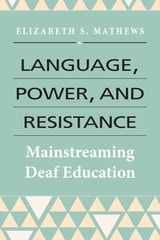
Language, Power, and Resistance
Mainstreaming Deaf EducationElizabeth S. Mathews
Gallaudet University Press, 2017
The current policy of educating d/Deaf and h/Hard of hearing (DHH) students in a mainstream setting, rather than in the segregated environments of deaf schools, has been portrayed as a positive step forward in creating greater equality for DHH students. In Language, Power, and Resistance, Elizabeth S. Mathews explores this claim through qualitative research with DHH children in the Republic of Ireland, their families, their teachers, and their experiences of the education system. While sensitive to the historical context of deaf education, Mathews focuses on the contemporary education system and the ways in which the mainstreaming agenda fits into larger discussions about the classification, treatment, and normalization of DHH children.
The research upon which this book is based examined the implications that mainstreaming has for the tensions between the hegemonic medical model of deafness and the social model of Deafness. This volume explores how different types of power are used in the deaf education system to establish, maintain, and also resist medical views of deafness. Mathews frames this discussion as one of power relations across parents, children, and professionals working within the system. She looks at how various forms of power are used to influence decisions, to resist decisions, and to shape the structure and delivery of deaf education. The author’s findings are a significant contribution to the debates on inclusive education for DHH students and will resonate in myriad social and geographic contexts.
The research upon which this book is based examined the implications that mainstreaming has for the tensions between the hegemonic medical model of deafness and the social model of Deafness. This volume explores how different types of power are used in the deaf education system to establish, maintain, and also resist medical views of deafness. Mathews frames this discussion as one of power relations across parents, children, and professionals working within the system. She looks at how various forms of power are used to influence decisions, to resist decisions, and to shape the structure and delivery of deaf education. The author’s findings are a significant contribution to the debates on inclusive education for DHH students and will resonate in myriad social and geographic contexts.
[more]

Learning to Leave
The Irony of Schooling in a Coastal CommunityMichael Corbett
West Virginia University Press, 2020
Published with a new preface, this innovative case study from Nova Scotia analyzes the relationship between rural communities and contemporary education. Rather than supporting place-sensitive curricula and establishing networks within community populations, the rural school has too often stood apart from local life, with the generally unintended consequence that many educationally successful rural youth come to see their communities and lifestyles as places to be left behind. They face what Michael Corbett calls a mobility imperative, which, he shows, has been central to contemporary schooling. Learning to Leave argues that if education is to be democratic and serve the purpose of economic, social, and cultural development, then it must adapt and respond to the specificity of its locale, the knowledge practices of the people, and the needs of those who struggle to remain in challenged rural places.
[more]
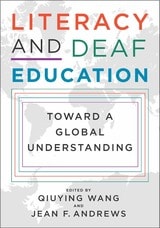
Literacy and Deaf Education
Toward a Global UnderstandingQiuying Wang
Gallaudet University Press, 2020
International perspectives about literacy and deaf students is an uncharted intellectual landscape. Much of the literacy research in deaf education is conducted in English-speaking countries—primarily the United States—but 90% of deaf children live outside the U.S. and learn various signed and spoken languages, as well as diverse writing systems. Many of these children face significant educational challenges. In order to improve the literacy outcomes of deaf students around the world, it is imperative to study how children are using their local signed and spoken languages along with Deaf culture to learn to read and write. This volume fills a void in the field by providing a global view of recent theoretical and applied research on literacy education for deaf learners.
Literacy and Deaf Education: Toward a Global Understanding is organized by region and country, with the first part discussing writing systems that use alphabetic scripts, and the second part focusing on countries that use non-alphabetic scripts. Some examples of the wide spectrum of topics covered include communication methodologies, curriculum, bilingual education, reading interventions, script diversity, and sociocultural development, including Deaf cultural developments. The contributors provide the results from literacy projects in fifteen countries and regions.
This volume aims to widen the knowledge base, familiarize others in the field with these initiatives, and improve global understandings and outcomes of literacy teaching and learning in deaf education from birth to high school.
Signed chapter summaries are available on the Gallaudet University Press YouTube channel.
[more]