Results by title
39 books match the query 'Stars'
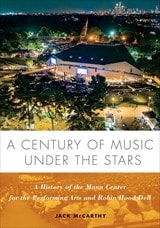
A Century of Music Under the Stars
A History of the Mann Center for the Performing Arts and Robin Hood DellMcCarthy, Jack, and The Mann Center for the Performing Arts
Temple University Press, 2025
The Dell, which opened in 1930, and the Mann, which opened in 1976, were initially built as summer homes for The Philadelphia Orchestra. As McCarthy fondly recounts, the Mann Center evolved to host the world’s top artists across many musical genres. Contemporary audiences have gathered on the Great Lawn for concerts by performers including James Taylor, The Roots, Phish, Diana Ross, John Legend, and others.
The venues, however, are more than just the music; they are about the beautiful natural setting, communal atmosphere, and spectacular view of the Philadelphia skyline. A Century of Music Under the Stars is a revealing and celebratory look back at beloved Philadelphia cultural icons. This informative and illuminating history will provide happy memories for generations of music lovers.
After the Irish Renaissance
A Critical History of the Irish Drama since The Plough and The StarsRobert Hogan
University of Minnesota Press, 1967
Behind the Stars, More Stars
The Tagus/Disquiet Collection of New Luso-American WritingEdited by Christopher Larkosh and Oona Patrick
Tagus Press, 2019
Presenting experimental and boundary-breaking prose from women, people of color, and LGBTQ writers, Behind the Stars, More Stars imagines a more diverse and inclusive Luso-American and Portuguese-American literary scene, which has traditionally been dominated by male voices. Since its first “Writing the Luso Experience” workshops were held in 2011, Dzanc Books's Disquiet International Literary Program in Lisbon has aimed to break silences within today's Luso-American communities. Disquiet faculty Katherine Vaz and Frank X. Gaspar appear alongside up-and-coming writers from the workshops, such as Traci Brimhall, Megan Fernandes, Hugo Dos Santos, and previously unpublished women writers.
Below the Stars
How the Labor of Working Actors and Extras Shapes Media ProductionBy Kate Fortmueller
University of Texas Press, 2021
Longlisted for the 2022 Kraszna-Krausz Book Award, Moving Image Category
Despite their considerable presence in Hollywood, extras and working actors have received scant attention within film and media studies as significant contributors to the history of the industry. Looking not to the stars but to these supporting players in film, television, and, recently, streaming programming, Below the Stars highlights such actors as precarious laborers whose work as freelancers has critically shaped the entertainment industry throughout the twentieth and twenty-first centuries. By addressing ordinary actors as a labor force, Kate Fortmueller proposes a media industry history that positions underrepresented and quotidian experiences as the structural elements of the culture and business of Hollywood.
Resisting a top-down assessment, Fortmueller explores the wrangling of labor unions and guilds that advocated for collective action for everyday actors and helped shape professional norms. She pulls from archival research, in-person interviews, and firsthand observation to examine a history that cuts across industry boundaries and situates actors as a labor group at the center of industrial and technological upheavals, with lasting implications for race, gender, and labor relations in Hollywood.
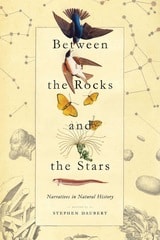
Between the Rocks and the Stars
Narratives in Natural HistoryStephen Daubert
Vanderbilt University Press, 2020
These stories take readers where they cannot go, be it out into space, back in time, deep under the ocean, down to microscopic scales, or out onto the geologic overview.
Squid turn themselves inside-out when disturbed by predators hunting through the darkness with sonar. Beneficial microbes spend their summer living in nectar and being transferred between blooms by the bees, then spend the winter living within those bees. Ecological stories are seen through the eyes of squirrels, birds, fish, ants, butterflies, and beetles.
Between the Rocks and the Stars dives deep into the relationships that shape the natural world. The book presents a collection of vignettes from the wild, each of which describes the natural advantage of a particular organism. These true-to-life accounts are then posed in particular circumstances that illustrate the principles—commensalism, speciation—that shape the place of these organisms in their living environment. Some stories cover topics in geology and cosmology, describing the physical world context in which natural history progresses across the eons.
Underlying themes in the book include the network of connections that link all these organisms together and the adaptations they make to the physical world in which they must find themselves a home.

Beyond the Stars
Stock Characters in American Popular FilmUniversity of Wisconsin Press, 1990
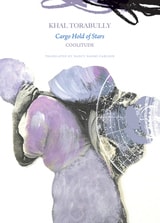
Cargo Hold Of Stars
CoolitudeKhal Torabully
Seagull Books, 2020
An arresting, musical ode to the forgotten voyages and resilient identities of indentured peoples.
Cargo Hold of Stars gives voice to the millions of indentured men and women, mostly from India and China, who were brought to Mauritius between 1849 and 1923. Kept in close quarters in the ship’s cargo hold, many died; most never returned home. Here, Khal Torabully introduces the concept of “Coolitude,” echoing Aimé Césaire’s “Negritude” to imbue the term with profound dignity, pride, and a resilient cultural identity. Stating that ordinary language could not capture these diverse voices, Torabully develops a new “poetics of Coolitude”: a French peppered with Mauritian Creole, brilliant wordplay, and neologisms.
The humor in these linguistic acrobatics only underscores the violence in which these poems are steeped. Deftly translated by Nancy Naomi Carlson, Cargo Hold of Stars is the song of an uprooting, destruction, and reconstruction. Yet it also celebrates setting down roots, conjuring an ideal homeland of fraternity and reconciliation in which bodies, memories, and languages mingle—a compelling odyssey defining the essence of humankind.
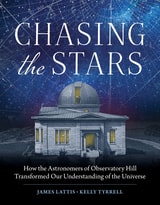
Chasing the Stars
How the Astronomers of Observatory Hill Transformed Our Understanding of the UniverseJames Lattis
Wisconsin Historical Society Press, 2024
Explore the remarkable story of Wisconsin astronomers whose curiosity, persistence, and innovation helped us better understand our universe.
Chasing the Stars traces the history of the University of Wisconsin’s Washburn Observatory, where some of the world’s most cutting-edge astronomical inventions were born. Learn about the earliest Indigenous stargazers, the women who worked as the first human computers, the astronomers who sold time by the stars, the scientists who shrank the Milky Way, and the crucial role Wisconsin astronomers played in the development of modern astrophysics and space astronomy.
This extraordinary book features more than 100 modern and historic photographs that illustrate the people and science behind Wisconsin’s astronomical innovations. Designed for lay readers and astronomers alike, Chasing the Stars inspires all of us to look up at the sky in wonder.
“Filled with fascinating astronomy-related facts, Chasing the Stars covers the first century-plus of the University of Wisconsin’s Washburn Observatory and the science it inspired. . . . [It is] a thorough, enlightening history of an important scientific site and the personalities who brought it to life.”
—Foreword Reviews
“Lattis and Tyrrell give us a masterful tour of Washburn Observatory, its legacy of astronomical discovery, and the key figures who forever changed our understanding of the cosmos. Readers will find delightful insights on these pages that bring this rich history to life and instill a desire to gaze at the stars.”
—Kenneth Sembach, former director of the Space Telescope Science Institute
“Through enchanting photos and compelling tales of astronomers, Lattis and Tyrrell shed light on the impressive innovations Wisconsin has contributed to the field of astrophysics. From the novel ways of collecting light from space to the new technologies sent to space on early satellites, readers will be fascinated to learn how Wisconsin astronomers have influenced our understanding of the universe.”
—Dr. Amanda Bauer, deputy director and head of science and education, Yerkes Observatory
“This fascinating and detailed account of the history of astronomy in Wisconsin highlights a diverse set of connections, from the construction of the University of Wisconsin’s first observatory in the late 1880s, to General Mills, Oscar Meyer, railroads, and the creation of the American Astronomical Society. Chasing the Stars recounts for us how Wisconsin’s astronomers came to be leaders in this field for more than a century and reminds us of why astronomy is a deeply human endeavor that appeals to professionals and nonprofessionals alike.”
—Dr. Andrea Ghez, UCLA astrophysicist and Nobel laureate

Children of the Stars
Indigenous Science Education in a Reservation ClassroomEd Galindo
Oregon State University Press, 2022
In Children of the Stars, Galindo relates his experience with this first team and with successive student teams, who continued to participate in NASA programs over the course of a decade. He discusses the challenges of teaching American Indian students, from the practical limits of a rural reservation school to the importance of respecting and incorporating Indigenous knowledge systems. In describing how he had to earn the trust of his students to truly be successful as their teacher, Galindo also touches on the complexities of community belonging and understanding; although Indigenous himself, Galindo is not a member of the Shoshone-Bannock tribes and was still an outsider who had as much to learn as the students.
Children of the Stars is the story of students and a teacher, courage and hope. Written in a conversational style, it’s an accessible story about students who were supported and educated in culturally relevant ways and so overcame the limitations of an underfunded reservation school to reach great heights.
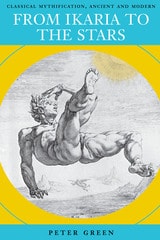
From Ikaria to the Stars
Classical Mythification, Ancient and ModernBy Peter Green
University of Texas Press, 2004
"I hadn't, till I really started digging, gauged the fierce intensity of the need for myth in the human psyche, of any age, or sensed the variety of motives dictating that need," writes Peter Green in the introduction to this wide-ranging collection of essays on classical mythology and the mythic experience. Using the need for myth as the starting point for exploring a number of topics in Greek mythology and history, Green advances new ideas about why the human urge to make myths persists across the millennia and why the borderland between mythology and history can sometimes be hard to map.
Green looks at both specific problems in classical mythology and larger theoretical issues. His explorations underscore how mythic expression opens a door into non-rational and quasi-rational modes of thought in which it becomes possible to rewrite painful truths and unacceptable history—which is, Green argues, a dangerous enterprise. His study of the intersections between classical mythology and Greek history ultimately drives home a larger point, "the degree of mythification and deception (of oneself no less than of others) of which the human mind is capable."
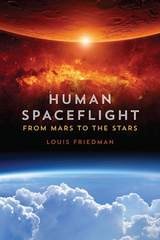
Human Spaceflight
From Mars to the StarsLouis Friedman
University of Arizona Press, 2015
Far from diminishing our future in space, Human Spaceflight lays out a provocative future for human space travel. The noted aerospace engineer and scientist says that human space exploration will continue well into the future, but space travel by humans will stop at Mars. Instead, nanotechnology, space sails, robotics, biomolecular engineering, and artificial intelligence will provide the vehicles of the future for an exciting evolution not just of space travel but of humankind.
Friedman has worked with agencies around the globe on space exploration projects to extend human presence beyond Mars and beyond the solar system. He writes that once we accept Mars as the only viable destination for humans, our space program on planet Earth can become more exciting and more relevant. Mars, he writes, will take hundreds, even thousands, of years to settle. During that time, humans and all our supporting technologies will evolve, allowing our minds to be present throughout the universe while our bodies stay home on Earth and Mars.
In Light of Stars
Bruce Willard
Four Way Books, 2021
Willard’s love of music combines with his love and respect for the natural world. Often rooted in, or coming out of, domestic encounters, the poems of this collection rise up (much like the clouds over his oft-traversed Rockies), as the speaker throws his attention to earth and sky, better to understand his own dynamic and shifting inner weather.
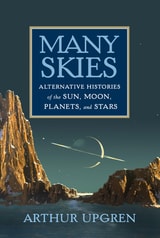
Many Skies
Alternative Histories of the Sun, Moon, Planets, and StarsUpgren, Arthur
Rutgers University Press, 2012
These and other imaginative scenarios are the subject of Arthur Upgren's inventive book Many Skies: Alternative Histories of the Sun, Moon, Planets, and Stars. Although the night sky as we know it seems eternal and inevitable, Upgren reminds us that, just as easily, it could have been very different.
Had the solar sytem happened to be in the midst of a star cluster, we might have many more bright stars in the sky. Yet had it been located beyond the edge of the Milky Way galaxy, we might have no stars at all. If Venus or Mars had a moon as large as ours, we would be able to view it easily with the unaided eye. Given these or other alternative skies, what might Ptolemy or Copernicus have concluded about the center of the solar sytem and the Sun?
This book not only examines the changes in science that these alternative solar, stellar, and galactic arrangements would have brought, it also explores the different theologies, astrologies, and methods of tracking time that would have developed to reflect them. Our perception of our surroundings, the number of gods we worship, the symbols we use in art and literature, even the way we form nations and empires are all closely tied to our particular (and accidental) placement in the universe.
Many Skies, however, is not merely a fanciful play on what might have been. Upgren also explores the actual ways that human interferences such as light pollution are changing the night sky. Our atmosphere, he warns, will appear very different if we have belt of debris circling the globe and blotting out the stars, as will happen if advertisers one day pollute space with brilliant satellites displaying their products.
From fanciful to foreboding, the scenarios in Many Skies will both delight and inspire reflection, reminding us that ours is but one of many worldviews based on our experience of a universe that is as much a product of accident as it is of intention.
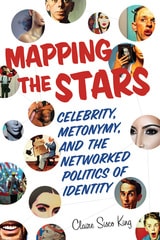
Mapping the Stars
Celebrity, Metonymy, and the Networked Politics of IdentityClaire Sisco King
The Ohio State University Press, 2023
King considers three stars with popular and controversial personas: Norman Rockwell, Will Smith, and Kim Kardashian. Working in very different contexts and with very different public images, these figures nonetheless share a consistent, if not conspicuous, interest in celebrity as a construct. Offering intertextual readings of their public images across such sites as movie posters, magazines, cinema, and social media—and deploying rhetorical theories of metonymy (a linguistic device linking signifiers by shared associations)—King argues that these stars’ self-reflexive attention to the processes by which celebrity is created and constrained creates opportunities for reframing public discourse about what it means to be famous and what it means to be a person.
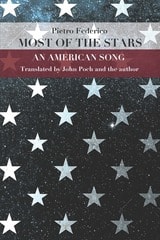
Most of the Stars
An American SongPietro Federico
St. Augustine's Press, 2024
In Most of the Stars the linguistic power of the Italian literary tradition and the contemporary vernacular combine to articulate an idiosyncratic understanding of the New World—the breadth of its cities, its towns, its frontiers and interiors. Federico’s deeply spiritual understanding of our own American personalities and histories offers us a gift of beautiful objectivity. Students of poetry, linguistics, and cultural anthropology will be grateful to Federico and Poch for the wonder offered in this bilingual collection.
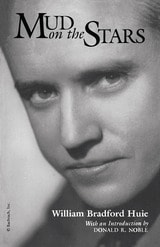
Mud on the Stars
William Bradford Huie
University of Alabama Press, 1996
William Bradford Huie’s first novel, Mud on the Stars, is largely autobiographical and is set in the years 1929-1942. As in many of his later books, the theme here is of the education of the inexperienced youth, which is, after all, the quintessential American story. Drawing on his own boyhood, Huie gives the reader a detailed account of rural life and race relations in the Tennessee Valley in the early years of this century, including a vivid picture of college life at The University of Alabama during the Great Depression. Through a careful weaving of characters and events, fact and fiction, Huie’s novel captures the tumultuous times before World War II in the urban South, times of social unrest and testing of new political ideologies. The book’s publication in 1942 was a huge financial success, by the economic standards of the day, and not only brought Huie the acclaim his talent warranted but also focused an approving national spotlight on this prolific Alabama writer.
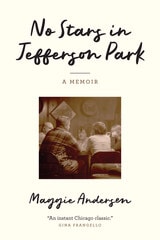
No Stars in Jefferson Park
A MemoirMaggie Andersen
Northwestern University Press, 2026
A Chicagoan’s coming-of-age memoir finds courage in the face of immense loss
In her early twenties, Maggie Andersen was a founding ensemble member of Chicago’s storied Gift Theatre with her then-boyfriend, Michael Patrick Thornton. But after a series of spinal strokes left Thornton paralyzed, Andersen made the heart-wrenching decision to leave him, along with their growing company and, later, her beloved city. No Stars in Jefferson Park alternates between two narratives: the energy and excitement of making art in Chicago’s thriving storefront theater scene and the devastating day-to-day realities of rehabilitation and rebuilding—and somewhere in the middle finding the courage to choose yourself.
Over the past twenty-plus years, the Gift—now performing in the working-class neighborhood of Portage Park—has become one of the most vital storefront theaters in Chicago, with Thornton’s career taking him to Hollywood and Broadway. But Andersen’s story has brought her back home. No Stars in Jefferson Park is a testament to lifelong friendship, a love letter to Chicago, and a profound coming-of-age story about the pain and necessity of putting yourself first.
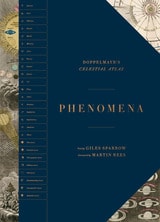
Phenomena
Doppelmayr's Celestial AtlasGiles Sparrow
University of Chicago Press, 2022
The expansive and intricate Atlas Coelestis, created by Johann Doppelmayr in 1742, set out to record everything known about astronomy at the time, covering constellations, planets, moons, comets, and more, all rendered in exquisite detail. Through stunning illustrations, historical notes, and scientific explanations, Phenomena contextualizes Doppelmayr’s atlas and creates a spectacular handbook to the heavens.
Phenomena begins by introducing Doppelmayr’s life and work, placing his extraordinary cosmic atlas in the context of discoveries made in the Renaissance and Enlightenment and highlighting the significance of its publication. This oversized book presents thirty beautifully illustrated and richly annotated plates, covering all the fundamentals of astronomy—from the dimensions of the solar system to the phases of the moon and the courses of comets. Each plate is accompanied by expert analysis from astronomer Giles Sparrow, who deftly presents Doppelmayr’s references and cosmological work to a modern audience. Each plate is carefully deconstructed, isolating key stars, planets, orbits, and moons for in-depth exploration. A conclusion reflects on the development of astronomy since the publication of the Atlas and traces the course of the science up to the present day. Following the conclusion is a timeline of key discoveries from ancient times onward along with short biographies of the key players in this history.
Physical Processes in Circumstellar Disks around Young Stars
Edited by Paulo J. V. Garcia
University of Chicago Press, 2011
Circumstellar disks are vast expanses of dust that form around new stars in the earliest stages of their birth. Predicted by astronomers as early as the eighteenth century, they weren’t observed until the late twentieth century, when interstellar imaging technology enabled us to see nascent stars hundreds of light years away. Since then, circumstellar disks have become an area of intense study among astrophysicists, largely because they are thought to be the forerunners of planetary systems like our own—the possible birthplaces of planets.
This volume brings together a team of leading experts to distill the most up-to-date knowledge of circumstellar disks into a clear introductory volume. Understanding circumstellar disks requires a broad range of scientific knowledge, including chemical processes, the properties of dust and gases, hydrodynamics and magnetohydrodynamics, radiation transfer, and stellar evolution—all of which are covered in this comprehensive work, which will be indispensable for graduate students, seasoned researchers, or even advanced undergrads setting out on the study of planetary evolution.

Picturing the Cosmos
Hubble Space Telescope Images and the Astronomical SublimeElizabeth A. Kessler
University of Minnesota Press, 2012
The vivid, dramatic images of distant stars and galaxies taken by the Hubble Space Telescope have come to define how we visualize the cosmos. In their immediacy and vibrancy, photographs from the Hubble show what future generations of space travelers might see should they venture beyond our solar system. But their brilliant hues and precise details are not simply products of the telescope’s unprecedented orbital location and technologically advanced optical system. Rather, they result from a series of deliberate decisions made by the astronomers who convert raw data from the Hubble into spectacular pictures by assigning colors, adjusting contrast, and actively composing the images, balancing the desire for an aesthetically pleasing representation with the need for a scientifically valid one.
In Picturing the Cosmos, Elizabeth A. Kessler examines the Hubble’s deep space images, highlighting the remarkable resemblance they bear to nineteenth-century paintings and photographs of the American West and their invocation of the visual language of the sublime. Drawing on art history and the history of science, as well as interviews with astronomers who work on the Hubble Heritage Project, Kessler traces the ways that the sublime, with its inherent tension between reason and imagination, not only forms the appearance of the images, but also operates on other levels. The sublime informs the dual expression—numeric and pictorial—of digital data and underpins the relevance of the frontier for a new era of exploration performed by our instruments rather than our bodies. Through their engagement with the sublime the Hubble images are a complex act of translation that encourages an experience of the universe as simultaneously beyond humanity’s grasp and within the reach of our knowledge.
Strikingly illustrated with full-color images, this book reveals the scientific, aesthetic, and cultural significance of the Hubble pictures, offering a nuanced understanding of how they shape our ideas—and dreams—about the cosmos and our places within it.
Planets, Stars and Nebulae Studied with Photopolarimetry
Edited by T. Gehrels
University of Arizona Press, 1974
“The high quality of this book is clearly due to strict editorial attention to each paper and the discussions. Gehrels’s book will surely stand for many years as the fundamental reference source for polarization studies in astronomy as well as in atmospheric physics.”—Journal of the Association of Lunar and Planetary Observers
Principles of Stellar Evolution and Nucleosynthesis
Donald D. Clayton
University of Chicago Press, 1984
Protostars and Planets III
Eugene Levy
University of Arizona Press, 1993
Protostars and Planets III reflects the enormous progress made in understanding star and planet formation as a result of new observational capabilities and cooperative research among scientists from diverse fields.
Protostars and Planets IV
Vince Mannings
University of Arizona Press, 2000
Protostars and Planets IV is also the first book to include chapters describing the discoveries of extrasolar planets, brown dwarfs, and Edgeworth-Kuiper Belt objects, and the first to include high-resolution optical and near-infrared images of protoplanetary disks. Protostars and Planets IV is an unsurpassed reference not only for established researchers but also for younger scientists whose imagination and work will lead to tomorrow's discoveries.
Protostars and Planets VI
Edited by Henrik Beuther, Ralf S. Klessen, Cornelis P. Dullemond, and Thomas Henning
University of Arizona Press, 2014
question: How do planets and their host stars form and evolve? Protostars and Planets VI brings together more than 250 contributing authors at the forefront of their field, conveying the latest results in this research area and establishing a new foundation for advancing our understanding of stellar and planetary formation.
Continuing the tradition of the Protostars and Planets series, this latest volume uniquely integrates the cross-disciplinary aspects of this broad field. Covering an extremely wide range of scales, from the formation of large clouds in our Milky Way galaxy down to small chondrules in our solar system, Protostars and Planets VI takes an encompassing view with the goal of not only highlighting what we know but, most importantly, emphasizing the frontiers of what we do not know.
As a vehicle for propelling forward new discoveries on stars, planets, and their origins, this latest volume in the Space Science Series is an indispensable resource for both current scientists and new students in astronomy, astrophysics, planetary science, and the study of meteorites.

Selected Papers, Volume 1
Stellar Structure and Stellar AtmospheresS. Chandrasekhar
University of Chicago Press, 1989
Chandrasekhar has selected papers that trace the development of his ideas and that present aspects of his work not fully covered in the books he has periodically published to summarize his research in each area.
Volume 1, Stellar Structure and Stellar Atmospheres, covers primarily the period 1930-40 and includes early papers on the theory of white dwarfs. In the Preface, Chandrasekhar explains the criteria for selection and provides historical background. Each subsequent volume will include a foreword by an authority on the topics covered.
Selected Papers, Volume 2
Radiative Transfer and Negative Ion of HydrogenS. Chandrasekhar
University of Chicago Press, 1989
Chandrasekhar has selected papers that trace the development of his ideas and that present aspects of his work not fully covered in the books he has periodically published to summarize his research in each area.
Volume 2 covers primarily the period 1940-50 and includes papers on the theory of radiative transfer and on the physics and astrophysics of the negative ion of hydrogen. Of particular note are Chandrasekhar's Gibbs Lecture to the American Mathematical Society in 1946 and his "Personal Account" presented at a conference at Erevan in the U.S.S.R. in 1981. A foreword by T. W. Mullikin, a distinguished scholar in the area of radiative transfer, and an author's note provide a historical context for the papers.
Selected Papers, Volume 7
The Non-Radial Oscillations of Stars in General Relativity and Other WritingsS. Chandrasekhar
University of Chicago Press, 1997
world through the eyes of one of the twentieth century's most brilliant
and sensitive scientists. Conceived by Chandrasekhar as a supplement to
his Selected Papers, this volume begins with eight papers he
wrote with Valeria Ferrari on the non-radial oscillations of stars. It
then explores some of the themes addressed in Truth and Beauty,
with meditations on the aesthetics of science and the world it examines.
Highlights include: "The Series Paintings of Claude Monet and the
Landscape of General Relativity," "The Perception of Beauty and the
Pursuit of Science," "On Reading Newton's Principia at Age Past
Eighty," and personal recollections of Indira Gandhi, Jawaharlal Nehru,
and others.
Selected Papers, Volume 7 paints a picture of Chandra's universe,
filled with stars and galaxies, but with space for poetics, paintings,
and politics.
The late S. Chandrasekhar was best known for his discovery of the upper
limit to the mass of a white dwarf star, for which he received the Nobel
Prize in Physics in 1983. He was the author of many books, including
The Mathematical Theory of Black Holes and, most recently,
Newton's Principia for the Common Reader.
Spiral to the Stars
Mvskoke Tools of FuturityLaura Harjo
University of Arizona Press, 2019
Geographer Laura Harjo demonstrates that Mvskoke communities have what they need to dream, imagine, speculate, and activate the wishes of ancestors, contemporary kin, and future relatives—all in a present temporality—which is Indigenous futurity.
Organized around four methodologies—radical sovereignty, community knowledge, collective power, and emergence geographies—Spiral to the Stars provides a path that departs from traditional community-making strategies, which are often extensions of the settler state. Readers are provided a set of methodologies to build genuine community relationships, knowledge, power, and spaces for themselves. Communities don’t have to wait on experts because this book helps them activate their own possibilities and expertise. A detailed final chapter provides participatory tools that can be used in workshop settings or one on one.
This book offers a critical and concrete map for community making that leverages Indigenous way-finding tools. Mvskoke narratives thread throughout the text, vividly demonstrating that theories come from lived and felt experiences. This is a must-have book for community organizers, radical pedagogists, and anyone wishing to empower and advocate for their community.
Star Day
A Story of 24 Hours and 24 Stellar LivesMarcia Bartusiak and Stephen Lowe
University of Chicago Press, 2027
An hourly guide that tracks twenty-four stars, stellar clusters, and constellations across the sky to reveal their luminous lives and lore.
Over the course of a day, the constellations slowly shift, rising in the east and setting in the west, due to Earth’s rotation. A full turn of the celestial sphere, that bowl above us where the stars seemingly appear fixed to the surface, is completed once every twenty-four hours. In fact, the stars inspired the twenty-four-hour day, and one star, our Sun, rules the circadian rhythms of all life on our planet. This short book sweeps through the celestial sphere hour by hour, introducing a remarkable cast of stellar characters with each chapter. Celebrated science writer Marcia Bartusiak and mathematician Stephen Lowe blend practical astronomy with fascinating history to share unique cosmological stories.
This husband and wife team explain that observers have long split the sky into twenty-four hours of right ascension—a celestial equivalent of longitude and a universal scheme for locating cosmological objects. Each chapter of Star Day presents a single right ascension hour, from the stellar death of S Andromedae (zeroth hour)—an explosion that helped reveal the size of the universe—to Scheat (twenty-third hour), an aging red giant. Twice the mass of the Sun and some 1,500 times as bright, Scheat sometimes guides amateur astronomers to distant galaxies. In between, we learn about humans’ pole star, Polaris (second hour), and meet the supermassive black hole at the center of our Milky Way galaxy (seventeenth hour). By the end of our star day, we will appreciate both our own stellar origins and the fragile and deep connections between human civilizations and the ever-changing heavens. Star Day reminds us that wonder and discovery are easily available, all for the simple price of looking up.
For each chapter, artist Matthew Green has depicted these stellar scenes with entrancing pen-and-ink drawings. Working together to narrate and illustrate these stars' stories, Bartusiak, Lowe, and Green have created an engaging read that is a perfect way to spend an hour or two—and a true gift to both seasoned skywatchers and curious beginners.
Stars as Laboratories for Fundamental Physics
The Astrophysics of Neutrinos, Axions, and Other Weakly Interacting ParticlesGeorg G. Raffelt
University of Chicago Press, 1996
Raffelt presents the many uses of stellar astrophysics for research in basic particle physics. He focuses primarily on the properties and nongravitational interactions of elementary particles. Numerous graphs and figures complement the text.
Stars as Laboratories for Fundamental Physics is a valuable reference for cosmologists, astrophysicists, and particle physicists.
Stars in My Eyes
Don Bachardy
University of Wisconsin Press, 2011
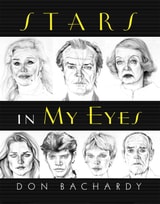
Stars in My Eyes is a revealing and entertaining collection of celebrity portraits, rendered both in acute drawings and in finely observed prose. In the 1970s and 1980s, internationally known artist Don Bachardy made portraits from life, depicting the actors, writers, artists, composers, directors, and Hollywood elite that he and his partner Christopher Isherwood knew. He then made detailed notes about these portrait sittings in the journal he has kept for more than forty years. The result is a unique document: we enter the mind of the artist as he records the images and behavior of his celebrity subjects—from Ruby Keeler and Barbara Stanwyck to Jack Nicholson and Linda Ronstadt—during their often intense collaboration with him.
Finalist, Lambda Literary Foundation Book Award
The Embers and the Stars
Erazim Kohák
University of Chicago Press, 1987
"Those who share Kohák's concern to understand nature as other than a mere resource or matter in motion will find his temporally oriented interpretation of nature instructive. It is here in particular that Kohák turns moments of experience to account philosophically, turning what we habitually overlook or avoid into an opportunity and basis for self-knowledge. This is an impassioned attempt to see the vital order of nature and the moral order of our humanity as one."—Ethics
The Stars
Edgar Morin
University of Minnesota Press, 2005
The Stars of Mauna Kea
Building Giant Telescopes on Hawai‘i’s Most Revered MountainPascal Marichalar
University of Chicago Press, 2026
The inside account of how astronomers were able to build the world’s largest observatories on Hawai‘i’s most revered mountain.
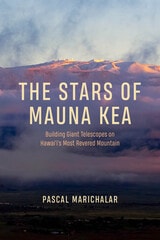
In July 2019, a demonstration erupted on Hawai‘i Island to prevent the construction of the Thirty Meter Telescope, which, if built, would be one of the largest and most advanced ground-based telescopes in the world. For months, thousands of people camped on the access road leading to the proposed location: Mauna Kea, a dormant volcano, the highest point in Hawai‘i, and a sacred site for Native Hawaiians. The standoff in 2019 was not the first. For decades, activists had resisted attempts to build the TMT and its predecessors. Even so, many astronomers were startled by opposition to the TMT and the discoveries it promised. Astronomers were focused on the stars; Native Hawaiians and environmentalists were concerned about not only the sky, but also the land.
The Stars of Mauna Kea traces the history of astronomy on Hawai‘i Island, shedding new light on why scientists were granted access to the volcano in the first place. Beginning in 1959, when Hawai‘i became the fiftieth US state, it chronicles the ways astronomers benefited from Hawai‘i’s colonial past to gain free and exclusive land use rights on what had long been the archipelago’s most revered mountain. Drawing on unprecedented archival research and extensive interviews, Pascal Marichalar carefully charts the course of astronomical development on Mauna Kea. He describes the devastating tsunami that led a local businessman to contact scientists just as a renowned astronomer was scouting for places to observe the stars; the controversial authority the University of Hawai‘i assumed over the volcano after 1964; the environmental opposition to the first large international project, the Canada-France-Hawai‘i Telescope; and the resistance to telescope development that became a major focus of the Hawaiian sovereignty movement. Marichalar introduces readers to scientists working on Mauna Kea, as well as the people living in the mountain’s shadow, including key opposition figures involved in recent events.
Like the dark matter that holds together rotating galaxies, the colonial forces that have shaped Hawai‘i exert a gravitational pull on the science undertaken on the volcano’s summit. The Stars of Mauna Kea brings readers inside an ongoing debate over the morality of scientific research conducted on contested ground.

The Stars, The Earth, The River
Short Stories by Le Minh KhueLe Minh Khue
Northwestern University Press, 1997
The Stars, the Earth, the River contains an excellent introduction by the translators, grounding the stories in Le Minh Khue's personal history. You simultaneously feel the rage of the author and the narrator when Khue disparagingly notes that the conversations around her center on luxuries, motor scooters, and business deals. Of what use, these stories ask, is such suffering? How can a culture honor the losses of war?
Theoretical Principles in Astrophysics and Relativity
Norman R. Lebovitz, William H. Reid, and Peter O. Vandervoort
University of Chicago Press, 1981
"The book as a whole should be a gift from every research supervisor to every new graduate student in theoretical astronomy."—D. W. Sciama, Science

United Artists, Volume 1, 1919–1950
The Company Built by the StarsTino Balio
University of Wisconsin Press, 2009
This edition is updated with a new introduction by Balio that places in relief UA’s operations for those readers who may be unfamiliar with film industry practices and adds new perspective to the company’s place within Hollywood.
We Are the Stars
Colonizing and Decolonizing the Oceti Sakowin Literary TraditionSarah Hernandez
University of Arizona Press, 2023
Women and land form the core themes of the book, which brings tribal and settler colonial narratives into comparative analysis. Divided into two parts, the first section of the work explores how settler colonizers used the printing press and boarding schools to displace Oceti Sakowin women as traditional culture keepers and culture bearers with the goal of internally and externally colonizing the Dakota, Nakota, and Lakota nations. The second section focuses on decolonization and explores how contemporary Oceti Sakowin writers and scholars have started to reclaim Dakota, Nakota, and Lakota literatures to decolonize and heal their families, communities, and nations.