Results by title
468 books match the query 'Industries' and 15 start with l

L. S. Ayres and Company
The Store at the Crossroads of AmericaKenneth L. Turchi
Indiana Historical Society Press, 2012
Labor Relations in the Aviation and Aerospace Industries
Robert W. Kaps, J. Scott Hamilton, Timm J. Bliss
Southern Illinois University Press, 2012
In this textbook designed for courses on aviation labor relations, the authors-experts with many years of experience in these sectors-examine and evaluate the labor process for all aspects of the aviation and aerospace industries, including aerospace manufacturing, airlines, general aviation, federal and state administrative agencies, and public airports.
Divided into three parts-Public Policy and Labor Law; Principles, Practices and Procedures in Collective Bargaining and Dispute Resolution; and the Changing Labor Relations Environment-the book provides an overview of the industries and the development of US labor law and policy, then explores the statutory, regulatory, and case laws applicable to each industry segment before concluding with an examination of current and developing issues and trends. The authors present the evolution of aviation and aerospace labor laws, going as far back as the early nineteenth century to lay the historical foundation, and cover the development and main features of the principal statutes governing labor relations in the United States today, the Railway Labor Act, the National Labor Relations Act, and the Civil Service Reform Act. They also investigate the growth of the industries and their impact on labor relations, as well as the current issues and challenges facing management and labor in each segment of this dynamic, sometimes volatile, business and their implications for collective bargaining. Twenty case studies not only illuminate practical applications of such fundamental concepts as unfair labor practices and unions' duty of fair representation but also enliven the subject, preparing the reader to use the concepts in real-world decision making.
A study guide with review questions, online assignments, supplemental readings, and exercises is available for students. For those teachers using the textbook in their courses, there is an instructor's manual with additional resources for developing courses in the classroom, online, or by blended learning, as well as a variety of assignments and materials to enhance and vary the mock negotiation exercise.
A revision and expansion of Robert W. Kaps's Air Transport Labor Relations, this outstanding new volume provides students and teachers with valuable information and perspectives on industries that are highly dependent on technologically skilled labor. Labor Relations in the Aviation and Aerospace Industries offers a sweeping and thorough treatment of labor relations, public policy, law, and practice and is the definitive work on the labor process in the aviation and aerospace sectors.
Labor Relations in the Aviation and Aerospace Industries
Study GuideRobert W. Kaps, J. Scott Hamilton, Timm J. Bliss
Southern Illinois University Press, 2012
This Study Guide is designed to be used with the textbook Labor Relations in the Aviation and Aerospace Industries. It is intended to assist students in comprehending basic terminology and principles of labor relations and the law, to relate those principles to unique features of the aviation and aerospace industry, and to prepare for the kinds of labor relations–related decisions students will soon be making as aviation professionals, whether in private or public sector employment. It includes review questions, online assignments, supplemental readings, and exercises.
Land, Livelihood, and Civility in Southern Mexico
Oaxaca Valley Communities in HistoryBy Scott Cook
University of Texas Press, 2014
In the Valley of Oaxaca in Mexico’s Southern Highland region, three facets of sociocultural life have been interconnected and interactive from colonial times to the present: first, community land as a space to live and work; second, a civil-religious system managed by reciprocity and market activity wherein obligations of citizenship, office, and festive sponsorships are met by expenditures of labor-time and money; and third, livelihood. In this book, noted Oaxacan scholar Scott Cook draws on thirty-five years of fieldwork (1965–1990) in the region to present a masterful ethnographic historical account of how nine communities in the Oaxaca Valley have striven to maintain land, livelihood, and civility in the face of transformational and cumulative change across five centuries.
Drawing on an extensive database that he accumulated through participant observation, household surveys, interviews, case studies, and archival work in more than twenty Oaxacan communities, Cook documents and explains how peasant-artisan villagers in the Oaxaca Valley have endeavored over centuries to secure and/or defend land, worked and negotiated to subsist and earn a living, and striven to meet expectations and obligations of local citizenship. His findings identify elements and processes that operate across communities or distinguish some from others. They also underscore the fact that landholding is crucial for the sociocultural life of the valley. Without land for agriculture and resource extraction, occupational options are restricted, livelihood is precarious and contingent, and civility is jeopardized.
Las Vegas in Singapore
Violence, Progress and the Crisis of Nationalist ModernityLee Kah-Wee
National University of Singapore Press, 2018
The first history begins in colonial Singapore in the 1880s, when British administrators revised gambling laws in response to the political threat posed by Chinese-run gambling syndicates. Following the tracks of these punitive laws and practices, the book moves into the 1960s when the newly independent city-state created a national lottery while criminalizing both organized and petty gambling in the name of nation-building. The second history shifts the focus to corporate Las Vegas in the 1950s when digital technology and corporate management practices found each other on the casino floor. Tracing the emergence of the specialist casino designer, the book reveals how casino development evolved into a highly rationalized spatial template designed to maximize profits. Today an iconic landmark of Singapore, Marina Bay Sands is also an artifact of these two histories, an attempt by Singapore to normalize what was once criminalized in its nationalist history.
Lee Kah-Wee argues that the historical project of the control of vice is also about the control of space and capital. The result is an uneven landscape where the legal and moral status of gambling is contingent on where it is located. As the current wave of casino expansion spreads across Asia, he warns that these developments should not be seen as liberalization but instead as a continuation of the project of concentrating power by modern states and corporations.

Last Paper Standing
A Century of Competition between the Denver Post and the Rocky Mountain NewsKen J. Ward
University Press of Colorado, 2023
This frequently sensational, sometimes outlandish, and occasionally bloody battle spanned numerous eras of journalism, embodying the rise and fall of the newspaper industry during the twentieth century in the lead up to the fall of American newspapering. Drawing on manuscript collections scattered across the United States as well as oral histories with executives, managers, and journalists from the papers, Ken J. Ward investigates the strategies employed in their competition with one another and against other challenges, such as widespread economic uncertainty and the deterioration of the newspaper industry. He follows this competition through the death of the Rocky Mountain News in 2009, which ended the country’s last great newspaper war and marked the close of the golden age of Denver journalism.
Fake news runs rampant in the absence of high-quality news sources like the News and the Post of the past. Neither canonizing nor vilifying key characters, Last Paper Standing offers insight into the historical context that led these papers’ managers to their changing strategies over time. It is of interest to media and business historians, as well as anyone interested in the general history of journalism, Denver, and Colorado.

Last Rights
Revisiting *Four Theories of the Press*Edited by John C. Nerone
University of Illinois Press, 1995
Though subjected to years of criticism, Four Theories of the Press remains a core text in communications. Its influence on the field, impact on generations of journalists, and ability to spark debate on why the press acts as it does continue to make it an oft-quoted source and classroom staple.
In Last Rights, eight communications scholars critique and expand on the classic text. The authors argue that Four Theories spoke to and for a world beset by a cold war ended long ago. At the same time, they praise the book for offering an alternative view of the press and society and as a useful tool for helping scholars and citizens alike grapple with contradictions in classical liberalism. They also raise important questions about the Internet and other major changes in communications systems and society since the original publication of Four Theories.
Contributors: William E. Berry, Sandra Braman, Clifford Christians, Thomas G. Guback, Steven J. Helle, Louis W. Liebovich, John C. Nerone, and Kim B. Rotzoll

Latin@s' Presence in the Food Industry
Changing How We Think about FoodMeredith E. Abarca
University of Arkansas Press, 2016
The networks Latin@s create, the types of identities they fashion through food, and their relationship to the US food industry are analyzed to understand Latin@s as active creators of food-based communities, as distinctive cultural representations, and as professionals. This vibrant new collection acknowledges issues of labor conditions, economic politics, and immigration laws—structural vulnerabilities that certainly cannot be ignored—and strives to understand more fully the active and conscious ways that Latina@s create spaces to maneuver global and local food systems.

Latinas on the Line
Invisible Information Workers in TelecommunicationsMelissa Villa-Nicholas
Rutgers University Press, 2022
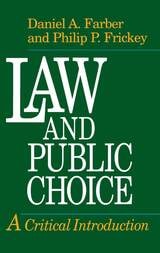
Law and Public Choice
A Critical IntroductionPhilip P. Frickey and Daniel A. Farber
University of Chicago Press, 1991
“Law and Public Choice is a most valuable contribution to the burgeoning literature. It
should be of great interest to lawyers, political scientists, and all others interested in issues at the intersection of government and law.”—Cass R. Sunstein, University of Chicago Law
School
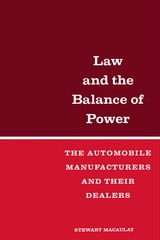
Law and the Balance of Power
The Automobile Manufacturers and their DealersStewart Macaulay
Russell Sage Foundation, 1966

Lifebuoy Men, Lux Women
Commodification, Consumption, and Cleanliness in Modern ZimbabweTimothy Burke
Duke University Press, 1996
With particular attention to cosmetic products and the contrast between colonial and pre-colonial ideas of cleanliness, Burke examines the role played by commodity culture, changing patterns of consumption, and the spread of advertising in the making of modern Zimbabwe. His work combines history, anthropology, and political economy to show how the development of commodification in the region relates to the social history of hygiene. Within this framework, and drawing on a wide variety of historical sources, Burke explores dense interactions between commodity culture and embodied aspects of race, gender, sexuality, domesticity, health, and aesthetics in a colonial society. Rather than viewing the production of needs simply as an imposition from above, Lifebuoy Men, Lux Women shows what heterogeneous and complex processes, involving the aims and histories of both colonizers and colonized, produced these changes in Zimbabwean society.
Integrating political economy, cultural studies, and a wide range of the social sciences, Lifebuoy Men, Lux Women will find readers among scholars of colonialism, African history, and ethnography as well those for whom the problem of commodification is a significant theoretical issue.
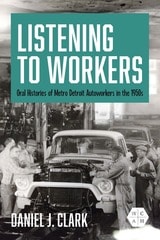
Listening to Workers
Oral Histories of Metro Detroit Autoworkers in the 1950sDaniel J. Clark
University of Illinois Press, 2024
Historians and readers alike often overlook the everyday experiences of workers. Drawing on years of interviews and archival research, Daniel J. Clark presents the rich, interesting, and sometimes confounding lives of men and women who worked in Detroit-area automotive plants in the 1950s.
In their own words, the interviewees frankly discuss personal matters like divorce and poverty alongside recollections of childhood and first jobs, marriage and working women, church and hobbies, and support systems and workplace dangers. Their frequent struggles with unstable jobs and economic insecurity upend notions of the 1950s as a golden age of prosperity while stories of domestic violence and infidelity open a door to intimate aspects of their lives. Taken together, the narratives offer seldom-seen accounts of autoworkers as complex and multidimensional human beings.
Compelling and surprising, Listening to Workers foregoes the union-focused strain of labor history to provide ground-level snapshots of a blue-collar world.

Local Vino
The Winery Boom in the HeartlandJames R. Pennell
University of Illinois Press, 2016
In Local Vino, James R. Pennell tracks among the hardy vines and heartland terroir of wineries across Illinois, Iowa, Indiana, and Ohio. Blending history and observation, Pennell gives us a top-down view of the business from cuttings and cultivation to sales and marketing. He also invites entrepreneurs to share stories of their ambitions, hard work, and strategies. Together, author and subjects trace the hows and whys of progress toward that noblest of goals: a great vintage that puts their winery on the map.

Long-Term Care around the World
Edited by Jonathan Gruber and Kathleen McGarry
University of Chicago Press, 2025
A comparative analysis of both formal and informal long-term care in ten of the world’s wealthiest countries.
Nations throughout the world are in the midst of an enormous demographic transition, with life expectancy increasing and fertility falling, leading to a rapidly aging population and critical implications for long-term care around the world. This volume documents and compares long-term care programs in ten wealthy countries.
Analyses of survey data and government statistics show that the costs of long-term care are beyond the financial means of a large fraction of the elderly population in most countries, particularly the oldest and most disabled. As a result, public systems bear most of the cost of formal long-term care, such as care in an institution or paid home care. Most countries spend more on nursing homes than on home care, but this relationship varies widely as does the mix of care needs and resources used to define eligibility for public funding. At the same time, most care is provided informally through family or unpaid caregivers. The costs of informal care, including the foregone earnings of caregivers, are estimated to account for at least one-third of all long-term care spending in every country. Thus, any estimate of the social costs of long-term care must account for the implicit costs of informal care.