Results by title
751 books match the query 'International Relations' and 11 start with l
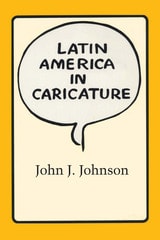
Latin America in Caricature
By John J. Johnson
University of Texas Press, 1993
“Not many readers will thank the author as he deserves, for he has told us more about ourselves than we perhaps wish to know,” predicted Latin America in Books of Latin America in Caricature—an exploration of more than one hundred years of hemispheric relations through political cartoons collected from leading U.S. periodicals from the 1860s through 1980.
The cartoons are grouped according to recurring themes in diplomacy and complementing visual imagery. Each one is accompanied by a lengthy explanation of the incident portrayed, relating the drawing to public opinion of the day. Johnson’s thoughtful introduction and the comments that precede the individual chapters provide essential background for understanding U.S. attitudes and policies toward Latin America.
Law and Democracy in the Empire of Force
H. Jefferson Powell and James Boyd White, editors
University of Michigan Press, 2009
James Boyd White is Hart Wright Professor of Law emeritus and Professor of English emeritus, at the University of Michigan. His latest book is Living Speech: Resisting the Empire of Force.
"An extraordinary collection of provocative, insightful, and inspiring essays on the future of law and democracy in the twenty-first century."
---Geoffrey R. Stone, Edward H. Levi Distinguished Service Professor of Law, University of Chicago
"These thoughtful essays diagnose democracy's perilous present, and---more importantly---they explore avenues to democracy's rescue through humanization of law."
---Kenneth L. Karst, David G. Price and Dallas P. Price Professor of Law Emeritus, UCLA
Contributors
Martin Böhmer, Universidad de San Andres, Buenos Aires, Argentina
M. Cathleen Kaveny, University of Notre Dame
Howard Lesnick, University of Pennsylvania
The Honorable John T. Noonan Jr., Ninth Circuit Court of Appeals
H. Jefferson Powell, Duke University
Jedediah Purdy, Duke University
Jed Rubenfeld, Yale University
A.W. Brian Simpson, University of Michigan
Barry Sullivan, Jenner and Block LLP, Chicago
Joseph Vining, University of Michigan
Robin West, Georgetown University
James Boyd White, University of Michigan

Law and Moral Action in World Politics
Cecelia Lynch
University of Minnesota Press, 2000
Leadership
Lessons from a Life in DiplomacySimon Mcdonald
Haus Publishing, 2023
Simon McDonald argues that we should reflect on the nature and strategies of leadership before entering a leadership role, and we should look to examples of others to help us in shaping our own approaches.
Over nearly four decades in Her Majesty's Diplomatic Service, McDonald worked for four permanent under-secretaries and a dozen senior ambassadors before becoming a permanent under-secretary himself and leading the Service—which has over 14,000 staff members in 270 countries—for five years. He also worked directly for six foreign secretaries and under five prime ministers. Observing these people undertaking such important and difficult work, McDonald saw the behaviors which helped them achieve their objectives, as well as those which hindered them.
In this book, McDonald synthesizes the skills he’s learned through his many years working in diplomacy, offering an insightful contribution amid heightening debates over the leadership of the United Kingdom. Considering the future of British leadership, he makes a case for the reform of the monarchy, the cabinet, civil service, and, in particular, the House of Lords, of which he has been a member since 2021.
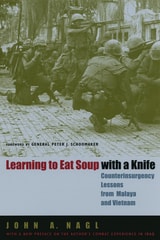
Learning to Eat Soup with a Knife
Counterinsurgency Lessons from Malaya and VietnamJohn A. Nagl
University of Chicago Press, 2005
In examining these two events, Nagl argues that organizational culture is key to the ability to learn from unanticipated conditions, a variable which explains why the British army successfully conducted counterinsurgency in Malaya but why the American army failed to do so in Vietnam, treating the war instead as a conventional conflict. Nagl concludes that the British army, because of its role as a colonial police force and the organizational characteristics created by its history and national culture, was better able to quickly learn and apply the lessons of counterinsurgency during the course of the Malayan Emergency.
With a new preface reflecting on the author's combat experience in Iraq, Learning to Eat Soup with a Knife is a timely examination of the lessons of previous counterinsurgency campaigns that will be hailed by both military leaders and interested civilians.
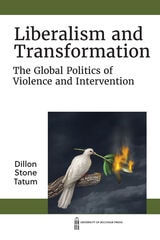
Liberalism and Transformation
The Global Politics of Violence and InterventionDillon Stone Tatum
University of Michigan Press, 2021
Liberalism and Transformation is the first scholarly work that explores the historical, philosophical, and intellectual development of global liberalism since the nineteenth century in the context of the deployment of violence, force, and intervention. Using an approach that includes interpretive and contextual analysis of texts from writers, philosophers, and policy-makers across nearly two centuries, as well as historiographical and historical analysis of archival documents (some of which have been recently declassified) and other media, Liberalism and Transformation narrates the messy history of emancipatory liberalism and its engagement with issues of war and peace. The book contributes to both a rethinking of liberal democracy and its relationship to world politics, as well as the effects of liberal internationalism on global processes. Furthermore, Liberalism and Transformation invites readers to reflect on global ethics and transformation in world politics. In the first place, it shows how ethical imaginings of the world have direct effects on actions of transformative importance. In the second place, it suggests that discourses are fluid, changing, and complex.
Lifting the Fog of Peace
How Americans Learned to Fight Modern WarJanine Davidson
University of Michigan Press, 2011
"Lifting the Fog of Peace is a captivating study of an agile and adaptive military evolving through the chaos of the post-9/11 world. In what is certain to be regarded as the definitive analysis of the reshaping of American combat power in the face of a complex and uncertain future, Dr. Janine Davidson firmly establishes herself as a rising intellectual star in government and politics. A thoroughly captivating study of organizational learning and adaptation—a 'must read' for leaders in every field."
---LTG William B. Caldwell, IV, Commanding General, NATO Training Mission - Afghanistan
"In Lifting the Fog of Peace, Dr. Janine Davidson explains how the American military has adapted itself to succeed in the wars in Afghanistan and Iraq that are the most likely future face of combat. The book is informed by her experience of these wars in the Department of Defense, where she now plays a critical role in continuing the process of learning that has so visibly marked the military's performance in today's wars. Highly recommended."
---John A. Nagl, President, Center for a New American Security
"Janine Davidson’s Lifting the Fog of Peace is a superb, concise, and well-written book that makes important contributions in three areas. It advances our knowledge of organizational learning in the Armed Forces. It also accurately captures the rich post-Vietnam operational and doctrinal history of the Army and the Marine Corps. The simplistic cartoon of dim-witted generals fixated on the Fulda Gap is replaced here by a more accurate version, where engaged senior officers studied the security environment, absorbed important lessons, and began to improve the learning capacity of the military services. Finally, Lifting the Fog of Peace assesses the state of contemporary stability operations and what must be done to further prepare our Armed Forces for modern war on the low end of the spectrum of conflict. It will be a 'must read' on the E-Ring of the Pentagon and in security studies programs across the nation."
---Joseph J. Collins, Professor, National War College, and former Deputy Assistant Secretary of Defense for Stability Operations
Counterinsurgency and stability operations in Iraq and Afghanistan are only the most recent examples of the U.S. Armed Forces fighting insurgents, building infrastructure, enforcing laws, and governing cities. For more than two centuries, these assignments have been a regular part of the military's tasks; yet until recently the lessons learned from the experiences have seldom been formally incorporated into doctrine and training. As a result, each generation of soldiers has had to learn on the job.
Janine Davidson traces the history of the U.S. military's involvement in these complex and frustrating missions. By comparing the historical record to the current era, Davidson assesses the relative influence of organizational culture and processes, institutional structures, military leadership, and political factors on the U.S. military's capacity to learn and to adapt. Pointing to the case of Iraq, she shows that commanders serving today have benefited at the tactical level from institutional changes following the Vietnam War and from the lessons of the 1990s. Davidson concludes by addressing the question of whether or not such military learning, in the absence of enhanced capabilities and capacity in other U.S. government agencies, will be sufficient to meet the complex challenges of the 21st century.
Janine Davidson, a former Air Force pilot, is a professor of national security at George Mason University, currently serving in the Pentagon as Deputy Assistant Secretary of Defense for Plans.
The views presented in this book are those of the author and do not necessarily represent the views of the Department of Defense or its Components.
Locating the Proper Authorities
The Interaction of Domestic and International InstitutionsDaniel W. Drezner, Editor
University of Michigan Press, 2002
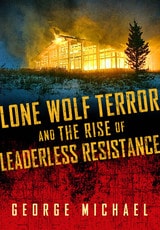
Lone Wolf Terror and the Rise of Leaderless Resistance
George Michael
Vanderbilt University Press, 2012
If Breivik did indeed act alone, he wouldn't be the first. Timothy McVeigh bombed a federal building in Oklahoma City based essentially on his own motivations. Eric Robert Rudolph embarked on a campaign of terror over several years, including the Centennial Park bombing at the 1996 Olympics. Ted Kaczynski was revealed to be the Unabomber that same year. And these are only the most notable examples. As George Michael demonstrates in Lone Wolf Terror and the Rise of Leaderless Resistance, they are not isolated cases. Rather, they represent the new way warfare will be conducted in the twenty-first century.
Lone Wolf Terror investigates the motivations of numerous political and ideological elements, such as right-wing individuals, ecoextremists, foreign jihadists, and even quasi-governmental entities. In all these cases, those carrying out destructive acts operate as "lone wolves" and small cells, with little or no connection to formal organizations. Ultimately, Michael suggests that leaderless resistance has become the most common tactical approach of political terrorists in the West and elsewhere.
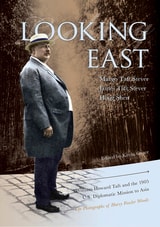
Looking East
William Howard Taft and the 1905 U.S. Diplomatic Mission to Asia: the Photographs of Harry Fowler WoodsMargo Taft Stever, James Taft Stever, and Hong Shen
University of Minnesota Press, 2015
Since the mid-19th century, relations between the United States in the West and Asian countries in the East have been an aggregate of diplomatic miscues and achievements, of trade policy successes and failures, and of cultural chasms and bridges. From the Treaty of Wangxia in 1844 that provided America with trading rights in China on a par with European countries to the contemporary political debates and educational partnerships in nations like Japan, Vietnam, India, and China, the element of understanding and appreciating differences has been paramount.
A singular event in this heritage of almost 150 years in the 1905 mission that sent William Howard Taft on a combination trade and culture junket to Asian countries. Occurring just a few years after U.S. Secretary of State's John Hay's 1899 Open Door Note that sought to keep China open to equitable trade with all countries, the Taft delegation primarily visited China, Japan, and the Philippines to shore up America's interests and to learn more about their emerging partners in the new century.
In Looking East, authors Margo Taft Stever, James Taft Stever, and Hong Shen explore this journey not only by an assiduous use of archives and historical analyses, but especially through the extraordinary images captured by photographer Harry Fowler Woods. Both Taft and Woods are ancestors of two of the authors so there is a particular interest on their part. With scholar Shen, they uncovered these photos and created exhibitions and published the initial Chinese-language edition of this volume by Zhejiang University Press in 2012. In this new, English-language edition, William Howard Taft's 1905 endeavors in Asia are freshly accorded the insight and appreciation they deserve in American diplomatic history.