Results by title
328 books match the query 'Islam' and 5 start with l
Learned Patriots
Debating Science, State, and Society in the Nineteenth-Century Ottoman EmpireM. Alper Yalçinkaya
University of Chicago Press, 2015
In Learned Patriots, M. Alper Yalçinkaya examines what it meant for nineteenth-century Ottoman elites themselves to have a debate about science. Yalçinkaya finds that for anxious nineteenth-century Ottoman politicians, intellectuals, and litterateurs, the chief question was not about the meaning, merits, or dangers of science. Rather, what mattered were the qualities of the new “men of science.” Would young, ambitious men with scientific education be loyal to the state? Were they “proper” members of the community? Science, Yalçinkaya shows, became a topic that could hardly be discussed without reference to identity and morality.
Approaching science in culture, Learned Patriots contributes to the growing literature on how science travels, representations and public perception of science, science and religion, and science and morality. Additionally, it will appeal to students of the intellectual history of the Middle East and Turkish politics.
Learning to Trust in Freedom
Signs from Jewish, Christian, and Muslim TraditionsDavid B. Burrell, C.S.C.
University of Scranton Press, 2010
True religious faith cannot be confirmed by any external proofs. Rather, it is founded on a basic act of trust—and the common root of that trust, for Jewish, Christian, and Islamic traditions, is a belief in the divine creation of the universe. But with Learning to Trust in Freedom, David B. Burrell asks the provocative question: How do we reach that belief, and what is it about the universe that could possibly testify to its divine origins? Even St. Augustine, he points out, could only find faith after a harrowing journey through the lures of desire—and it is that very desire that Burrell seizes on as a tool with which to explore the origin and purpose of the world. Delving deep into the intertwinings of desire and faith, and drawing on St. John of the Cross, Edith Stein, and Charles Taylor, Burrell offers a new understanding of free will, trust, and perception.
Liberating Shahrazad
Feminism, Postcolonialism, and IslamSuzanne Gauch
University of Minnesota Press, 2006
In Liberating Shahrazad, Suzanne Gauch analyzes how postcolonial writers and filmmakers from Algeria, Morocco, and Tunisia have reclaimed the storyteller in order to portray Muslim women in ways that highlight their power to shape their own destinies. Gauch looks at Maghrebian works that incorporate Shahrazad’s storytelling techniques into unexpected and unforeseen narratives. Highlighting the fluid nature of storytelling, Gauch demonstrates how these new depictions of Shahrazad—from artists such as Moufida Tlatli, Fatima Mernissi, Tahar Ben Jelloun, Assia Djebar, Leïla Sebbar—navigate the demands of a global marketplace, even as they reshape the stories told about the Islamic world.
In the face of both rising fundamentalism and proliferating Western media representations of Arab and Muslim women as silent, exploited, and uneducated victims, Gauch establishes how contemporary works of literature and film revive the voice of a long-silenced Shahrazad—and, ultimately, overthrow oppressive images of Muslim women. Suzanne Gauch is assistant professor of English and women’s studies at Temple University.
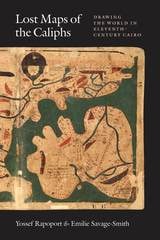
Lost Maps of the Caliphs
Drawing the World in Eleventh-Century CairoYossef Rapoport and Emilie Savage-Smith
University of Chicago Press, 2018
Lost Maps of the Caliphs provides the first general overview of The Book of Curiosities and the unique insight it offers into medieval Islamic thought. Opening with an account of the remarkable discovery of the manuscript and its purchase by the Bodleian Library, the authors use The Book of Curiosities to re-evaluate the development of astrology, geography, and cartography in the first four centuries of Islam. Their account assesses the transmission of Late Antique geography to the Islamic world, unearths the logic behind abstract maritime diagrams, and considers the palaces and walls that dominate medieval Islamic plans of towns and ports. Early astronomical maps and drawings demonstrate the medieval understanding of the structure of the cosmos and illustrate the pervasive assumption that almost any visible celestial event had an effect upon life on Earth. Lost Maps of the Caliphs also reconsiders the history of global communication networks at the turn of the previous millennium. It shows the Fatimid Empire, and its capital Cairo, as a global maritime power, with tentacles spanning from the eastern Mediterranean to the Indus Valley and the East African coast.
As Lost Maps of the Caliphs makes clear, not only is The Book of Curiosities one of the greatest achievements of medieval mapmaking, it is also a remarkable contribution to the story of Islamic civilization that opens an unexpected window to the medieval Islamic view of the world.
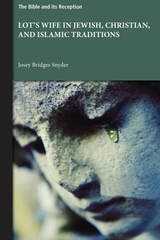
Lot’s Wife in Jewish, Christian, and Islamic Traditions
Josey Bridges Snyder Snyder
SBL Press, 2025